
Click the link below the picture
.
This episode was made possible by the support of Yakult and produced independently by Scientific American’s board of editors.
Rachel Feltman: For Scientific American’s Science Quickly, I’m Rachel Feltman.
People often talk about having “gut feelings,” but new research suggests there may be more to the idiom than we thought. Scientists are finding that specialized cells in our intestines can send signals directly to the brain, potentially influencing appetite and even mood.
Recent studies hint that our microbiomes could play a role in this communication system, though researchers are still trying to understand exactly how these interactions work and what they mean for our health.
Here to walk us through the emerging science of the belly-to-brain connection is Maya Kaelberer, an assistant professor at the University of Arizona in the Department of Physiology.
Thanks so much for coming on to chat with us today.
Maya Kaelberer: It’s my pleasure. I’m happy to be here.
Feltman: So you recently co-authored a study that looks at the gut-brain connection a little bit. Could you tell us a little bit about why scientists are interested in that and what we know about it so far?
Kaelberer: Yeah, I mean, I think more than just scientists are interested in it; we have our gut feelings all the time. And so my work is really focused on understanding the biology behind those gut feelings and how is it that our gut can communicate to us. ’Cause we know, right, things like hangry exist. We know that how we feel or what food we eat or even what microbes are there is gonna affect overall how we feel in the world.
Feltman: Mm.
Kaelberer: And so understanding the molecular and cellular and neuronal connections between the gut and the brain is gonna help us better understand, like, this relationship that we have, that we have these gut feelings, right?
Feltman: Yeah.
Kaelberer: We know they’re there [laughs].
Feltman: Well, and beyond, you know, hanger, which is obviously a great example, what are some conditions that have been connected to the gut that might surprise people?
Kaelberer: So when I was in my postdoc we discovered that there was this direct connection between these cells in the surface of the gut, we call them neuropod cells, and neurons that communicate directly—they reach directly into the brain. And so we call this as—our “gut sense,” and the number-one question I would always get was: Who cares? Like, what [laughs], you know, what is our gut possibly telling us that our mouth and our nose did not already tell us about the food that we ate?
And so we delved into this a little bit more in some previous publications with regards to sugar sensing, and I use this example ’cause it’s really salient in my own life, which is that I like artificial sweetener in my coffee.
Feltman: Mm.
Kaelberer: And I don’t like regular sugar because regular sugar just feels heavy to me, and I want that, like, artificial sweetener. It kind of keeps me going. I can be caffeinated. I can be, like, on the go. I’m not gonna, like, sit down and take a nap afterwards. And so we know that these two stimuli feel different in our gut. And what we found is that these neuropod cells are actually distinguishing between the two stimuli, between real sugar and artificial sweetener. And they release different signals, and then the signal for sugar actually drives the animal to consume the sugar over the artificial sweetener.
So now we take it back to my coffee preference, and suddenly, I’m like, “Well, this makes sense. I like the artificial sweetener because I don’t want that heaviness.” And that heaviness is telling me that that food was gratifying or that food was satisfying; there was some kind of value associated with that that’s gonna help me survive in nature. And so then this is now this communication system of, like, “Oh, our gut sense is telling us something about the food we eat past whether or not it tastes good. It’s telling us a little bit about the value of what we’re consuming.”
.
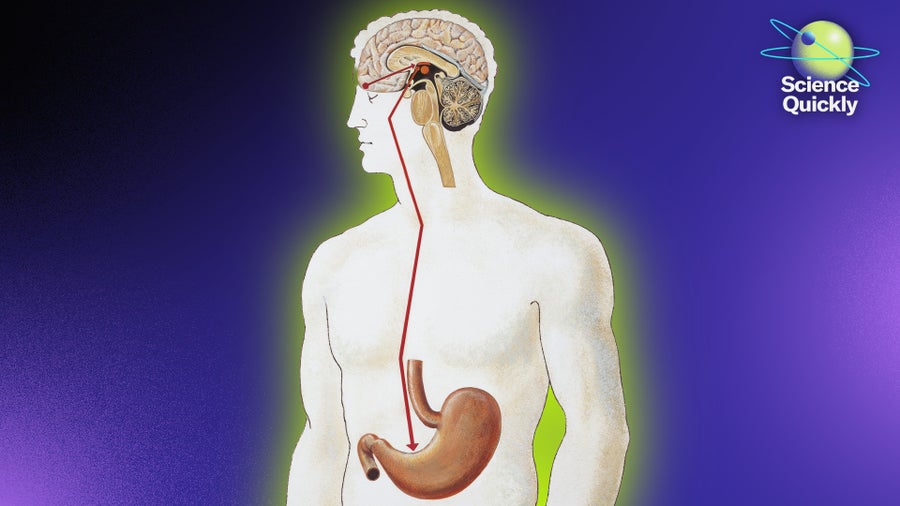
An illustration of a man revealing his brain and stomach with an arrow drawn between them on a purple background De Agostini/Getty Images
.
.
Click the link below for the complete text and podcast:
.
__________________________________________
 James' World 2
Leave a comment