
Click the link below the picture
.
This week’s meeting of the Centers for Disease Control and Prevention’s Advisory Committee on Immunization Practices represented a notable departure from its prior practice of presenting and debating high-quality data on vaccine safety and risk-benefit analyses. Committee members, many of whom were hastily installed by Secretary of Health and Human Services Robert F. Kennedy, Jr., cited—without solid evidence—hypothetical risks of immunization with mRNA COVID vaccines, disregarding extensive studies showing the Food and Drug Administration–approved vaccines are safe and effective. The consequences of this meeting extend far beyond the specific votes the committee made today and could undermine confidence in vaccines and the U.S. medical establishment more broadly, some experts have noted. The story below has been updated with details of the discussion and votes regarding each vaccine considered.
The already tumultuous landscape of U.S. vaccine policy faces more turmoil in what’s anticipated to be a politically charged two-day meeting of a recently overhauled advisory panel to the Centers for Disease Control and Prevention.
The Advisory Committee on Immunization Practices (ACIP) is an independent panel of experts that has traditionally met three times a year to make science-based recommendations about who should receive certain vaccines. But this year the Trump administration’s efforts to undermine science and public health has upended the committee. Just yesterday former CDC director Susan Monarez, who led the agency for a month, testified to the Senate about her experience of being pushed out of office for not condoning attacks on vaccines unsupported by evidence. Most dramatically, Robert F. Kennedy, Jr., secretary of health and human services and a veteran antivaccine activist, fired the panel’s membership, with the newest appointees announced only days ago.
On September 18 and 19, the committee is holding its second meeting of the year, and experts now worry that the new ACIP members will continue eroding public access to lifesaving vaccinations. Already, one in six parents in the U.S. reports delaying or skipping a vaccine for their child, according to a recent poll.
“I fear for the health of children in this country,” says Paul Offit, a pediatric infectious diseases specialist at Children’s Hospital of Philadelphia. “RFK, Jr.’s goal is to make vaccines less available, less affordable and more feared. That’s his goal, and he’s doing a great job of it.”
ACIP’s decisions are important because they dictate the price of lifesaving preventive care. The Affordable Care Act requires private insurance companies to cover ACIP-recommended vaccines at no cost; government-run insurance programs, including the Vaccines for Children (VFC) program, which covers half of childhood vaccines administered nationwide, also base costs on the panel’s decisions.
At this week’s meeting, the newly reconstituted panel will discuss three vaccines: the combined measles, mumps, rubella and varicella vaccine, the hepatitis B vaccine and this year’s updated COVID shots.
The meeting’s agenda is a departure from ACIP’s norm, says Edwin Asturias, a pediatric infectious disease specialist and epidemiologist at the University of Colorado, who joined ACIP in July 2024 and was dismissed during Kennedy’s overhaul of the committee earlier this year. “This is one of the shortest agendas that we have seen for a long time from ACIP,” Asturias says. “Typically, ACIP has a lot of things to look through because there’s a lot of vaccines that are advancing through different aspects of development, as well as new data being generated.” Meetings in 2024 each discussed at least eight different vaccines.
Asturias and other public health experts are particularly worried the meeting will institutionalize attacks on the childhood vaccine schedule—a carefully choreographed, evidence-based timeline of vaccines given to kids in their earliest years.
“The childhood immunization schedule has proven to be very effective at reducing a lot of diseases that cause a lot of pain, suffering, and death in children,” Asturias says.
The meeting will be livestreamed on both September 18 and September 19. Here’s what experts are keeping an eye on.
The Measles, Mumps, Rubella, and Varicella Vaccine
What Happened
Members voted 8-3 not to recommend the single combination MMRV vaccine before age four, removing the option for children younger than four years old to receive the shot for the first dose. Children younger than age four are recommended separate MMR and varicella vaccines.
.
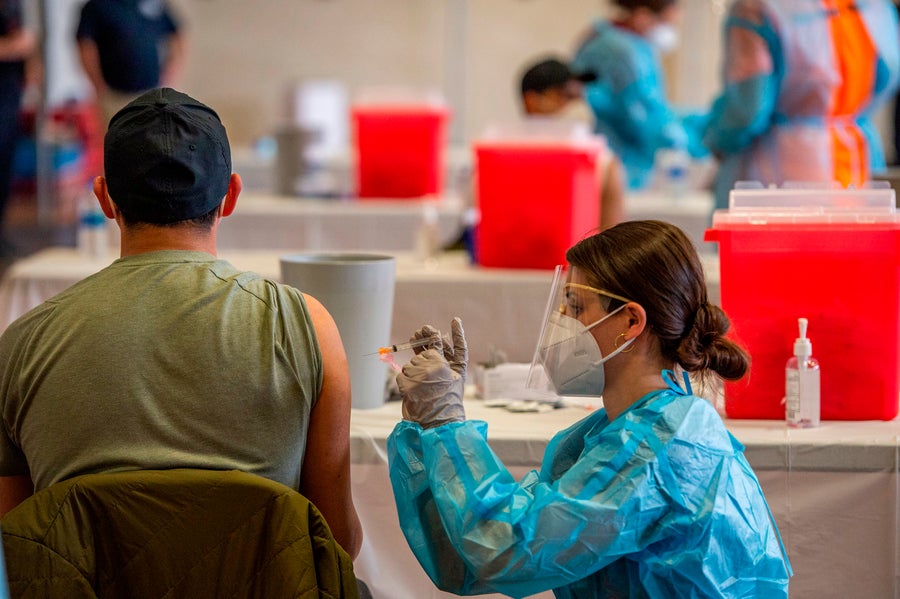 Joseph Prezioso/AFP via Getty Images
.
.
Click the link below for the complete article:
.
__________________________________________
 James' World 2
Leave a comment