
Click the link below the picture
.
Mark Harmon crouches low next to log number 219: a moss-covered western hemlock tree trunk, five meters long, lying dead on the ground in the lush green woods. It’s marked by a thin aluminum tag. The forest ecologist leans in close, his unruly white beard nearly brushing against the decomposing cylinder. Dark, flaky patches on the dull, reddish-brown wood closer to the ground show where fungi have infiltrated the cellulose within. Farther down the trunk, multicolored fungal conks protrude like hard shelves barely big enough for a mouse. A shiny black beetle scurries along the ground, then out of sight under the log. Harmon presses gently on 219 with three fingertips. It’s so spongy that he is reluctant to roll back a chunk of it to reveal what lies underneath. “Oh, I don’t want to destroy it,” he says slowly. “It’s all falling apart.”
Harmon, a longtime faculty member at Oregon State University, has been watching number 219, and more than 500 other logs nearby, decay for 40 years. He has trekked to this site in the H. J. Andrews Experimental Forest, a watershed nestled in Oregon’s western Cascade Mountains, at least 100 times. He drives more than two hours on paved and gravel roads from his home in Corvallis, Ore., then hikes in half a mile through the undergrowth, carrying tape measures, scales, saws and a computer to chronicle the relentless changes. His goal: establish an exhaustive baseline dataset that any scientist could use to test hypotheses about tree decomposition or to compare patterns of decomposition in the Pacific Northwest with those in other regions.
Decomposition can explain how and how fast carbon, captured by plants during photosynthesis, returns to the atmosphere. That process, which plays out at dizzying scales of both space and time, influences the long-term productivity and biodiversity of a forest. Harmon’s findings could influence when, or even whether, forest planners decide to remove dead logs to improve the health of the woods. Decay shapes how wildfire spreads through a timberland, too. Snags (dead but standing trunks) and downed trees also provide habitat for animals.
Before Harmon and his colleagues launched this log-decomposition experiment, scientists studying the impact of dead wood on the environment primarily looked only at what had already rotted, without understanding the variety of long-term factors that affected the decay. But by the early 1980s Harmon and other researchers realized patterns of decomposition emerged only from detailed tracking of actual logs sustained over decades, like snapshots stitched together into a multidimensional movie. Even after 40 years, Harmon says, ecologists are unearthing new questions: How does temperature affect the activity of decomposers such as brown rot fungi on various wood species? How do changing ecosystems promote or hinder interactions among invertebrates, microbes and wood? At what rate is carbon released from downed wood? This last one is of particular importance because it affects nutrient cycling through soils and roots, as well as climate change.
Harmon is leading the way to answers, but he may never know what they are. He designed the grand project to run for at least 200 years—well beyond his lifespan and those of his immediate successors. Ecologist Jennifer Powers of the University of Minnesota says that Harmon “really thought about long-term processes that shape forests in setting up a study he knew he would never see the end of.
”Most people regard dead trees as a nuisance, a wasted resource or something to trip over. Harmon sees revelation. When he was 21, during a run in the hilly forests of central Massachusetts, he encountered a green log that seemed to glow against the dark wooded backdrop. He had a vision that he would one day run a research effort on log decay. Granted, he wasn’t entirely clearheaded at the time. “It was helped by some substances,” he admits. “But I can still see that log.” For his first major research project, Harmon compared decomposition rates of 10 species of trees killed by fires in the Smoky Mountains. Conifer species, he found, decayed more slowly than deciduous trees, and Quercus prinus, the chestnut oak, decayed the fastest, losing 11 percent of its wood density every year.
.
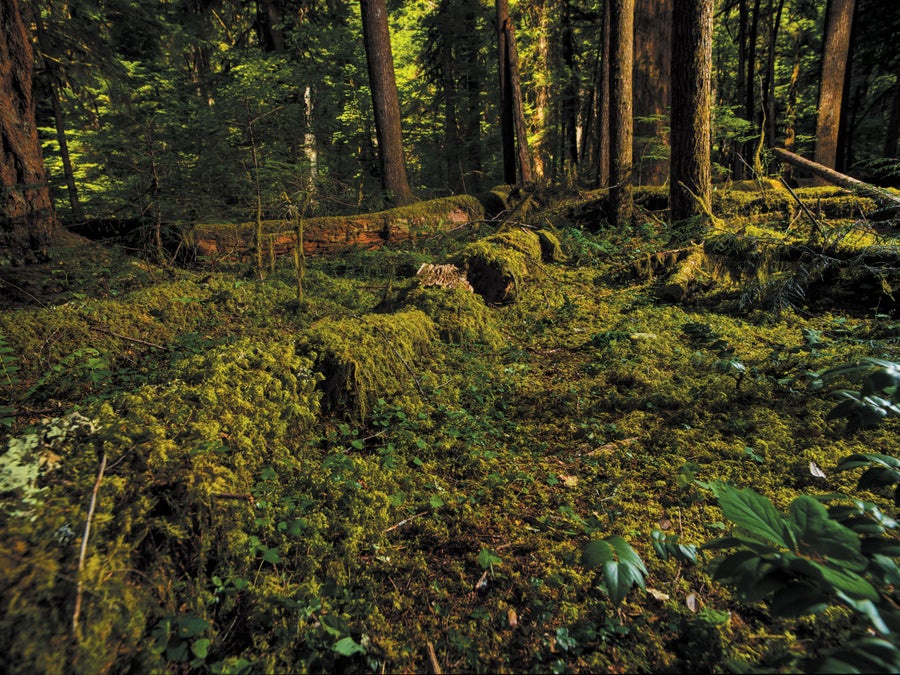
Green moss encases dead, downed logs at site 3 in Oregon’s H.J. Andrews Experimental Forest, part of a remarkable 200-year study of tree decay that is 40 years underway. Chris Gunn
.
.
Click the link below for the complete article:
.
__________________________________________
 James' World 2
Leave a comment