
Click the link below the picture
.
Here in New York City, we humans crown ourselves rulers of the five boroughs—but the kingdom is split. We cohabit with a parallel society that commutes along subway rails, picnics in parks, and patronizes trash cans like they’re Restaurant Row. A new field study watched them the way New Yorkers often watch each other: from a respectful distance and with digital tech. The findings shed light on how rats have adapted to city life—and how chatty they are. “There’s this kind of secret language that rats are communicating in with each other that we don’t hear,” says Emily Mackevicius, a neuroscientist and a co-author of the study. “They’re very social,” adds Ralph Peterson, another study co-author. “They’re rugged, and they’re New Yorkers themselves: persistent and resilient and able to thrive in a very extreme environment.”
At three Manhattan locations—a park, a subway platform, and a sidewalk—the team used a specialized wireless recorder to eavesdrop on the rats’ ultrasonic conversations, which humans can’t hear. They placed thermal cameras on tripods or held them by hand to record the warm bodies moving like glowing, otherworldly specters along the cooler ground. Dmitry Batenkov, a team member who works with machine learning and computational modeling, then converted the two-dimensional videos into three dimensions because 2D recordings distort the size and movement of animals, making rats closer to the camera appear larger.
New York City is home to an estimated three million rats—approximately one for every three humans. Virtually all of these are Rattus norvegicus—the brown rat, aka the Norway rat—a larger and more robust species than the black rat (Rattus rattus), which arrived first on ships in the 1600s but was displaced by the brown rat in the 1700s. Since then, about 500 generations of brown rats have lived here and have developed unique genetic adaptations related to metabolism, diet, nervous system, and locomotion. Even the shape of their heads has changed. And to survive, they need a single daily ounce of water and food, the latter of which we provide in abundance, often processed.
Over this past summer in New York City, the research team—Mackevicius, Peterson, Batenkov, and Ahmed El Hady, a neuroscientist who has studied rats and collective behavior—came together with a simple yet powerful idea: take what is known about rats from lab research and see how it holds up in the places we share with them. They wanted to do so not just to understand the animals’ behavior and cognition in the urban wild but also so that city planners, building managers, and public‑health teams could craft decisions with real data to make city life a little less—squeaky. If scientists can more precisely measure rats’ complex habits and predilections, they can apply those data to trash pickup timing, building design, disease risk near burrows, and even the question of which blocks attract big, bold rats versus skittish juveniles. Peterson, a computational neuroscientist, sums the concept up succinctly. “It’s like Sun Tzu says in The Art of War: to defeat your enemy, you have to understand your enemy.”
“To defeat your enemy, you have to understand your enemy.”In 1944 Joseph Mitchell, the legendary New Yorker writer who chronicled the city’s overlooked characters, wrote about the metropolis’s shadow mascot: “Anyone who has been confronted by a rat in the bleakness of a Manhattan dawn and has seen it whirl and slink away, its claws rasping against the pavement, thereafter understands fully why this beast has been for centuries a symbol of the Judas and the stool pigeon, of soullessness in general.”
But maybe Mitchell was wrong about the soulless part. Rats are the dolphins of the sewage system; they chatter constantly as they run along the sidewalk in packs, peeking from holes, scavenging beneath grates, or slipping into human-audible squeaks during scuffles by the dumpsters. One of the rats that the team recorded even soliloquized alone inside a garbage bag—perhaps offering a Yelp review for passing comrades.
Rats are the dolphins of the sewage system.
The study, which was released as a preprint paper that has not yet been peer-reviewed, also revealed that the rats modulated their ultrasonic squeaking based on ambient sound. In the subway system, which was louder than parks and sidewalks, rats communicated more loudly. But the moment that truly surprised Mackevicius was in the street. “There was an ambulance going by, and you could look at that in the spectrogram, and the rat vocalizations were louder than the ambulance,” she says. “They’re just kind of screaming to each other, but we just don’t hear it.” Peterson, who has studied rodent vocalizations in the lab, was struck by how talkative the vermin were. “Why would you vocalize if not to some end?” he asks. “The fact that we don’t understand that yet—this is one of the questions that really keeps me up.”
.
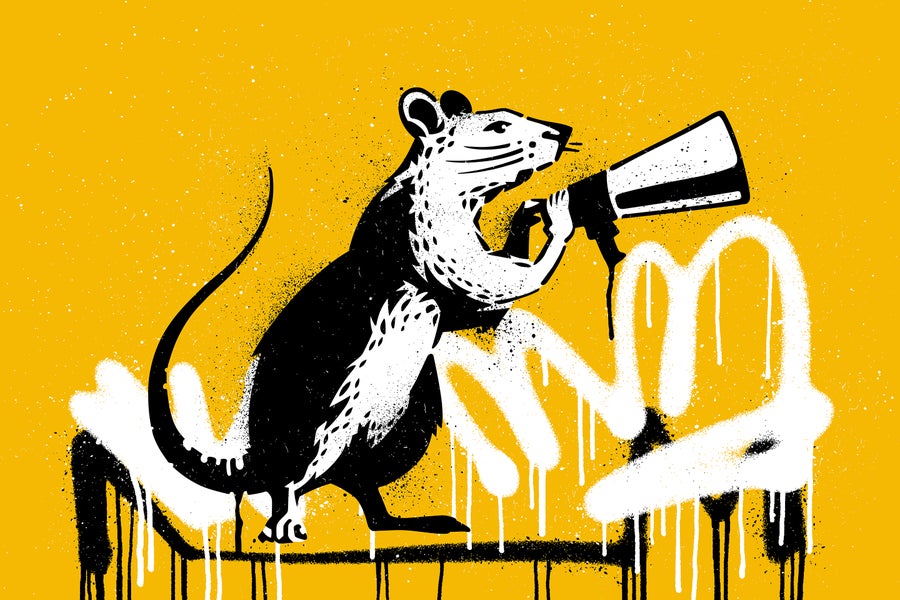 Man_Half-tube/Getty Images
.
.
Click the link below for the complete article:
.
__________________________________________
 James' World 2
Leave a comment