
Click the link below the picture
.
The most enthralling rock yet found on Mars—a speckled hunk of mudstone that just may contain evidence of ancient alien life—is still worth getting excited about.
Teased last year in a preliminary announcement from NASA, that’s the official conclusion of a peer-reviewed paper, published today in Nature, that reports a deeper analysis of the curious outcrop. Were it found on Earth instead of Mars, the rock’s speckles would likely be interpreted as evidence for a microbial feeding frenzy that occurred long ago. But getting certainty about what this rock truly contains likely requires hauling it off the Red Planet and delivering it back to Earth—an ambitious multiphase mission that NASA calls Mars Sample Return.
The rock in question is packed with organic carbon—another promising prerequisite for life—and lies within a lithic formation called Bright Angel, which is exposed along a channel called Neretva Vallis. Eons ago, that now dry channel was a river valley, formed by water rushing into and feeding a lake-and-delta system in what’s now known as Jezero Crater. Those apparently warm, wet origins led to NASA targeting Jezero as the landing spot for the space agency’s Perseverance rover, which has been exploring the site for any past or present signs of life since it touched down in 2021.
“This result gives us reason to consider the possibility that Mars was host to microbial life,” says the new study’s co-author Joel Hurowitz, a geoscientist at Stony Brook University. Although this is nowhere close to direct, clinching evidence of Martian life, Hurowitz and his team hope that the findings help scientists “make progress in our quest to understand whether there’s life on other planets in the solar system and beyond.”
After NASA’s initial teaser, scientists who were eager for more information paid close attention to a presentation by Hurowitz in mid-March of this year at the Lunar and Planetary Science Conference in the Woodlands, Tex. During his talk, Hurowitz recounted how he and his colleagues on the Perseverance team had found a carbon-rich rock with small patches ranging from black to dark blue to dark green, which they called “poppy seeds,” as well as larger patches with dark-toned rims and lighter-toned centers, which they referred to as “leopard spots.” They called the rock itself “Cheyava Falls.”
Using multiple instruments on Perseverance, an early analysis showed that the poppy seeds and rims of the leopard spots were enriched with iron and phosphorus, while the centers of the leopard spots had abundant iron and sulfur. That distribution of elements hints at both types of patches forming from organic carbon reacting with iron and sulfate minerals—a process that, on Earth, is typically kick-started by certain types of microbes to fuel their metabolism. But it can also occur abiotically via chemical reactions that happen at high temperatures.
In their Nature study, Hurowitz and his co-authors elaborate on the likely mineralogical composition of Cheyava Falls and its speckles, as well as on the conditions in which it probably formed. Perseverance’s measurements suggested the speckles contained the minerals vivianite, an iron phosphate, and greigite, an iron sulfide, and that both formed in close association with organic carbon. On Earth, vivianite frequently forms in lakes and coastal sediments where microbes use iron in their metabolism. Greigite tends to form when microbes break down sulfate. When found together on Earth, these minerals and organic molecules are usually considered a sort of biosignature, a physical sign of past or present life—at least if they can be shown to have formed at low temperatures rather than via hotter, less life-friendly conditions.
The most enthralling rock yet found on Mars—a speckled hunk of mudstone that just may contain evidence of ancient alien life—is still worth getting excited about.
Teased last year in a preliminary announcement from NASA, that’s the official conclusion of a peer-reviewed paper, published today in Nature, that reports a deeper analysis of the curious outcrop. Were it found on Earth instead of Mars, the rock’s speckles would likely be interpreted as evidence for a microbial feeding frenzy that occurred long ago. But getting certainty about what this rock truly contains likely requires hauling it off the Red Planet and delivering it back to Earth—an ambitious multiphase mission that NASA calls Mars Sample Return.
The rock in question is packed with organic carbon—another promising prerequisite for life—and lies within a lithic formation called Bright Angel, which is exposed along a channel called Neretva Vallis. Eons ago, that now dry channel was a river valley, formed by water rushing into and feeding a lake-and-delta system in what’s now known as Jezero Crater. Those apparently warm, wet origins led to NASA targeting Jezero as the landing spot for the space agency’s Perseverance rover, which has been exploring the site for any past or present signs of life since it touched down in 2021.
“This result gives us reason to consider the possibility that Mars was host to microbial life,” says the new study’s co-author Joel Hurowitz, a geoscientist at Stony Brook University. Although this is nowhere close to direct, clinching evidence of Martian life, Hurowitz and his team hope that the findings help scientists “make progress in our quest to understand whether there’s life on other planets in the solar system and beyond.”
After NASA’s initial teaser, scientists who were eager for more information paid close attention to a presentation by Hurowitz in mid-March of this year at the Lunar and Planetary Science Conference in the Woodlands, Tex. During his talk, Hurowitz recounted how he and his colleagues on the Perseverance team had found a carbon-rich rock with small patches ranging from black to dark blue to dark green, which they called “poppy seeds,” as well as larger patches with dark-toned rims and lighter-toned centers, which they referred to as “leopard spots.” They called the rock itself “Cheyava Falls.”
Using multiple instruments on Perseverance, an early analysis showed that the poppy seeds and rims of the leopard spots were enriched with iron and phosphorus, while the centers of the leopard spots had abundant iron and sulfur. That distribution of elements hints at both types of patches forming from organic carbon reacting with iron and sulfate minerals—a process that, on Earth, is typically kick-started by certain types of microbes to fuel their metabolism. But it can also occur abiotically via chemical reactions that happen at high temperatures.
In their Nature study, Hurowitz and his co-authors elaborate on the likely mineralogical composition of Cheyava Falls and its speckles, as well as on the conditions in which it probably formed. Perseverance’s measurements suggested the speckles contained the minerals vivianite, an iron phosphate, and greigite, an iron sulfide, and that both formed in close association with organic carbon. On Earth, vivianite frequently forms in lakes and coastal sediments where microbes use iron in their metabolism. Greigite tends to form when microbes break down sulfate. When found together on Earth, these minerals and organic molecules are usually considered a sort of biosignature, a physical sign of past or present life—at least if they can be shown to have formed at low temperatures rather than via hotter, less life-friendly conditions.
The Nature study correspondingly details further analyses that suggest a low-temperature origin for the speckles—that is, they seem to have arisen in relatively clement conditions near the surface, where life could possibly thrive, rather than the inhospitably hot depths of the Martian subsurface. “We believe that these features happened early in the life of the sediment, shortly after it was deposited and likely before it had been ‘lithified’ to form hard rock,” Hurowitz says.
.
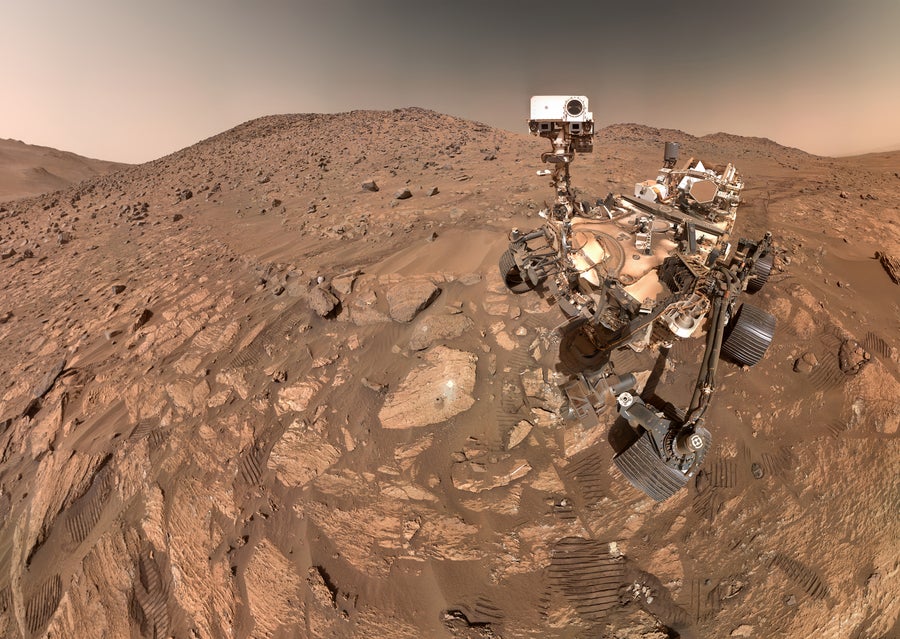
NASA’s Perseverance Mars rover took this selfie, made up of 62 individual images, on July 23, 2024. A rock nicknamed “Cheyava Falls,” which bears tantalizing features suggesting it may contain ancient microbial fossils, is to the left of the rover near the center of the image. NASA/JPL-Caltech/MSSS
.
.
Click the link below for the complete article:
.
__________________________________________
 James' World 2
Leave a comment