
Click the link below the picture
.
Shortly after 10 a.m. on Monday, when an Israeli military strike hit the facade of a hospital building in southern Gaza, emergency responders who were already nearby rushed to the scene. So did journalists.
But just minutes later, according to witnesses, hospital officials, and video footage that captured the immediate aftermath of that first blast, a second strike hit the same part of the hospital, enveloping it in a thick cloud of smoke and dust.
Once the air cleared, the full extent of the horror at Nasser Hospital was revealed.
Four Palestinian journalists had been killed on the spot, and a fifth would later die of his wounds. At least 15 more people were killed, including members of the medical staff, rescue workers, and patients, according to the Gazan health ministry. Dozens more were injured, it said.
The Israeli military provided no immediate explanation for the attack, one of the deadliest for members of the news media, who have already died in unusually high numbers covering the war. The five journalists had worked for news outlets that included Reuters, The Associated Press, and Al Jazeera, according to their employers.
The military acknowledged carrying out a strike in the area of Nasser Hospital, without saying what the target was. In a statement, it said that it regretted “any harm to uninvolved individuals” and that its chief of staff had ordered an immediate inquiry.
The office of Prime Minister Benjamin Netanyahu, who generally casts civilian deaths in Gaza as a regrettable but unavoidable part of war, suggested that those on Monday were the result of a military blunder.
“Israel deeply regrets the tragic mishap that occurred today at the Nasser Hospital,” the office said in a statement. It went on to say that “Israel values the work of journalists, medical staff, and all civilians.”
But the rare expressions of regret did little to assuage the growing swell of local and international outrage.
Even before Monday, the war in Gaza between Israel and Hamas had been one of the deadliest conflicts anywhere for journalists, with almost 200 killed since the fighting began, according to the Committee to Protect Journalists.
The Israeli government has barred international journalists from entering Gaza to freely report on the war. That has left much of the world relying on local Palestinian journalists, reporting amid bombardment and widespread hunger, to understand the situation in the enclave.
“The killing of journalists in Gaza should shock the world — not into stunned silence — but into action, demanding accountability and justice,” the spokeswoman for the United Nations human rights office, Ravina Shamdasani, said in a statement issued after the strikes.
In a joint letter sent by The A.P. and Reuters to Israeli officials later Monday, the agencies said they had found the Israeli military’s “willingness and ability to investigate itself in past incidents to rarely result in clarity and action.”
The circumstances of the attack, in the southern city of Khan Younis, were not immediately clear, and the military did not specify if the strikes had been carried out by missiles, tank fire, or drones.
But Israel’s conduct in the war has prompted international censure of the soaring civilian death toll as well as Israeli restrictions on the entrance of aid. Parts of Gaza are now experiencing famine, according to a global group of experts backed by the United Nations.
More than 60,000 Palestinians have been killed in Gaza, according to health officials there. Their tally does not distinguish between combatants and civilians, but it includes about 18,000 children and minors. The Hamas-led attack on Israel on Oct. 7, 2023, that ignited the war killed around 1,200 people, with about 250 others taken as hostages to Gaza.
Some of Israel’s attacks on journalists have been intentional. A strike that killed several journalists in Gaza earlier this month was aimed at Anas al-Sharif, a reporter with Al Jazeera, the Qatari-based network. Israel accused him of being a Hamas operative. Al Jazeera rejected that assertion.
On Monday, after one of its cameramen was killed, the network, which has frequently clashed with Israel, accused the Israeli military of killing its reporters as part of a “systematic campaign to silence the truth.”
Last year, a New York Times investigation found that, since the start of the war, the Israeli military had also significantly loosened safeguards meant to protect civilians.
.
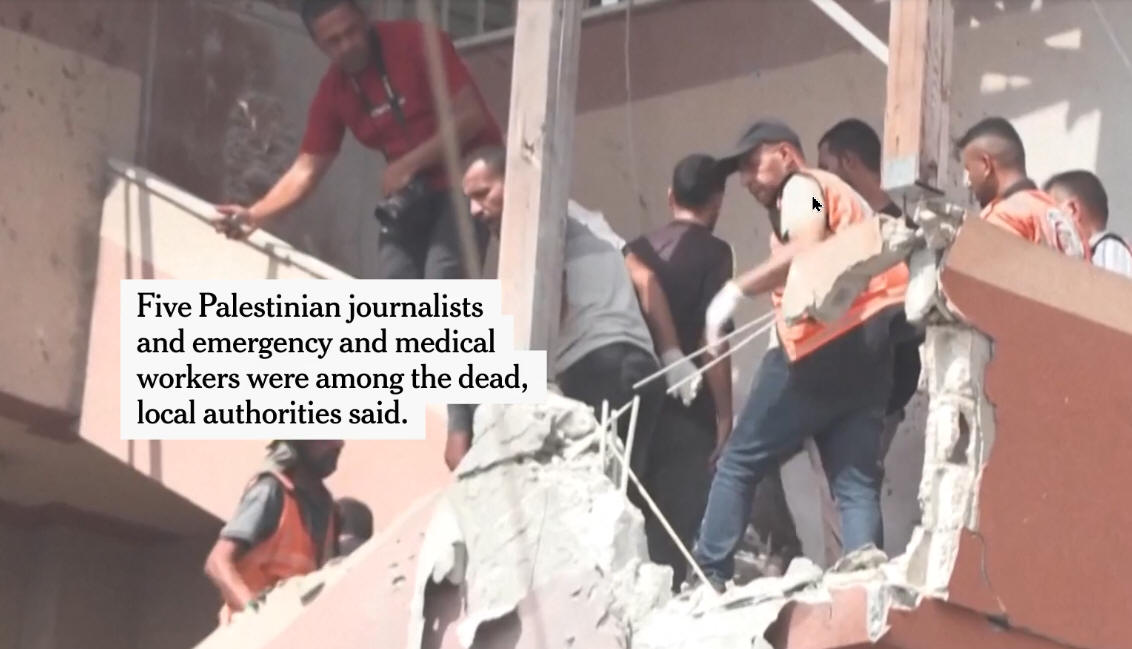 Two Israeli strikes hit a hospital in southern Gaza on Monday, killing five Palestinian journalists and at least 15 other people, according to local health officials.CreditCredit…Agence France-Presse — Getty Images
.
.
Click the link below for the complete article:
.
__________________________________________
 James' World 2
Leave a comment