
Click the link below the picture
.
Rachel Feltman: For Scientific American’s Science Quickly, I’m Rachel Feltman.
When it comes to birth control, men have exactly two reliable options: condoms or a vasectomy. That’s it. For decades, researchers have been working to expand those choices, but progress has been slow.
Now, a new pill for men has just passed its first safety trial in humans. What’s particularly exciting about this daily pill, which works by blocking a key step in sperm production, is that it’s hormone-free.
Here to tell us more about the latest progress on male contraception is Hannah Seo, a freelance science journalist based in Brooklyn.
Hannah, thanks so much for coming on to chat today.
Hannah Seo: Thanks for having me. It’s exciting.
Feltman: So you recently wrote a story for Scientific American about some advances in male birth control. Could you start by just telling us what this particular method is and, and how it works?
Seo: Yeah, I was really fascinated to read about this trial because it’s the first nonhormonal male birth control pill. So a lot of the birth control methods that we think about usually involve hormones of some kind or involve some sort of surgery, right, like a vasectomy. But this does neither of those things. It is a pill that’s supposed to be taken daily, and it just kind of stops sperm production from happening through nonhormonal methods, so I thought this was a really innovative piece of medicine that is being—in development right now.
Feltman: Could you tell us more about the mechanism by which it prevents sperm production?
Seo: Yes, absolutely. So one thing that’s interesting to note is that in people of all sexes, if you have a severe vitamin A deficiency, that can really impact your fertility, and so the makers of this drug were really focused on this detail. And what they found out is that cells in the testes will take up vitamin A, metabolize vitamin A into this metabolite called retinoic acid; retinoic acid will bind to a receptor, and in that binding it’ll drive changes in gene expression that leads to sperm production—there’s, like, a cascade of effects, and the consequence is that you get sperm.
And so what this drug does is it prevents that binding from happening …
Feltman: Mm.
Seo: It prevents retinoic acid from binding to its receptor. And as a consequence, it sort of breaks the chain, and, you know, all the various effects can’t really cascade the way they would—normally would, and you prevent sperm production that way. And then once you’ve stopped taking the drug, after a while, you eventually regain that function.
Feltman: Just, you know, remind us: Where are we at with male birth control in general right now? You know, what’s available, what’s in the works?
Seo: Yeah, right now, what people can currently get include just two things: you can get a vasectomy, or you can use condoms. And so, as far as male contraception goes, those are really the only two options, and neither one of those is particularly ideal, especially if you’re someone who wants a reversible option to control your fertility.
At the moment, there are several options in development, including this pill, which is a nonhormonal birth control pill taken daily. There’s also a gel—I think a lot of people will have heard of this gel. It’s called Nest/T, which stands for a progestin called Nestorone, as well as testosterone. People who are doing hormone-replacement therapy will use a similar gel on their shoulders. It’s a very, very similar mechanism. And this works a little bit similarly to the nonhormonal pill in that it stops sperm production reversibly. So that is probably the male contraceptive that is furthest along in development. That is currently on the cusp of starting phase 3 clinical trials.
There’s also a reversible vasectomy. Some vasectomies, currently, surgically are reversible, but not all of them, and this, quote, unquote, “reversible vasectomy” is really an implant. And what it is, is that it’s a tiny, little hydrogel that can be inserted into the vas deferens, and it just physically blocks sperm from being able to escape into the ejaculate. And so that is also pretty far along in development.
And those are really the two that are kind of closest to becoming released onto the market. Besides those two we then have this nonhormonal contraceptive pill that stops sperm production and, like, a few other smaller options that are also kind of in early, early development.
Feltman: Yeah, so speaking of which: Where in development is this pill? I know there [was] some recent news about progress, but where does that leave us?
.
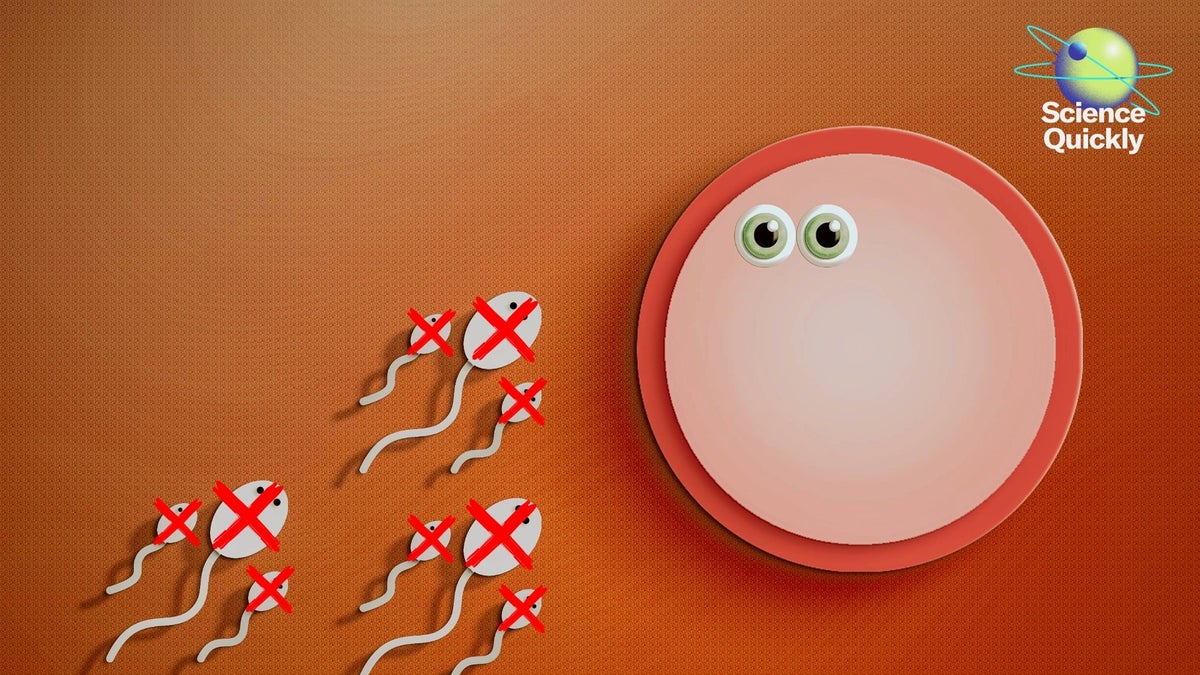
Carol Yepes/Getty Images; Scientific American illustration
.
.
Click the link below for the complete article:
.
__________________________________________
 James' World 2
Leave a comment