
Click the link below the picture
.
Five years ago, electrical engineer Sun Hongbin was given what many would consider an impossible task: build a full-fledged clean-energy system amid some of the coldest temperatures on Earth, screaming winds, and half-year darkness.
China was then building its fifth Antarctic research station, called Qinling, on Inexpressible Island in Terra Nova Bay. And the nation’s government was pushing the concept of “green expeditions” to protect Antarctica’s uniquely fragile environment while studying and surveying the continent. “So having a system that would provide the bulk of Qinling’s energy with renewable power fit that goal,” Sun says.
But conventional solar and wind installations are no match for temperatures that plummet below –40 degrees Celsius, winds of up to 300 kilometers per hour (kmh), and ferocious blizzards. Such conditions can snap wind turbine blades, sharply reduce the performance of solar panels, and prevent batteries from charging and discharging properly. And of course, there are the six months of polar night, when the sun never rises above the horizon.“It was a huge challenge” to build a system for the Earth’s coldest, darkest and most remote continent, says Sun, now president of Taiyuan University of Technology in China and chief scientist for polar clean energy at the Polar Research Institute of China.
But in late 2024, his team traveled to the station to install a system that took $14 million to develop. It consists of 10 wind turbines, 26 solar modules, a hydrogen energy system, a container full of frost-resistant lithium-ion batteries, and a smart grid that can predict and balance supply and demand. The entire renewable system is now running and, according to Sun, should provide half of the base’s average annual energy needs.
“The use of clean energy is a huge advancement to keep the continent clean,” says Kim Yeadong, chair of the Korean National Committee on Polar Research in South Korea, who was not involved with the project. “Other stations will probably have to learn how they achieve that much clean energy. I think it’s remarkable.”
Where Diesel Power Is King
A 2024 preprint analysis of 81 Antarctic research bases found that 37 had installed renewable-energy sources such as solar panels and wind turbines. But the proportion of renewable energy these bases used was “often low,” the researchers wrote. An exception so far has been Belgium’s Princess Elisabeth Station, which is only staffed during the Antarctic summer. It runs completely on wind and solar power, taking advantage of the almost 24-hour daylight. Even so, the vast majority of stations still depend on diesel-powered generators to keep their crews warm, fed, and safe. The main reason this is the case is simply that “they are used to using diesel,” says Daniel Kammen, a professor of energy at the University of California, Berkeley.
.
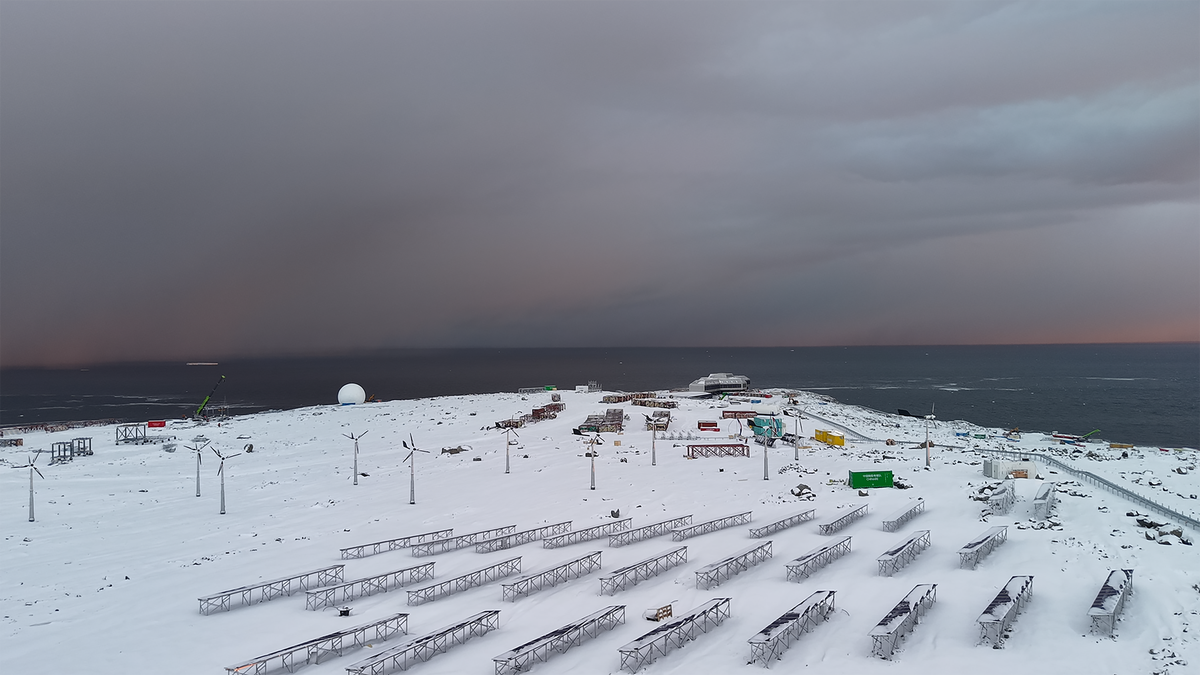
The majority of power at China’s Qinling research station in Antarctica now comes from clean energy. Members of China’s 41st Antarctic expedition team
.
.
Click the link below for the complete article:
.
__________________________________________
 James' World 2
Leave a comment