
Click the link below the picture
.
CLIMATEWIRE | Texas knows it isn’t prepared for floods.
But the state has done little to address the risk, and the federal government under President Donald Trump is unlikely to help Texas cover the cost.
The threat was underscored last week when floodwaters ravaged central Texas, killing more than 100 people, including more than two dozen children and staff at a riverside summer camp. About 160 people were still missing as of Tuesday evening, according to Texas public safety officials.
Officials have vowed to take action, and state lawmakers are scheduled to meet July 21 for a special legislative session that’s intended to bolster Texas’ emergency response.
Yet the latest disaster isn’t the first time Texas has dealt with mass casualties from a flood event. Nor is the upcoming Statehouse session the first time that Texas has tried to address flood risk.
The lack of meaningful progress highlights the challenge of preparing for natural disasters such as floods and wildfires that are being made worse by climate change. And it reinforces the risk of shifting more of that responsibility to states, as proposed by the Trump administration.
“Hopefully this tragic event will open everyone’s eyes,” said Marie Camino, government affairs director at the Nature Conservancy in Texas.
Texas has faced devastating floods before, including 2017, when Hurricane Harvey dumped more than 48 inches of rain on Houston and other Gulf Coast communities. The storm left dozens dead and caused more than $125 billion in damages.
In response, state lawmakers in 2019 created the Texas Flood Infrastructure Fund and began planning projects to control high water around the state.
The fund, overseen by the Texas Water Development Board, has identified $54 billion in flood control needs across Texas. But lawmakers so far have devoted just $1.4 billion to fix them.
The lack of funding can be attributed to two factors, observers say.
The first is ideological. Texas Republicans — who control the Statehouse and governor’s mansion — are big believers in fiscal conservatism. So there isn’t a groundswell of enthusiasm to fund major government projects.
There’s a practical concern, too.
Before lawmakers were willing to commit money to flood projects, they wanted to make sure that plans were written to address each river basin in the state.
Otherwise, there’s the risk that a project in one city would simply steer floodwaters to other communities, said state Sen. Charles Perry, who chairs the Senate Committee on Water, Agriculture and Rural Affairs.
“We created this very detailed, very elaborate watershed planning, where every watershed would coordinate with all the municipalities and cities up and down that watershed to make sure that as you’re moving water from one place, you’re not just dumping it on the next place,” he said.
Texas legislators have tried recently to steer more money to the effort.
This spring, lawmakers passed a plan that would devote up to $500 million annually over the next 20 years to flood projects. But the proposal must first earn the support of Texas voters in a statewide referendum, now set for November.
Texas Gov. Greg Abbott and other state officials have described the plan as a “Texas-sized” commitment to water infrastructure and flood prevention.
.
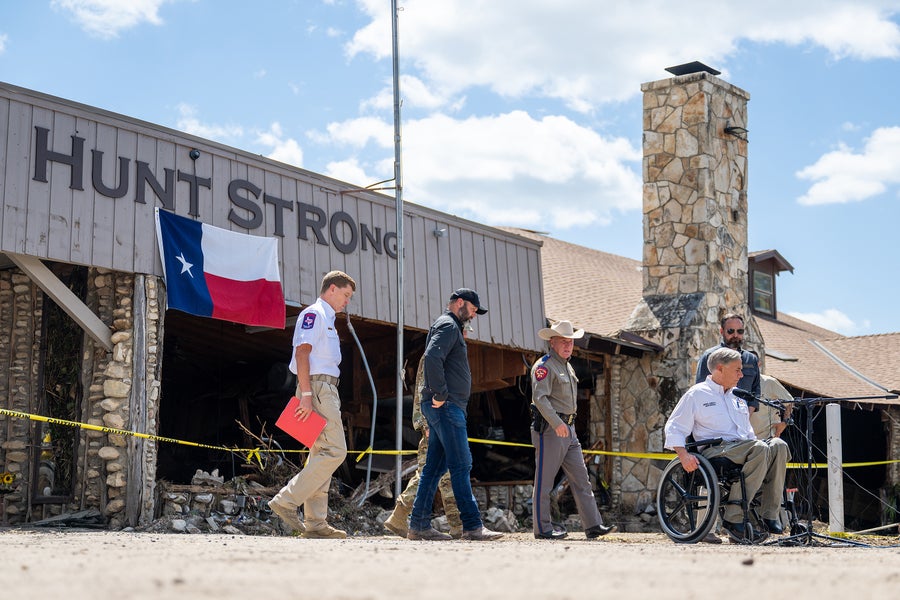
Gov. Greg Abbott arrives at a news conference on July 08, 2025, in Hunt, Texas. Gov. Abbott announced that more than 160 people are still missing after deadly floods early Friday. Last week, heavy rainfall caused severe flash flooding along the Guadalupe River in central Texas, leaving more than 100 people reported dead, including children attending Camp Mystic. Brandon Bell/Getty Images
.
.
Click the link below for the complete article:
.
__________________________________________
 James' World 2
Leave a comment