
Click the link below the picture
.
Grant cancellations and budget reductions at the National Institutes of Health have put millions of dollars in research for promising new cancer treatments, tuberculosis therapies, and much more in jeopardy. Our elected officials could intervene if all Americans, not just academics, were to send a clear signal that they should. Instead, much of the public has shrugged its shoulders.
University and Princeton University. The Department of Education has opened investigations into 60 universities over allegations of antisemitism, using these inquiries to justify funding cuts and impose policy mandates. The administration has also placed international students under scrutiny, threatening visa revocations and deportations for those participating in campus protests deemed hostile to government interests. The administration has detained foreign-born academics such as Kseniia Petrova, a researcher at Harvard, who was recently released after she was placed in criminal custody for failing to declare research materials at customs.
Collectively, we’re witnessing unprecedented attempts to bully academic institutions with the administration’s ideological aims. These attempts challenge long-standing norms of academic freedom—that is, the ability of a teacher or researcher in higher education to investigate and discuss subjects without fear of political interference. Our elected officials should stand up for scientific research and those who produce it in the face of politically motivated attacks. But public apathy is making it easier for legislators to ignore the problem.
In late March, we worked with YouGov to conduct a nationally representative online survey of 1,500 U.S. adults. We found that while few Americans actively support the president’s attacks on science, many more are unbothered by them.
For example, 65 percent of Americans either have no position (31 percent) or outright support (34 percent) the possibility that the Trump administration might revoke federal funding to universities that support “pro-Palestine / anti-Israel protests”. That possibility became very real on April 21, when the NIH suggested making grant awards conditional on compliance with anti-boycott provisions regarding Israeli companies . Similarly, a majority (67 percent) either take no issue with or outright support revoking funding to universities (like the White House did to the University of Pennsylvania) that allow transgender athletes to compete.
More urgently, defunding and censoring science could have dramatically negative consequences for all Americans. Canceling research on vaccine communication hinders not just our preparedness for future pandemics, but also our response to seasonal flu and COVID. Curtailing studies of health disparities weakens efforts to improve maternal mortality rates, particularly in communities of color, people who have low income and gender-diverse communities. Cutting international academic exchange isolates the U.S. from global scientific collaboration, including partnerships with entities, such as the World Health Organization, that are trying to promote access to lifesaving medical treatments and preventatives.
The costs of academic repression, in other words, are not confined to elite institutions—they are borne by everyone. Yet very few Americans seem to be concerned.
Why is that so? Politically motivated distrust in academic institutions, particularly on the ideological right, may help explain the attitude and why the Trump administration is taking these actions.
.
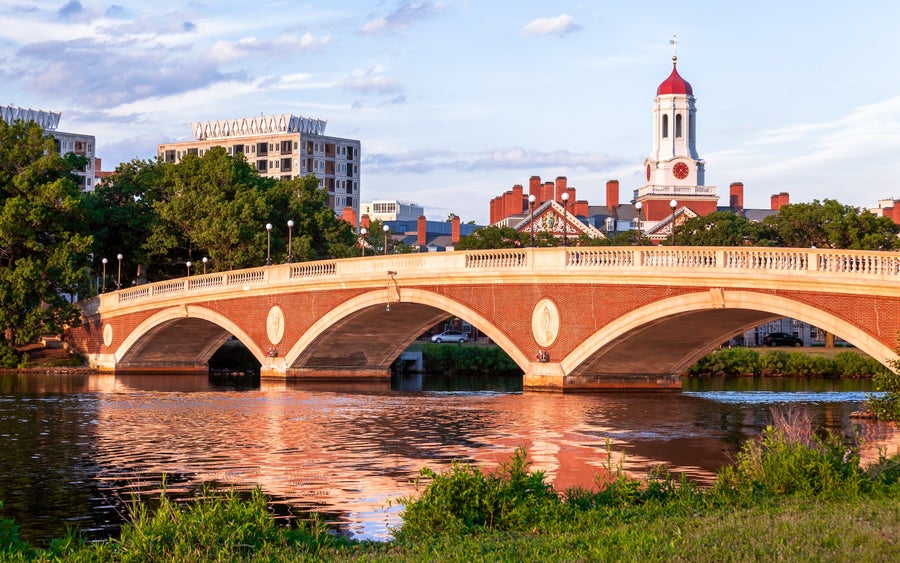
The John W. Weeks Bridge at Harvard University in Cambridge, Massachusetts. Joe Daniel Price
.
.
Click the link below for the complete article:
.
__________________________________________
 James' World 2
Leave a comment