
Click the link below the picture
.
Jeffrey Lawson was born prematurely in February 1985. Shortly afterward, the newborn had to undergo heart surgery without anesthesia. He remained awake throughout the procedure, given only Pavulon, a muscle relaxant, to prevent movement. He died five weeks later.
After Jeffrey Lawson’s death, his mother was told that her son had been too young to tolerate anesthesia. And the anesthesiologist had attempted to reassure her that there was no evidence premature babies felt any pain.
The Lawson family’s story, famous in pain research, was not an anomaly. Until the 1980s, surgical procedures on infants were routinely performed with little or no anesthesia. Even clear defensive reactions to painful stimuli were considered to be mere reflexes.
But more than 20 years after Jeffrey Lawson’s operation, an international research team found evidence that the brains of newborn premature babies react to pain stimuli in a very similar way to those of adults. More specifically, the researchers observed an increased oxygen supply in parts of the cerebral cortex that were associated with conscious experience. This evidence of increased neuronal activity indicated that premature babies do indeed feel pain.
Understanding the experiences of infants has presented a challenge to science. How do we know when infants consciously experience pain, for example, or a sense of self? When it comes to reporting subjective experience, “the gold standard proof is self-report,” says Lorina Naci, a psychologist and a neuroscientist at Trinity College Dublin. But that’s not possible with babies.
Among the debates surrounding the developing mind is the question of when consciousness first emerges. And that question is tied to the scientific challenge of defining conscious experience. Various philosophical, psychological and neurobiological models have attempted to explain what it is and what underlies it. Investigating whether this phenomenon exists across early development may offer new insights and ways to assess theories of consciousness.
Many scientists now recognize multiple types of consciousness and suspect that certain forms exist earlier than others in development. That insight has helped address some issues but has left others unresolved. “The answer to the question of when children become conscious depends on what exactly is meant by consciousness,” says developmental psychologist Norbert Zmyj of TU Dortmund University in Germany.
Sensation and Sensibility
Broadly speaking, there are two camps among researchers when it comes to consciousness in early development, Naci says. Some take a strict view that consciousness emerges in early childhood and that a being is only conscious once it reaches a stage where it can demonstrate abilities such as decision-making and self-reflection.
For example, one influential idea is that a mental state becomes conscious when a thought is directed toward it. So if you see a red apple and then think, “I see a red apple,” you are conscious of this sensation because you have a higher-order thought that represents it. With that definition, consciousness only arises in the course of childhood because it requires higher thought processes.
.
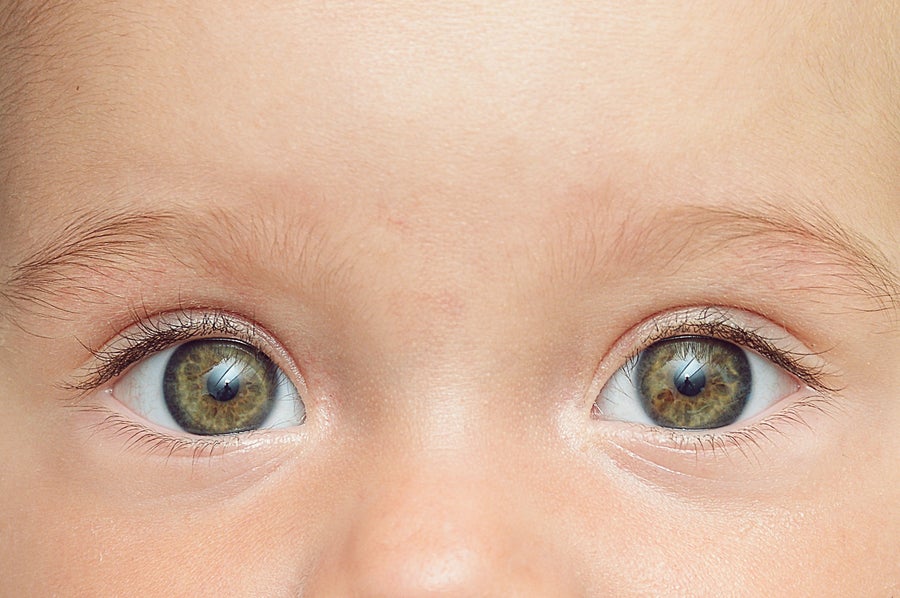 Paul Biris/Getty Images
.
.
Click the link below for the complete article:
.
__________________________________________
 James' World 2
Leave a comment