
Click the link below the picture
.
Welcome to a mind-blowing new era of astronomy.
The long-awaited Vera C. Rubin Observatory, a cutting-edge new telescope perched atop a mountain in Chile, released its first images of the universe on June 23—and its views are just as jaw-dropping as scientists hoped.
The new images come from only 10 hours of observations—an eyeblink compared with the telescope’s first real work, the groundbreaking, 10-year Legacy Survey of Space and Time (LSST) project. On display are billowing gas clouds that are thousands of light-years away from our solar system and millions of sparkling galaxies—all emblematic of the cosmic riches that the observatory will ultimately reveal.
“You can see here a universe teeming with stars and galaxies,” said Željko Ivezić, an astronomer at the University of Washington and director of the Rubin Observatory, during a live event held by the observatory. “The seemingly empty, black pockets of space between stars in the night sky when you look at it with unaided eyes, are transformed here into these glittering tapestries.”
The Rubin Observatory released several videos to highlight the strengths of the new telescope, which captures images that are too enormous to meaningfully grasp with our perception, Ivezić explained. Each of them would require 400 high-definition televisions, a space the size of a basketball court, to display at full detail.
Among the sights that Rubin captured are individual detail images that show portions of the Virgo Cluster, a massive clump of galaxies located in the constellation of the same name
And the appeal of these images isn’t just aesthetic. “When I look at the images, I often don’t pay attention to the beautiful nearby galaxies; I look at the little fuzzballs,” said Aaron Roodman, a physicist at Stanford University and program lead for the Rubin Observatory’s LSST Camera, during the live event. “Many of those galaxies are five, perhaps even 10 billion light-years away and have up to 100 billion stars in them. And those are the galaxies that we use the most if we want to study the expansion of the universe and dark energy.
”Understanding dark energy—the mysterious force that propels the accelerating expansion of the universe—and the equally enigmatic dark matter, which shapes the cosmos but can’t be directly detected by scientists, represents one of the four key science pillars of the Rubin Observatory. The others include cataloging the solar system, mapping the Milky Way and exploring so-called transient phenomena that change over time.
.
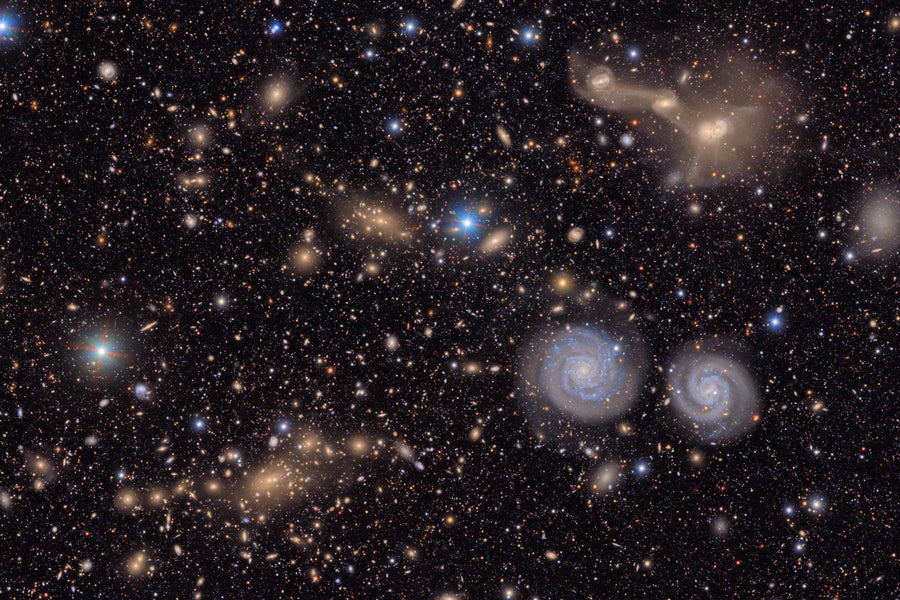
A small section of the Vera C. Rubin Observatory’s total view of the Virgo Cluster shows two prominent spiral galaxies (lower right), three merging galaxies (upper right), several groups of distant galaxies, many stars in the Milky Way galaxy, and more. NSF-DOE Vera C. Rubin Observatory
.
.
Click the link below for the complete article:
.
__________________________________________
 James' World 2
Leave a comment