
Click the link below the picture
.
Astrophysics is, as many astrophysicists will tell you, the story of everything. The nature and evolution of stars, galaxies, galaxy clusters, dark matter, and dark energy—and our attempts to understand these things—allow us to pose the ultimate questions and reach for the ultimate answers. But the practitioners of these arts, as the late astronomer Vera Rubin wrote in her autobiography’s preface, “too seldom stress the enormity of our ignorance.”
“No one promised that we would live in the era that would unravel the mysteries of the cosmos,” Rubin wrote. And yet a new observatory named for her, opening its eyes soon, will get us closer than ever before to unraveling some of them. This will be possible because the Vera C. Rubin Observatory will do something revolutionary, rare, and relatively old-fashioned: it will just look out at the universe and see what there is to see.
Perched on a mountaintop in the Chilean Andes, the telescope is fully assembled and operating, although scientists are not able to use it just yet. A few weeks of testing remain to ensure that its camera—the largest in astronomical history, with a more than 1.5-meter lens—is working as it should. Engineers are monitoring how Earth’s gravity causes the telescope’s three huge glass mirrors to sag and how this slight slumping will affect the collection and measurement of individual photons, including those that have traveled for billions of light-years to reach us. They are also monitoring how the 350-metric-ton telescope will rapidly pan across seven full moons’ worth of sky, stabilize and go completely still, and take two 15-second exposures before doing it all over again all night long.
In this fashion, the scope plans to canvas the entire sky visible from Earth’s Southern Hemisphere every three nights, remaking an all-sky map over and over again and noticing how it changes. And computer scientists are finalizing plans for how to sift through 20 terabytes of data every night, which is 350 times more than the data collected by the vaunted James Webb Space Telescope each day. Others are making sure interesting objects or sudden cosmic surprises aren’t missed among Rubin Observatory’s constant stream of images. Software will search for differences between each map and send out an alert about each one; there could be as many as 10 million alerts a night about potential new objects or changes in the maps.
From finding Earth-grazing asteroids and tiny failed stars called brown dwarfs to studying the strangely smooth rotation of entire galaxies sculpted by dark matter, the Rubin Observatory’s mission will encompass the entire spectrum of visible-light astronomy. The telescope will continue mapping the sky for 10 years. It may be better poised to answer astrophysicists’ deepest questions than any observatory built to date.
“The potential for discovery is immense,” said Christian Aganze, a galactic archaeologist at Stanford University, who will use the observatory’s data to study the history of the Milky Way.
The Rubin Observatory’s Mission
The observatory’s goal was not always so broad. Originally named the Large Synoptic Survey Telescope (LSST), the Rubin Observatory was initially proposed as a dark-matter hunter. Vera Rubin found the first hard evidence for what we now call dark matter, a gargantuan amount of invisible material that shapes the universe and the way galaxies move through it. She and her colleague, the late astronomer Kent Ford, were studying the dynamics of galaxies when they made the discovery in the 1970s.
.
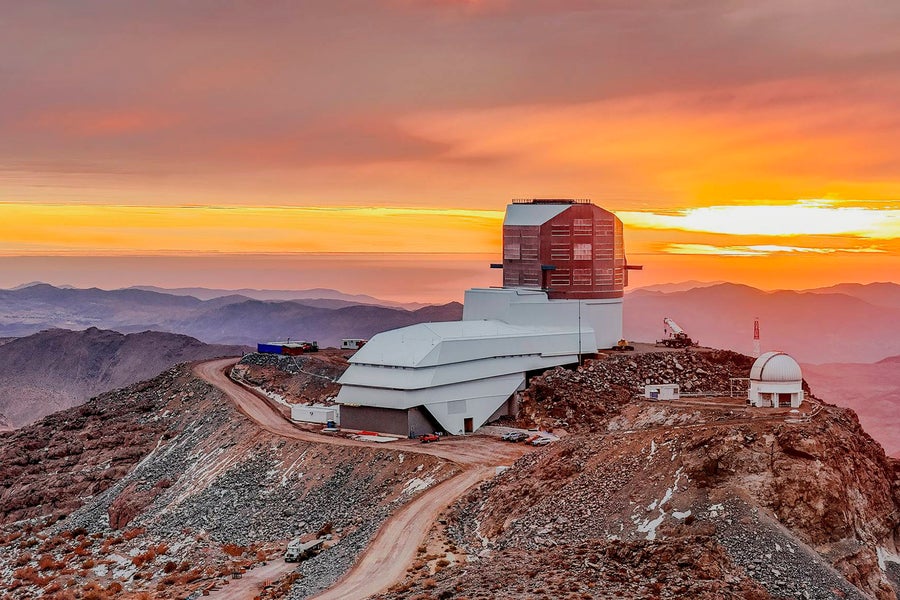
View of Rubin Observatory at sunset in May 2024. The 8.4-meter Simonyi Survey Telescope at Rubin Observatory, equipped with the LSST camera, the largest digital camera in the world, will take enormous images of the Southern Hemisphere sky, covering the entire sky every few nights. Olivier Bonin/SLAC National Accelerator Laboratory
.
.
Click the link below for the complete article:
.
__________________________________________
 James' World 2
Leave a comment