
Click the link below the picture
.
Subatomic particles such as quarks can pair up when linked by ‘strings’ of force fields — and release energy when the strings are pulled to the point of breaking. Two teams of physicists have now used quantum computers to mimic this phenomenon and watch it unfold in real time.
The results, described in two Nature papers on June 4, are the latest in a series of breakthroughs towards using quantum computers for simulations that are beyond the ability of any ordinary computers.
“String breaking is a very important process that is not yet fully understood from first principles,” says Christian Bauer, a physicist at the Lawrence Berkeley National Laboratory (LBNL) in Berkeley, California. Physicists can calculate the final results of particle collisions that form or break strings using classical computers, but cannot fully simulate what happens in between. The success of the quantum simulations is “incredibly encouraging,” Bauer says.
String simulations
Each experiment was conducted by an international collaboration involving academic and industry researchers — one team at QuEra Computing, a start-up company in Cambridge, Massachusetts, and another at the Google Quantum AI Lab in Santa Barbara, California.
The researchers using QuEra’s Aquila machine encoded information in atoms that were arranged in a 2D honeycomb pattern, each suspended in place by an optical ‘tweezer’. The quantum state of each atom — a qubit that could be excited or relaxed — represented the electric field at a point in space, explains co-author Daniel González-Cuadra, a theoretical physicist now at the Institute for Theoretical Physics in Madrid. In the other experiment, researchers encoded the 2D quantum field in the states of superconducting loops on Google’s Sycamore chip.
The teams used diametrically opposite quantum-simulation philosophies. The atoms in Aquila were arranged so that the electrostatic forces between them mimicked the behaviour of the electric field, and continuously evolved towards their own states of lower energy — an approach called analogue quantum simulation. The Google machine was instead used as a ‘digital’ quantum simulator: the superconducting loops were made to follow the evolution of the quantum field ‘by hand’, through a discrete sequence of manipulations.
.
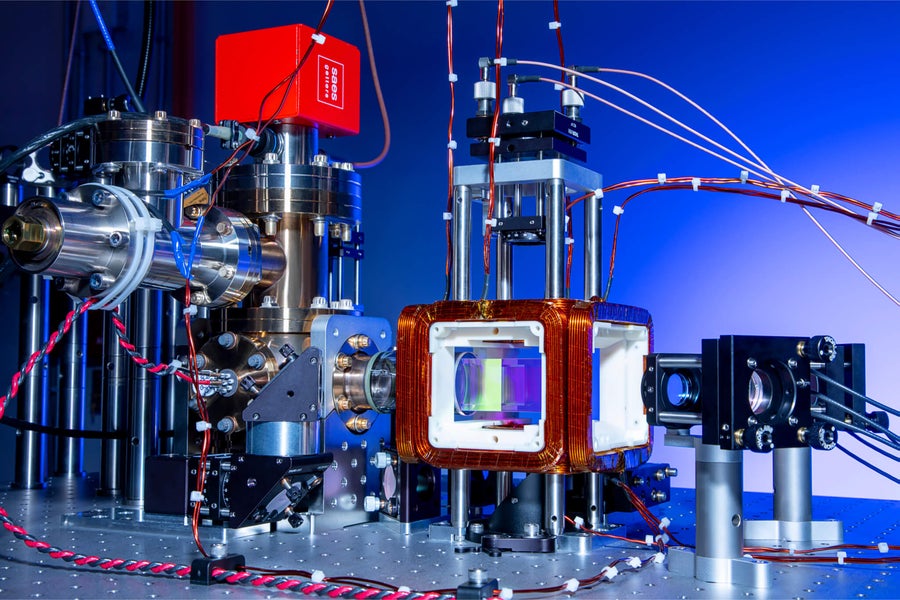
The Aquila magneto-optical trap in QuEra’s facilities. QuEra Computing Inc.
.
.
Click the link below for the complete article:
.
__________________________________________
 James' World 2
Leave a comment