
Click the link below the picture
.
Warnings of a potentially dangerous invasive ant have popped up on news sites and social media this week. You’d be forgiven for thinking a new threat had arrived. But this insect, the Asian needle ant (Brachyponera chinensis), is no newcomer—just a master of remaining inconspicuous.
The ant is getting attention after University of Georgia (UGA) entomologist Dan Suiter issued a warning that its sting can be remarkably painful and sometimes cause a serious allergic reaction called anaphylaxis. The ant is not new or spreading any faster than it used to, Suiter says. Rather, as a UGA Cooperative Extension entomologist, he’s been getting calls about people being stung by the ant and needing hospital care. With summer in full swing, the insect is active, and people are likely to be in the woods or in their gardens where they might encounter it, prompting Suiter to raise awareness of the species.
“By this time last year, I had fielded three calls of people who had been stung by an Asian needle ant—they knew it was an Asian needle ant—and suffered anaphylaxis,” Suiter says. The problem, he adds, is that the insect is small, black, and nondescript. “You’re not thinking that ‘this tiny little creature right here could have consequences if it stung me.’”
The Asian needle ant is native to Japan, Korea, and China. It arrived in the U.S. around or before the 1930s, probably in ships carrying plants and livestock, “before we even realized that is a great way to spread things around,” says Theresa Dellinger, a diagnostician at the Insect Identification Lab at Virginia Tech. It’s not clear precisely where the ant has spread within the U.S., but it’s plentiful in the Southeast and appears to range as far north as Massachusetts, according to sightings on the community science app iNaturalist. It’s not often seen farther west than Missouri, probably because it’s not well-adapted to arid conditions, Dellinger says.
Studies have found that when Asian needle ants move into an area, they outcompete native ants, reducing ant diversity.
These ants don’t lay down pheromone trails to lead their colony to food, so you won’t see them marching in a line like the little black ant (Monomorium minimum). Instead, when an Asian needle ant finds food, it will return to its colony, pick up another worker and physically carry it to the jackpot, says Christopher Hayes, an entomologist at North Carolina State University.
And unlike fire ants, Asian needle ants don’t build big nest mounds. Instead they love nesting in damp wood, such as fallen logs or wet mulch. While they aren’t particularly aggressive, they will sting to protect their nest, making them a danger to the home gardener.
Their sting is initially more painful than a fire ant sting, Hayes says, but also irritatingly persistent, like fiberglass under the skin. The pain can also come and go. Hayes’s two-year-old son recently got a sting. The little boy was fine after a few minutes, Hayes says, but then woke up after midnight that night crying about the pain again.
In their native range, Asian needle ant bites are associated with a 2 percent risk of anaphylaxis compared with a 0.5 to 1.5 percent risk from the bites of fire ants, Hayes says.
.
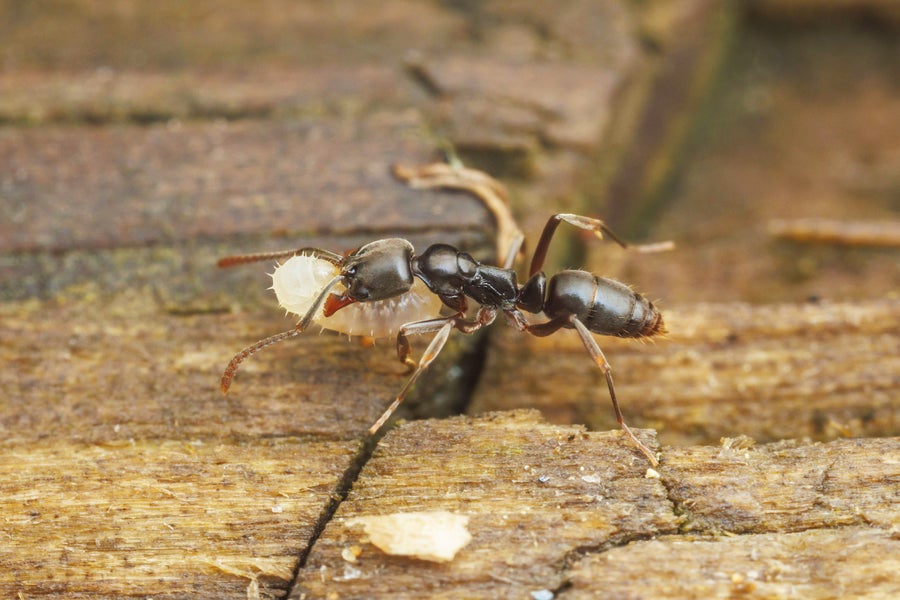
An Asian Needle Ant (Brachyponera chinensis) worker moves a larva from a disturbed nest. Clarence Holmes Wildlife/Alamy Stock Photo
.
.
Click the link below for the complete article:
.
__________________________________________
 James' World 2
Leave a comment