
Click the link below the picture
.
The Supreme Court delivered an important victory to disabled children on Thursday, unanimously affirming their right to reasonable accommodations in public education. Chief Justice John Roberts’ opinion for the court reiterated that schools engage in unlawful discrimination when they deny these accommodations to kids, even if officials are not acting in bad faith. His ruling provides a lifeline to schoolchildren throughout the country who are wrongly denied equal access to learning opportunities because of a disability.
Yet this victory comes with an asterisk: In a concurrence, Justice Clarence Thomas, joined, alarmingly, by Justice Brett Kavanaugh, launched an assault on civil rights law that would devastate disabled Americans’ ability to receive an education and participate in all aspects of public life. Thomas and Kavanaugh suggested that the long-standing interpretation of disability law is, in fact, unconstitutional, arguing that states should have far more leeway to discriminate against those with disabilities. We should expect such callous radicalism from Thomas. But Kavanaugh’s endorsement of this position is yet another ominous sign that the justice is drifting toward the hard-right flank of the court.
It is difficult to know exactly what to make of Kavanaugh’s drift to the right because he remains an intellectual lightweight who struggles to articulate and defend his views with any coherence. Is he just another MAGA-pilled jurist eager to promote Trump’s agenda? Did his bruising confirmation battle leave him with a lifelong grudge against Democrats that he acts upon by trashing progressive priorities from the bench? Has he fallen under the influence of Thomas and Justice Samuel Alito, who spurn centrism as craven capitulation to their perceived enemies on the left? Whatever the cause of his transformation, it is by now an undeniable fact that he has abandoned the middle of the court, sliding to the right of Roberts, Justice Amy Coney Barrett, and sometimes even Justice Neil Gorsuch.
Thursday’s case, A. J. T. v. Osseo Area Schools, shows exactly why robust federal protections for disabled Americans remain so vital. The plaintiff, Ava Tharpe, “suffers from a rare form of epilepsy that severely limits her physical and cognitive functioning,” as Roberts put it. Her seizures are worst in the morning, leaving her able to learn only after about 12 p.m. each day. When Tharpe transferred to a new school district in 2015, officials refused to provide her with special evening instruction, leaving her with far fewer hours of instruction than her peers.
Eventually, Tharpe’s parents sued under several laws, including the Americans with Disabilities Act and the Rehabilitation Act, which broadly bar discrimination on the basis of disability. But the federal courts tossed out their suit. These courts acknowledged that Tharpe was denied equal access to education because of her disability. But they held that Tharpe was not entitled to an injunction or damages under the relevant statutes because she had not proven that school officials “acted with bad faith or gross misjudgment.” Mere “non-compliance” with the law, the courts concluded, was not enough to justify judicial intervention.
.
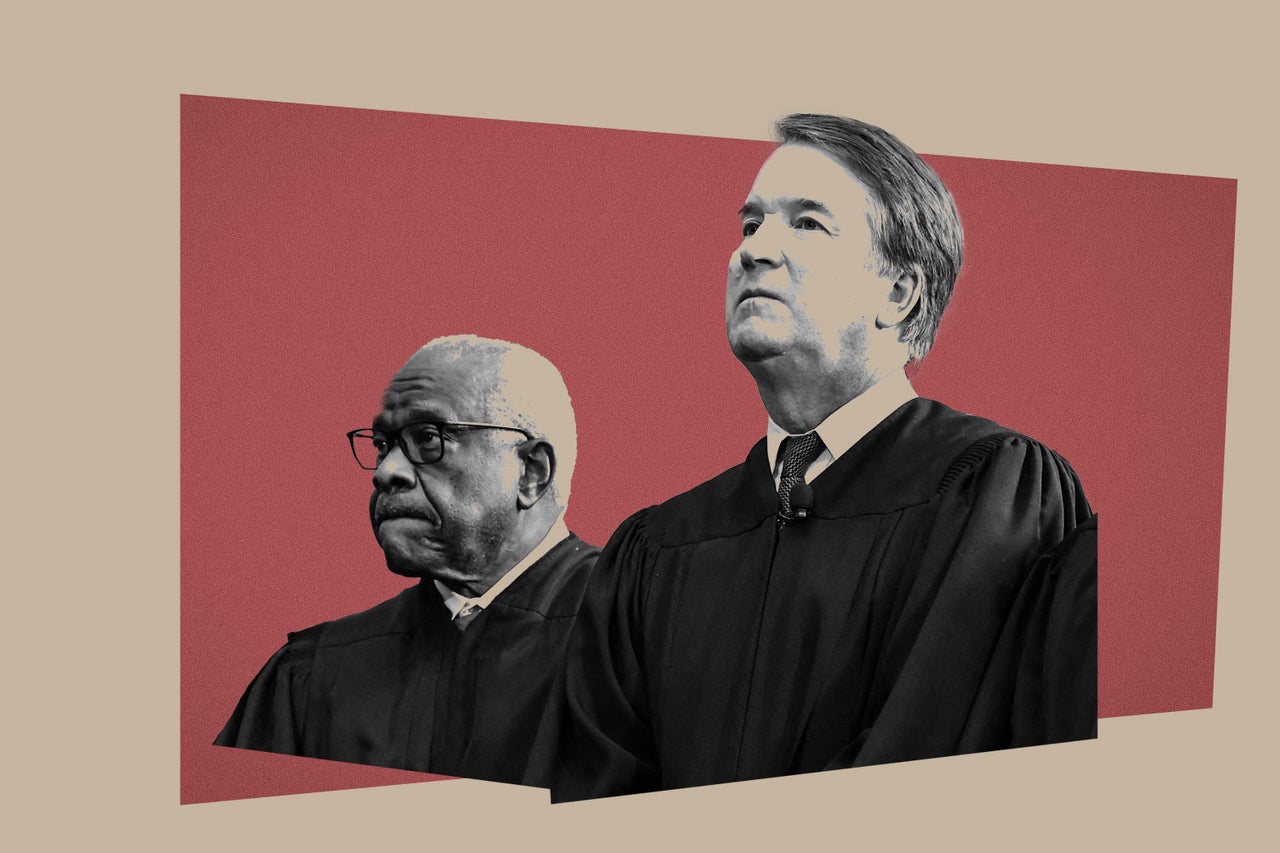 Thomas and Kavanaugh suggested that the long-standing interpretation of disability law is, in fact, unconstitutional. Photo illustration by Slate. Photo by Chip Somodevilla/Pool/AFP via Getty Images.
.
.
Click the link below for the complete article:
.
__________________________________________
 James' World 2
Leave a comment