
Click the link below the picture
.
We’ve never been so close to discovering life beyond Earth. Our generation could be the one that finds it, provided two essential ingredients exist. First, that there’s life out there. Second, that we’re willing to look.
Alien life’s existence is outside our control, but the universe seems to encourage our attention. Many people rest their optimism about alien life on the remarkable fact that our cosmos is brimming with planetary possibilities. To date, we’ve discovered nearly 6,000 exoplanets, most of them around only the nearest of the Milky Way’s hundreds of billions of stars. That means all our astonishingly successful planet-hunting surveys have studied just a mere teardrop of a vast cosmic sea—and implies there are at least as many planets as stars in our galaxy alone, plus some 1025 worlds in the rest of the observable universe. Chances are we’re not alone, so long as the probability that planets spring forth life is not astronomically miniscule.
Discovering alien life, on the other hand, rests squarely on us. For the first time in human history, we can meaningfully answer once-timeless questions. Countless generations before us could only ask, “Are we alone?” as passive stargazers. Today, our rockets reliably reach otherworldly destinations, our robotic emissaries yield transformative knowledge about our planetary neighbors, and our telescopes gaze ever farther into the heavens, revealing the subtle beauty of the cosmos.
NASA has led the way on this work, but it now faces an existential threat in the form of short-sighted budget cuts proposed by the White House. If passed into law by Congress, these cuts would axe critical space missions, gut NASA’s workforce, and abandon one of the most captivating quests in all of science. Additional sweeping cuts planned for the National Science Foundation would be similarly ruinous for ground-based astronomy and a host of other endeavors that support NASA’s work at the high frontier.
Led by NASA, for more than a half-century, the U.S. has been building toward a golden age of astrobiology, a field of research the space agency helped invent. The groundwork was laid on Mars, beginning with the Viking missions of the 1970s and continuing into today, where the agency has “followed the water” to dried-up lakebeds. In 2014, NASA’s Curiosity rover uncovered clues pointing to an ancient, life-friendly Mars, and more recently, NASA’s Perseverance rover has been caching promising rock samples for return to Earth. Researchers eagerly await their arrival, because if Mars ever did harbor life, then some of Perseverance’s specimens may well contain some sort of Martian fossils.
Besides our own familiar Earth, Mars isn’t the only promising incubator of life around the sun. In the outer solar system, NASA’s Galileo probe and Cassini orbiter lifted the icy veils of Jupiter’s moon Europa and Saturn’s moon Enceladus, respectively. Beneath thick shells of ice, both moons harbor global subsurface oceans, which could be teeming with bacterial or even macroscopic denizens. NASA’s Clipper spacecraft launched in 2024 and is hurtling toward Europa, where it will make close flybys of the moon to assess its habitability. The agency has developed concepts for follow-on missions to land on both worlds and taste the chilly chemistry there for the telltale signs of life.
Every organism on Earth requires liquid water, but perhaps that’s not a strict requirement elsewhere. Astrobiologists speculate about “weird life” in Venus’s sulfuric acid clouds and in the liquid hydrocarbon seas of Saturn’s frigid moon Titan. NASA plans to visit each of these worlds with state-of-the-art spacecraft—two to Venus and one to Titan—in the 2030s.
And then there’s the great expanse of exoplanets. NASA’s James Webb Space Telescope has furnished unprecedented data about exoplanet atmospheres, most of them hot and puffy—the easiest to observe. But the most alluring exoplanets for astrobiologists—those the size and temperature of Earth—are just beyond our sight. Currently, teams of scientists are conceptualizing NASA’s next great eye in space, the Habitable Worlds Observatory, whose mission is, as its name suggests, to image and examine dozens of notionally Earth-like planets for the global exhalations of alien biospheres.
.
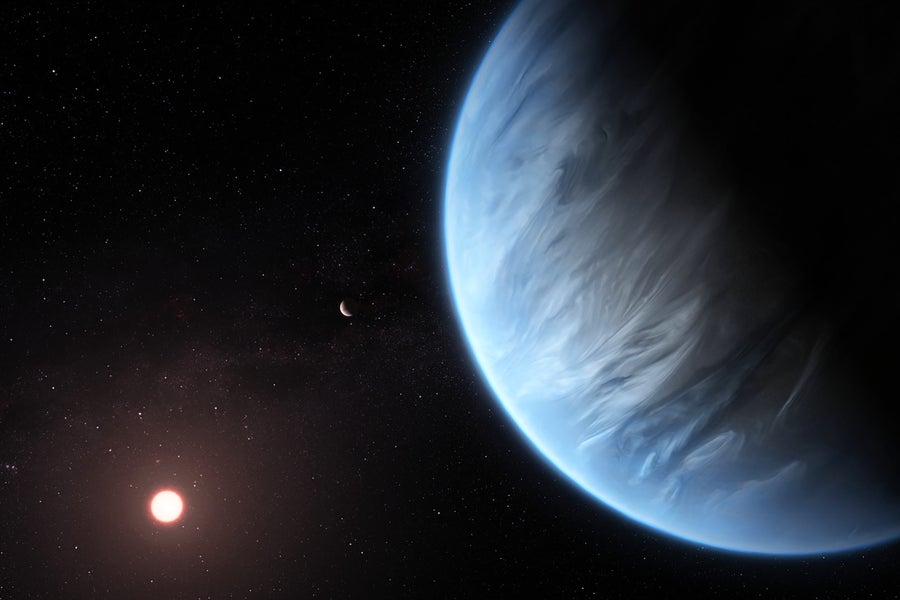
An artist’s illustration of a potentially habitable exoplanet orbiting a red dwarf star. NASA’s Goddard Space Flight Center
.
.
Click the link below for the complete article:
.
__________________________________________
 James' World 2
Leave a comment