
Click the link below the picture
.
Is it ever okay—or at least, understandable—for one child to bully another?
I spend a lot of time speaking to parent groups and students about bullying, and it’s common for parents to approach me after a talk with questions about their personal situation. A mother once asked for my thoughts about a situation in which her eight-year-old son had been accused of bullying another boy.
In my experience, parents often have a hard time believing that their child could ever engage in bullying; this mother clearly accepted that the behavior had happened, yet she just as clearly felt that there were extenuating circumstances. She pointed out that the target had the annoying habit of picking his nose, and this had bothered her son, who had lashed out.
She hedged; surely, she thought, there could be circumstances under which it’s acceptable for one child to bully another.
If your child is being accused of bullying another, it can be surprising and upsetting. Beyond those understandable emotions, as a parent, you have many options to help your child understand their behavior and why it was seen as bullying.
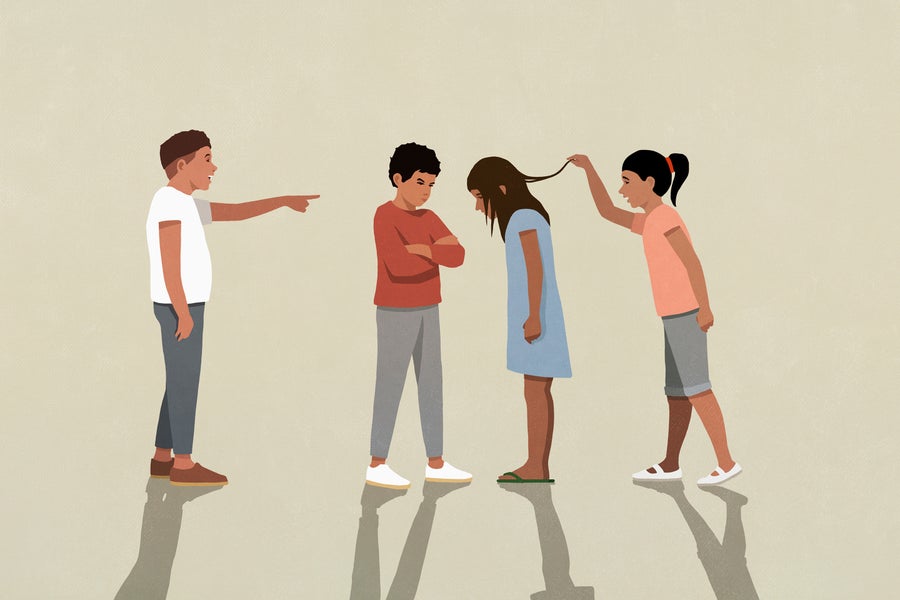
Let’s first define what it is we are talking about: bullying means that someone repeatedly and deliberately hurts a less powerful person. Bullying is a very unhealthy and potentially damaging behavior, for both the target and the bully. Research tells us that children who bully carry mental health consequences like depression and anxiety into adulthood. This is especially true for kids who are both bullies and victims.
I think most people would agree that bullying sometimes calls for punishment, and often calls for interventions, but is bullying ever a behavior that calls for understanding? If your child is being aggressive once (which doesn’t meet the definition of bullying), and in self-defense, that may indeed be excusable. On the other hand, if your child is bullying, that repeated torment is not excusable. I reminded the mother whose son bullied the nose-picking child that bullying is harmful to both individuals, so even when it happens because of a provocation, it shouldn’t be shrugged off.
What’s interesting is that generally, children don’t excuse bullying. In a study in which scientists interviewed elementary school children (both those involved and uninvolved in bullying) in Sweden to understand how kids view bullying, the students tended to think that bullies were either psychologically troubled, or alternatively, attention seekers—bullying to gain social status (in other words, that they wanted other children to see their power and admire it).
Kids who bully others, however, tend to have justifications for their behavior. In my study of more than 2,200 teens, about 62 percent of those who admitted bullying others offered one or more of the following explanations: “People didn’t try to understand my point of view,” or “I needed to show I wasn’t intimidated or afraid,” or “My behavior was taken way too seriously; I never meant it.”
It’s important to understand that kids can engage in bullying for a variety of reasons. Parents may think of bullying as a behavior reserved for only truly disturbed kids. The research, however, shows that some youth who bully are otherwise doing well socially, while others, who tend to be both bullies and targets, struggle more with making friends and being social. It can be difficult to believe that a child who does well in school and has friends could actually be a bully.
What should parents do when their children are accused of bullying? How should they handle their child’s protests that they were justifiably provoked? Should they believe their child and accept the reasons for the bullying? Should the response be punishment, intervention or understanding—or all three?
The word bullying tends to be overused, and is sometimes applied to any situation (repeated, deliberate or not) when someone hurts someone else. How you approach the situation may be completely different if the aggression in question only happened once, or between two children with relatively equal social and physical power, which likely would not be bullying.
If the power dynamic is unequal, and it appears to be a bullying situation, talk to everyone to determine the facts. Make it clear to everyone involved that you’re approaching this with an open mind. The school’s perspective is almost certain to be different from your child’s. It’s not hard to imagine a situation where a school counselor explains that your child has bullied another student, but your son or daughter claims they were just mad and not thinking. Bullying is a behavior that is planned out. It is not an impulsive, one-time response to someone else’s provocation. A target may have engaged in nose-picking, and that may have been genuinely irritating, but repeated aggression against them isn’t impulsive or thoughtless.
.
 Malte Mueller/Getty Images
.
.
Click the link below for the complete article:
.
__________________________________________
 James' World 2
Leave a comment