
Click the link below the picture
.
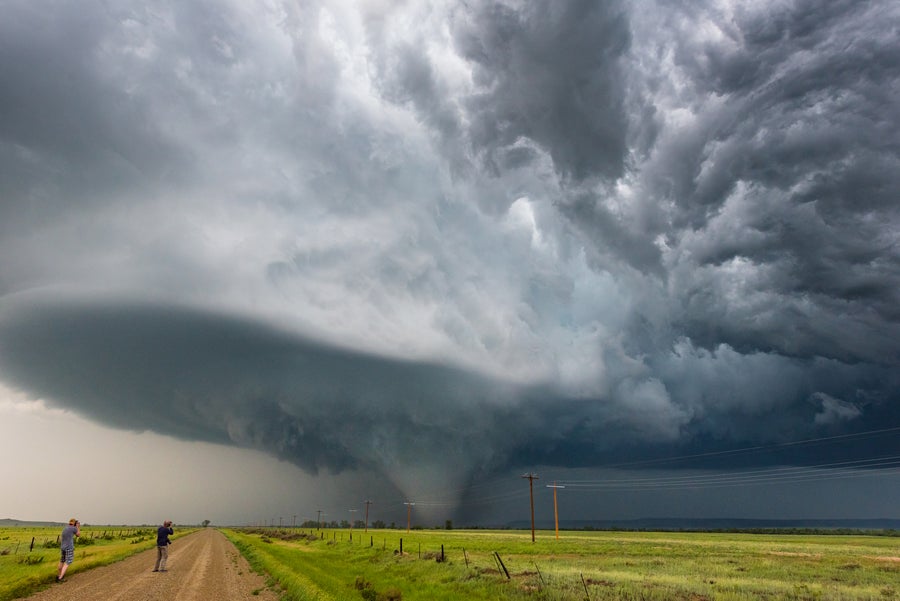
Tornadoes threaten huge swaths of the U.S. this weekend amid a season already marked by unusually high storm activity, even as the National Weather Service faces budget cuts likely to impede its ability to respond to severe weather.
What to Expect
The National Weather Service’s Storm Prediction Center has forecast severe thunderstorms with scattered tornadoes—some of them intense—across parts of Kentucky, Missouri, Illinois, Indiana, Tennessee, Arkansas, and Ohio for the afternoon and evening of May 16.
“Today we’re expecting a severe weather outbreak across the mid-Mississippi, Tennessee, and Ohio valleys,” says Jenni Pittman, a meteorologist and deputy chief of the Science and Technology Integration division at the National Weather Service’s Central Region Headquarters. These regions stretch farther east than the historically prevalent “Tornado Alley” of the mid- to late 1900s.
“Then we see a renewed chance for severe weather Sunday, continuing Monday and continuing Tuesday as well,” Pittman says. “A lot of the risks on Sunday through Tuesday are going to be from the High Plains pretty much through the Midwest.” National Weather Service maps show these risks concentrated in Kansas and Oklahoma.
This weekend’s predicted tornadoes would follow a slight lull in the region, she adds. “We’ve had a little bit of a break here in May, which is typically a pretty busy severe weather month,” Pittman says. “April was very active, and the rest of May does look pretty active as well.”
This Year in Tornadoes
As of May 15, the National Weather Service has tallied 779 tornadoes in its local storm reports—a preliminary number but a helpful metric for tracking the season’s severity. For comparison, between 2005 and 2015, that same tally averaged 624; between 2010 and 2024, it was 592.
“As of mid-May, the U.S. is running well above the typical number of tornadoes to this point in the year,” says Rich Thompson, chief of forecast operations for the Storm Prediction Center.
This year to date also stands out against individual years. The most active tornado season of recent years was 2011, when hundreds of storms struck in late April; by mid-May the tally stood at more than 1,300 storms, with more than 2,200 by the end of the year.
That year also demonstrated the close connection between just a few days of serious storms and a bad season. “Intense tornadoes are disproportionately responsible for damage, injuries, and deaths, and such tornadoes are more common on a few ‘outbreak’ days,” Thompson says. “Thus, the number of outbreak days often determines the severity of the season, with 2011 being the prime example of multiple high-impact tornado outbreaks.”
.
 Thomas Trott/Getty Images
.
.
Click the link below for the complete article:
.
__________________________________________
 James' World 2
Leave a comment