
Click the link below the picture
.
Recent breakthroughs suggest that hydrogen reservoirs are buried in countless regions of the world, including at least 30 U.S. states.
Finding such reservoirs could help accelerate a global energy transition, but until now, geologists only had a piecemeal understanding of how large hydrogen accumulations form — and where to find them.
“The game of the moment is to find where it has been released, accumulated, and preserved,” Chris Ballentine, a professor and chair of geochemistry at the University of Oxford and lead author of a new review article on hydrogen production in Earth’s crust, told Live Science in an email.
Ballentine’s new paper starts to answer those questions. According to the authors, Earth’s crust has produced enough hydrogen over the past 1 billion years to meet our current energy needs for 170,000 years. What’s still unclear is how much of that hydrogen could be accessed and profitably extracted.
In the new review, published Tuesday (May 13) in the journal Nature Reviews Earth and Environment, the researchers draw up an “ingredient” list of geological conditions that stimulate the creation and build-up of natural hydrogen gas belowground, which should make it easier to hunt for reservoirs.
“The specific conditions for hydrogen gas accumulation and production are what a number of exploration companies (e.g., Koloma, funded by a consortium led by Bill Gates’ Breakthrough Energy fund, Hy-Terra, funded by Fortescue, and Snowfox, funded by BP [British Petroleum] and RioTinto) are looking at carefully, and this will vary for different geological environments,” Ballentine said.
Natural hydrogen reservoirs require three key elements to form: a source of hydrogen, reservoir rocks, and natural seals that trap the gas underground. There are a dozen natural processes that can create hydrogen, the simplest being a chemical reaction that splits water into hydrogen and oxygen, and any type of rock that hosts at least one of these processes is a potential hydrogen source, Ballentine said.
“One place that is attracting a lot of interest is in Kansas, where a feature called the mid continental rift, formed about 1 billion years ago, created a huge accumulation of rocks (mainly basalts) that can react with water to form hydrogen,” he said. “The search is on here for geological structures that may have trapped and accumulated the hydrogen generated.”
Based on knowledge of how other gases are released from rocks underground, the review’s authors suggest that tectonic stress and high heat flow may release hydrogen deep inside Earth’s crust. “This helps to bring the hydrogen to the near surface where it might accumulate and form a commercial resource,” Ballentine said.
Within the crust, a wide range of common geological contexts could prove promising for exploration companies, the review found, ranging from ophiolite complexes to large igneous provinces and Archaean greenstone belts.
Ophiolites are chunks of Earth’s crust and upper mantle that once sat beneath the ocean, but were later thrust onto land. In 2024, researchers discovered a massive hydrogen reservoir within an ophiolite complex in Albania. Igneous rocks are those solidified from magma or lava, and Archaean greenstone belts are up to 4 billion-year-old formations that are characterized by green minerals, such as chlorite and actinolite.
.
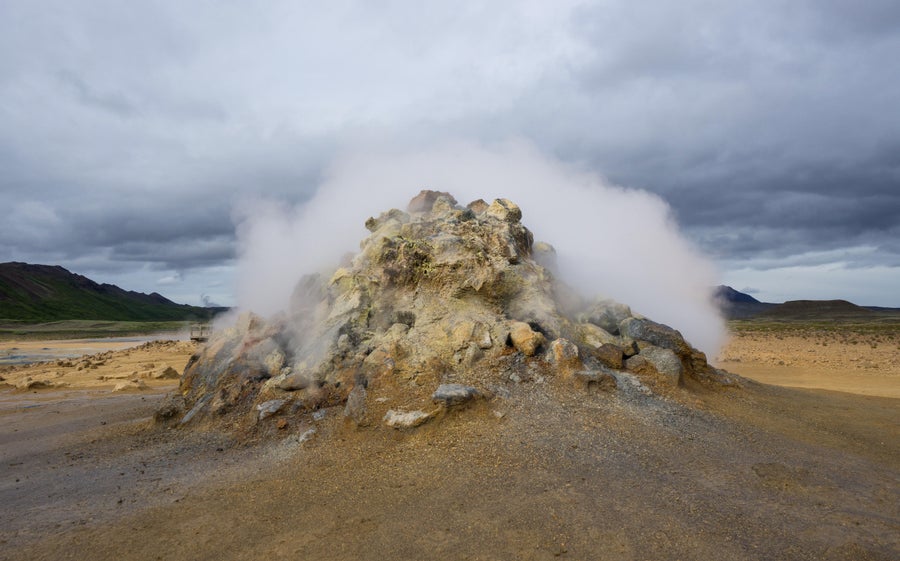
Finding reservoirs of hydrogen in Earth’s crust could help accelerate the energy transition away from fossil fuels. Simon Dux/Alamy Stock Photo
.
.
Click the link below for the complete article:
.
__________________________________________
 James' World 2
Leave a comment