
Click the link below the picture
.
Scientific research over the past 30 years has revealed a patchwork of potential causes of autism. Most of them are genetic—the condition is between 60 and 90 percent heritable—and some involve nongenetic risk factors that might impact development during pregnancy.
“We’ve found a great deal of the underlying [causes],” says Helen Tager-Flusberg, an autism researcher and a professor emerita at Boston University. But how these different risk factors come together as the brain develops remains a challenge to piece together. “Autism is not a simple disorder,” she says. “There are no simple answers. There are no so-called smoking guns.”
Even so, Robert F. Kennedy, Jr., the U.S. secretary of health and human services, talks about autism in a way that suggests he thinks there are simple and direct causes. He often refers to the steady rise in autism prevalence (which is likely due to improved screening and diagnosis) as an indicator that
we’re in the middle of an “autism epidemic” driven by “environmental toxins.” He has also refused to disavow the long-debunked idea that vaccines cause autism. This month, as part of Kennedy’s effort to find “the root causes of autism,” the National Institutes of Health and the Centers for Medicare & Medicaid Services announced that they will create a “data platform” to study the condition. In April, NIH Director Jay Bhattacharya had described plans for “national disease registries, including a new one for autism.” The plan involved collecting “comprehensive” private health data on autism that would represent “broad coverage” of the U.S. population, leading autism advocacy organizations, civil rights groups, and research scientists to warn of medical privacy concerns. (Shortly after outlets reported on Bhattacharya’s statements in April, HHS denied that it planned to create an “autism registry.”)
In a budget hearing on Wednesday, Kennedy called for an end to genetic research into autism. “I don’t think we should be funding that genetic work anymore,” he said. “What we really need to do now is to identify the environmental toxins.”
In response to this dismissal of well-established science, Tager-Flusberg has organized a coalition of scientists to push back. The Coalition of Autism Scientists now has 258 members and is still growing.
Scientific American spoke with Tager-Flusberg about Kennedy’s statements this week and how the autism community is responding.
In a Congressional budget hearing Wednesday afternoon, Robert F. Kennedy, Jr., said: “Autism is an epidemic, and the genes do not cause epidemics. They can contribute a vulnerability, but you need an environmental toxin. It’s like cigarettes and smoking.” What was your reaction to that?
There is no reason that we need to refer to the increased prevalence rates, which have been rising steadily for many years now, as an epidemic. This is not the definition of an epidemic, so I take issue with highlighting that.
Second of all, genetics are the primary contributing factor to autism. We know specific genes and variants confer increased risk, even in cases where there aren’t any clear environmental contributions. If anything, it’s the other way around—it’s the environmental factors that add to or interact with the genetic risk for autism.
Take one of the very well-regulated nongenetic factors: parental age, particularly paternal age. What we think is going on is that, as parents age, their germ cells [which develop into eggs or sperm] are changing, and so this is leading to alterations in the DNA that then confer risk for autism.
.
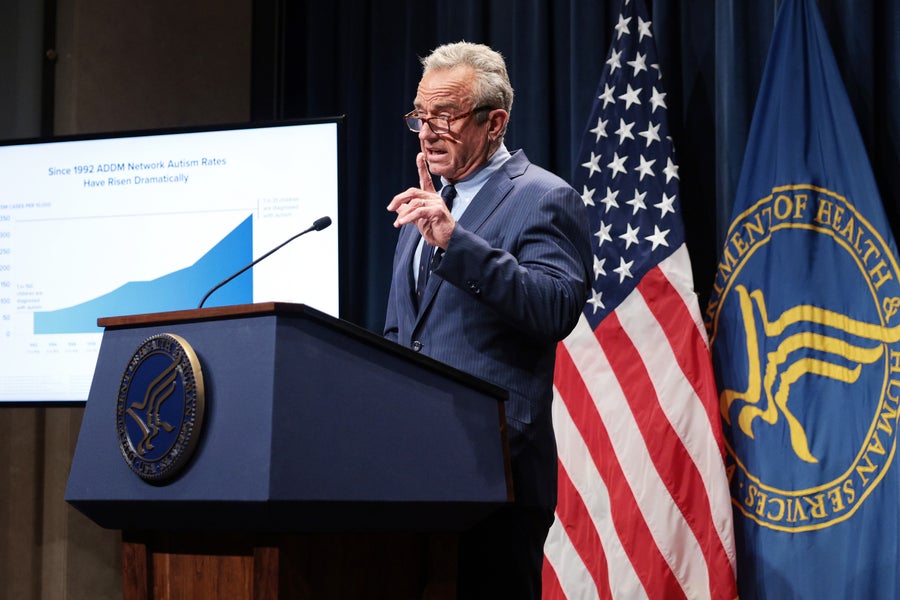
Secretary of Health and Human Services Robert F. Kennedy Jr. speaks during a news conference at the Department of Health and Human Services on April 16, 2025, in Washington, DC. Alex Wong/Getty Images
.
.
Click the link below for the complete article:
.
__________________________________________
 James' World 2
Leave a comment