
Click the link below the picture
.
A bomb from a black hole would probably be the most destructive weapon in the universe. Hypothetically, it could be created by wrapping one of these cosmic monsters in mirrors and waiting for it to go “boom.” Now Hendrik Ulbricht of the University of Southampton in England and his colleagues have demonstrated this principle, called superradiance, in the lab using a rotating metal cylinder instead of a black hole. They submitted their results, which have not yet been peer-reviewed, to the preprint server arXiv.org in late March.
“This work shows that a ‘black hole bomb’ can actually be built in the laboratory,” says physicist Vitor Cardoso of the Niels Bohr Institute in Denmark, who was not involved in the study. “It thus provides a solid basis for studying the entire physics of black holes.”
Among the strangest objects in the universe, black holes pack so much mass into such a small space that they can radically warp spacetime. A black hole’s gravitational pull is so strong that within a certain distance, nothing can escape it, not even light. Theorist Roger Penrose is one of the pioneers who first studied black holes mathematically in detail, work for which he shared the Nobel Prize in Physics in 2020. And amid that early work, he realized something surprising.
As Penrose knew, nothing stands still in our cosmos, not even black holes. These massive monsters can spin, distorting spacetime in the process to form a kind of vortex. An approaching object can be caught up in this vortex and spiral around the spinning black hole. Even before the object passes the event horizon, beyond which not even light can escape gravity’s clutches, it reaches an area that physicists call the “ergosphere.” There, the object would have to move faster than light to escape the rotation around the black hole.
This ergosphere is a strange place, as Penrose noted, because objects there can possess negative energy. A particle, for example, could split into two equal-but-opposite parts: one with negative energy and another with positive energy. The former would then crash into the black hole (thus reducing the black hole’s energy), allowing the latter to escape the cosmic behemoth’s mighty grip. An external observer would see a particle with a certain energy falling toward the black hole, only to apparently rebound outward with higher energy. The black hole loses part of its rotational energy in the process.
Black Hole Mining and Superradiance
In principle, this would allow black holes to serve as gigantic sources of energy. The process could not only imbue massive objects with more energy but also amplify electromagnetic waves in a phenomenon called superradiance. This realization spurred some physicists to even imagine how advanced alien civilizations might use superradiance to generate energy. But despite how relatively simple it is to describe on paper, no one knew how the signal of superradiance could be observed in real black holes. Thus, the concept initially remained mere speculation.
This ergosphere is a strange place, as Penrose noted, because objects there can possess negative energy. A particle, for example, could split into two equal-but-opposite parts: one with negative energy and another with positive energy. The former would then crash into the black hole (thus reducing the black hole’s energy), allowing the latter to escape the cosmic behemoth’s mighty grip. An external observer would see a particle with a certain energy falling toward the black hole, only to apparently rebound outward with higher energy. The black hole loses part of its rotational energy in the process.
Black Hole Mining and Superradiance
In principle, this would allow black holes to serve as gigantic sources of energy. The process could not only imbue massive objects with more energy but also amplify electromagnetic waves in a phenomenon called superradiance. This realization spurred some physicists to even imagine how advanced alien civilizations might use superradiance to generate energy. But despite how relatively simple it is to describe on paper, no one knew how the signal of superradiance could be observed in real black holes. Thus, the concept initially remained mere speculation.
In 1971, however, two years after Penrose first described this phenomenon, physicist Yakov Zel’dovich published research that suggested that black holes aren’t the only objects that can be tapped as superradiant energy sources. Any rotating, axially symmetrical body that absorbs electromagnetic radiation, such as a metal cylinder, can also exhibit superradiance under certain circumstances. “Roughly speaking, the rotating absorber must rotate faster
than the phase rotation of the incident radiation,” explains physicist Maria Chiara Braidotti of the University of Glasgow in Scotland, who was involved in the latest work. “If this condition is met, the absorption coefficient of the cylinder changes sign, thus amplifying the radiation.”
Zel’dovich even went one step further by showing that superradiance could also take place in a vacuum and wouldn’t require an incoming electromagnetic wave. That’s because on quantum scales, the vacuum is anything but empty. At any time, pairs of virtual particles and antiparticles can pop into existence, although they typically immediately annihilate each other again. The phenomenon is known as vacuum fluctuation. And these fluctuations could also be amplified in the vicinity of black holes, or a rotating metal cylinder. “Stephen Hawking didn’t believe this idea and tried to refute it,” explains Marion Cromb, a researcher in Ulbricht’s group at the University of Southampton and a contributor to the new work. “Not only did [Hawking] admit that Zel’dovich was right, but he was also able to prove that even nonrotating black holes—without an ergosphere—spontaneously emit radiation.” This realization led to the discovery of Hawking radiation.
.
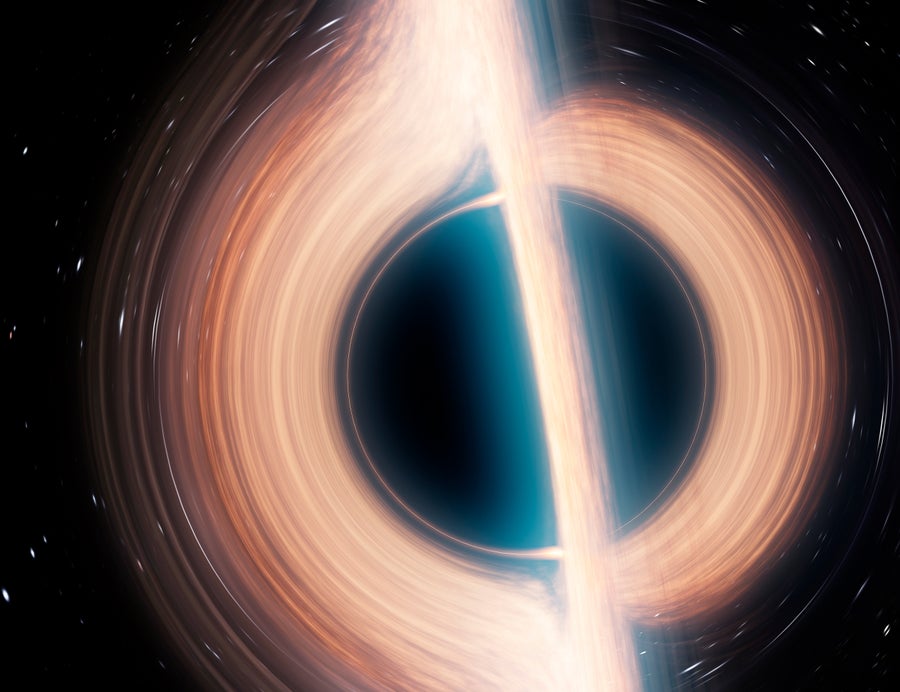
An artist’s rendition of a black hole surrounded by a glowing accretion disc of material, the light from which is warped by the strong gravity. In principle, energy could be harvested from a spinning black hole, and lab-based demonstrations are beginning to show physicists how this could occur. Mark Garlick/Science Photo Library/Getty Images
.
.
Click the link below for the complete article:
.
__________________________________________
 James' World 2
Leave a comment