
Click the link below the picture
.
Every week, millions of Americans toss their recyclables into a single bin, trusting that their plastic bottles, aluminum cans, and cardboard boxes will be given a new life.
But what really happens after the truck picks them up?
Single-stream recycling makes participating in recycling easy, but behind the scenes, complex sorting systems and contamination mean a large percentage of that material never gets a second life. Reports in recent years have found 15% to 25% of all the materials picked up from recycle bins ends up in landfills instead.
Plastics are among the biggest challenges. Only about 9% of the plastic generated in the U.S. actually gets recycled, according to the Environmental Protection Agency. Some plastic is incinerated to produce energy, but most of the rest ends up in landfills instead.
So, what makes plastic recycling so difficult? As an engineer whose work focuses on reprocessing plastics, I have been exploring potential solutions.
How does single-stream recycling work?
In cities that use single-stream recycling, consumers put all of their recyclable materials − paper, cardboard, plastic, glass, and metal − into a single bin. Once collected, the mixed recyclables are taken to a materials recovery facility, where they are sorted.
First, the mixed recyclables are shredded and crushed into smaller fragments, enabling more effective separation. The mixed fragments pass over rotating screens that remove cardboard and paper, allowing heavier materials, including plastics, metal,s and glass, to continue along the sorting line.
Magnets are used to pick out ferrous metals, such as steel. A magnetic field that produces an electrical current with eddies sends nonferrous metals, such as aluminum, into a separate stream, leaving behind plastics and glass.
The glass fragments are removed from the remaining mix using gravity or vibrating screens.
That leaves plastics as the primary remaining material.
While single-stream recycling is convenient, it has downsides. Contamination, such as food residue, plastic bags and items that can’t be recycled, can degrade the quality of the remaining material, making it more difficult to reuse. That lowers its value.
Having to remove that contamination raises processing costs and can force recovery centers to reject entire batches.
Which plastics typically can’t be recycled?
Each recycling program has rules for which items it will and won’t take. You can check which items can and cannot be recycled for your specific program on your municipal page. Often, that means checking the recycling code stamped on the plastic next to the recycling icon.
These are the toughest plastics to recycle and most likely to be excluded in your local recycling program:
- Symbol 3 – Polyvinyl chloride, or PVC, found in pipes, shower curtains, and some food packaging. It may contain harmful additives such as phthalates and heavy metals. PVC also degrades easily, and melting can release toxic fumes during recycling, contaminating other materials and making it unsafe to process in standard recycling facilities.
- Symbol 4 – Low-density polyethylene, or LDPE, is often used in plastic bags and shrink-wrap. Because it’s flexible and lightweight, it’s prone to getting tangled in sorting machinery at recycling plants.
- Symbol 6 – Polystyrene, often used in foam cups, takeout containers, and packing peanuts. Because it’s lightweight and brittle, it’s difficult to collect and process and easily contaminates recycling streams.
Which plastics to include
That leaves three plastics that can be recycled in many facilities:
- Symbol 1 – Polyethylene terephthalate, or PET, widely used in soda bottles.
- Symbol 2 – High-density polyethylene, or HDPE, commonly used in milk jugs and laundry detergent bottles.
- Symbol 5 – Polypropylene, PP, used in products such as pill bottles, yogurt cups and plastic utensils.
.
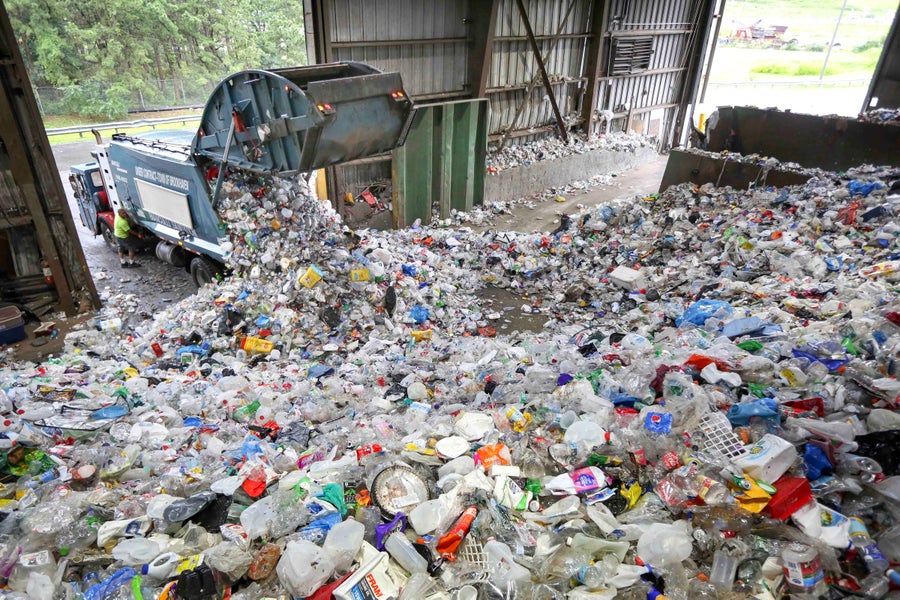
A truck dumps its contents of recyclable items on the tipping floor at the Town of Brookhaven Material Recycling Facility in Yaphank, N.Y. John Paraskevas/Newsday RM via Getty Images
.
.
Click the link below for the complete article:
.
__________________________________________
 James' World 2
Leave a comment