
Click the link below the picture
.
Thirty-five years ago today, a revolutionary new era of astronomy began when the Hubble Space Telescope, tucked onboard the space shuttle Discovery, blasted off Earth into history. The next day, a robotic arm tipped the telescope into orbit from the shuttle’s cargo bay. Within a month, Hubble had truly begun its mission, gazing out at the cosmos for NASA and the European Space Agency with its 2.4-meter-wide starlight-gathering mirror—the largest ever launched to space at the time.
In the years since, Hubble has gathered more than 1.6 million observations and 430 terabytes of data. The telescope has revealed that supermassive black holes nestle at the heart of most large galaxies, Jupiter’s icy moon Europa may be shooting plumes of water out into space, and, in the distant future, our Milky Way galaxy will likely collide with our neighbor, Andromeda.
But the mission almost flopped.
The Hubble Space Telescope was decades in the works, even making a cameo appearance in a Superman comic in 1972, before it reached space in 1990. But after Hubble’s deployment, as the telescope began operations, astronomers realized its vision was blurry and traced the issue to a tiny imperfection in the telescope’s mirror.
Astoundingly, that mirror is still in use today aboard the observatory. Fortunately, Hubble was uniquely designed to be serviced in orbit by astronauts. NASA’s first (and most urgent) servicing mission flew in December 1993; during five separate spacewalks, astronauts installed a new primary camera able to counteract Hubble’s blurred vision, as well a bulky new apparatus that corrected the light that fed into the observatory’s original suite of instruments.
Additional shuttle missions in 1997, 1999, 2002, and 2009 also visited the observatory, extending its lifetime and expanding its view each time with new hardware and better instruments.
The results have been nothing short of breathtaking. Hubble’s position well above most of Earth’s atmosphere allows it to see the cosmos unhindered by the tempests and turbulence that all ground-based observatories face. That privileged vantage point has profoundly shaped our understanding of the solar system and universe around us.
In our own neighborhood, Hubble has studied the changing weather on the outer planets, discovered moons orbiting Pluto, and watched the once-in-a-lifetime impact of Comet Shoemaker-Levy 9 on Jupiter scar the giant planet with dark spots as big as Earth. It has even glimpsed the sun, in a feat it was most definitely not designed to attempt.
.
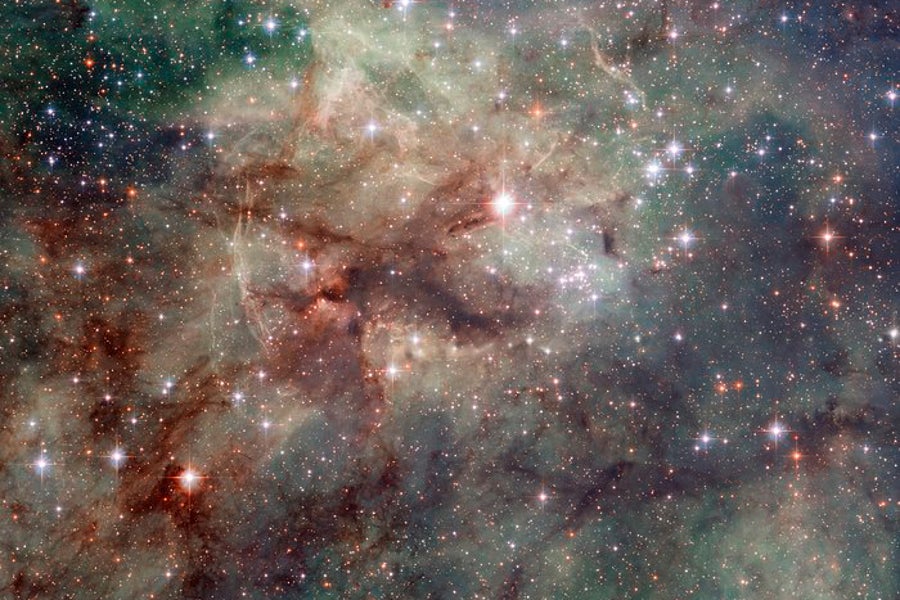
The Tarantula Nebula, located about 161,000 light-years away in the Large Magellanic Cloud bordering our Milky Way, is packed with ionized hydrogen gas dotted by supernova remnants. NASA/ESA (CC BY 4.0)
.
.
Click the link below for the complete article and more photographs:
.
__________________________________________
 James' World 2
Leave a comment