
Click the link below the picture
.
CLIMATEWIRE | Climate-warming carbon dioxide concentrations in the atmosphere grew at a record-breaking speed in 2024, surging by 3.7 parts per million, a recent NOAA data analysis has found.
It’s one of the agency’s biggest scientific findings of the year — yet the research largely has flown under the radar after NOAA officials took steps to minimize the announcement.
Instead of publishing a press release or a featured article online, the agency described the findings only in social media posts on Facebook and on X. And the posts failed to highlight the dataset’s most important finding: that last year’s CO₂ concentrations jumped by an unprecedented amount.
That’s a departure from the agency’s historical approach to public communication. NOAA typically releases a public report each spring, prominently featured on its website, describing the previous year’s greenhouse gas concentrations. It also usually sends a press release to members of the media.
Last year’s report, for instance, noted that carbon dioxide, methane and nitrous oxide concentrations all continued to climb in the atmosphere in 2023.
According to a source with knowledge of the 2024 analysis, NOAA staff prepared a public web story this year as usual. But officials nixed the report at the last minute, instead releasing the findings only on social media. The source was granted anonymity because they feared reprisal from the Trump administration.
A NOAA communications officer did not respond to a request for comment.
The move is part of a broader assault on NOAA science and public communications by the new administration.
Last month, the agency confirmed it was ending its regular monthly climate briefings, in which NOAA scientists presented climate and weather data to the media. That’s on top of widespread layoffs this year at the agency. And a recent proposal from the White House Office of Management and Budget would dramatically reorganize the agency and terminate much of its climate work — eliminating its entire Office of Oceanic and Atmospheric Research.
A NOAA official suggested that downplaying the new CO₂ data has dampened media attention on what otherwise would have been a major climate headline. The scientific findings were reported earlier this month by The Washington Post, and the suppressed web story was reported by CNN earlier this week. There’s otherwise been little news reported on the subject.
But scientists say it’s a finding that’s worth more attention — and more worry. Some researchers believe last year’s CO₂ spike is evidence that the Earth system itself is becoming more vulnerable to the impacts of rising temperatures.
Natural landscapes, such as forests and wetlands, historically have acted as a carbon sink — soaking up excess CO₂ emissions and helping to offset some of the impacts of climate change. But some of these ecosystems may be breaking down under the stress of continued warming, with the added side effects of droughts and wildfires. And they’re storing less carbon in the process.
.
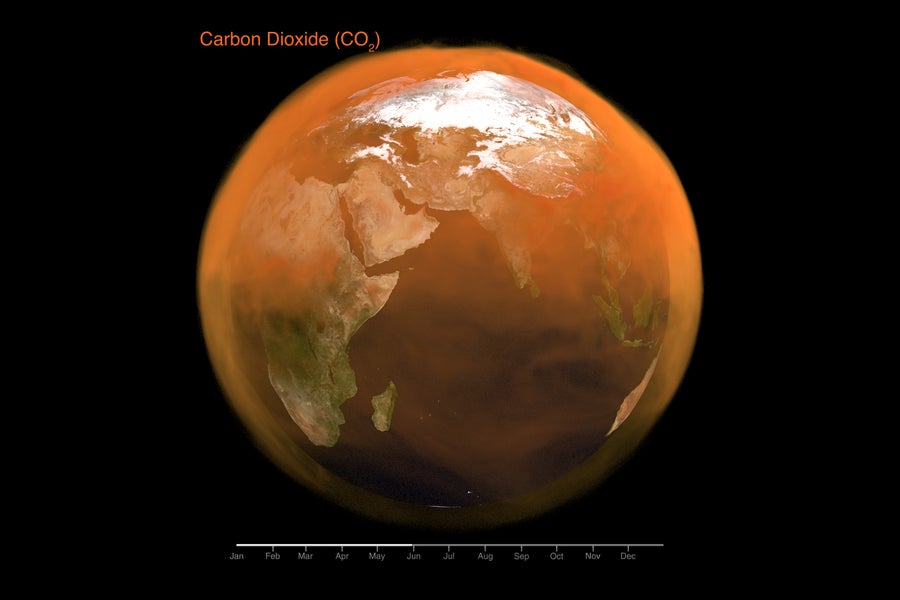
Volumetric visualization of the total carbon dioxide (CO₂) on a global scale added on Earth’s atmosphere over the course of the year 2021. NASA’s Scientific Visualization Studio
.
.
Click the link below for the complete article:
.
__________________________________________
 James' World 2
Leave a comment