
Click the link below the picture
.
Preliminary copies of some of the US government’s spending plans suggest that President Donald Trump’s administration intends to slash climate and space science across some US agencies.
At risk is research that would develop next-generation climate models, track the planet’s changing oceans and explore the Solar System. NASA’s science budget for the fiscal year 2026 would be cut nearly in half, to US$3.9 billion. The US National Oceanic and Atmospheric Administration (NOAA), which monitors Earth’s climate and makes weather forecasts, would have its 2026 budget cut by 27%, to $4.5 billion. The leaked documents containing this information were sent by the White House to federal agencies last week; they were reported by other media outlets and obtained by Nature.
Although the proposed cuts aren’t final, they have alarmed scientists and science advocates alike. “We’re talking about a wholesale dismantling of NASA’s scientific fleet and the pipeline of future missions,” says Casey Dreier, chief of space policy for the Planetary Society, a non-profit space organization in Pasadena, California. “Trump’s budget plan for NOAA is both outrageous and dangerous,” says a statement released by Zoe Lofgren, a member of the US House of Representatives from California, who is the ranking Democrat on the House Committee on Science, Space, and Technology. “This budget will leave NOAA hollowed out.”
“No final funding decisions have been made,” says Alexandra McCandless, a spokesperson for the US Office of Management and Budget. The proposed cuts come as Trump’s team has tried to downsize the US government markedly, firing federal workers en masse and axing programmes, purportedly in the name of government efficiency.
Here, Nature looks at some of the programmes and projects that, according to the documents, are on the chopping block.
Crucial climate science
NOAA’s Office of Oceanic and Atmospheric Research (OAR), which funds numerous scientific endeavours, including climate modelling, cloud monitoring and hurricane forecasting, would be slashed by 74%, to $171 million. OAR is the agency’s main research arm, with 11 laboratories and 16 cooperative institutes that collaborate with scientists at various universities; the budget proposal would defund any of them that work on climate, weather or the ocean. The draft budget also appears to terminate funding for “Regional Climate Data and Information”, a $50 million programme to help communities with climate science, such as tracking droughts and heat waves. In total, the cuts would eliminate OAR as an independent office and disperse its remaining activities to other parts of NOAA. For many scientists, it’s a sign that the Trump administration is planning to turn its back on research that is needed to help understand long-term climate and environmental effects. “This is a huge threat to research at NOAA, but also to the safety and economic security of the American public,” says Craig McLean, a former assistant administrator for research at NOAA.
A next-generation space telescope
The Hubble and James Webb space telescopes, iconic for their views of the cosmos, won’t last forever. And now, their successor could be in trouble. The $4.3-billion Nancy Grace Roman Space Telescope is nearing completion at NASA’s Goddard Space Flight Center in Greenbelt, Maryland, but Trump’s preliminary proposal would cancel all funding for it, as well as for many other Goddard projects. During his first term as president in 2017–21, Trump, a Republican, tried repeatedly to eliminate funding for the Roman telescope, but was blocked by the US Congress in each case. The same could happen this time: “I will fight tooth and nail against these cuts,” said Chris Van Hollen, a Democratic senator from Maryland, whose district includes the Goddard centre and who is the ranking member of the congressional spending committee that oversees NASA.
Earth-observing satellites
Trump’s proposals would cancel next-generation Earth-observing satellites at both NASA and NOAA. At NASA, the Earth-science budget would be cut in half, to just over $1 billion; that would almost certainly derail efforts to launch a fleet of new satellites to monitor factors crucial to weather and climate forecasting, including aerosols, clouds and sea-level rise. At NOAA, preliminary plans call for the cancellation of a programme to build and launch new weather satellites in geostationary orbits, which is a backbone of US weather-forecasting efforts. Trump would also remove climate instruments on future weather satellites, and end the long-standing agreement through which NASA launches NOAA’s weather satellites.
.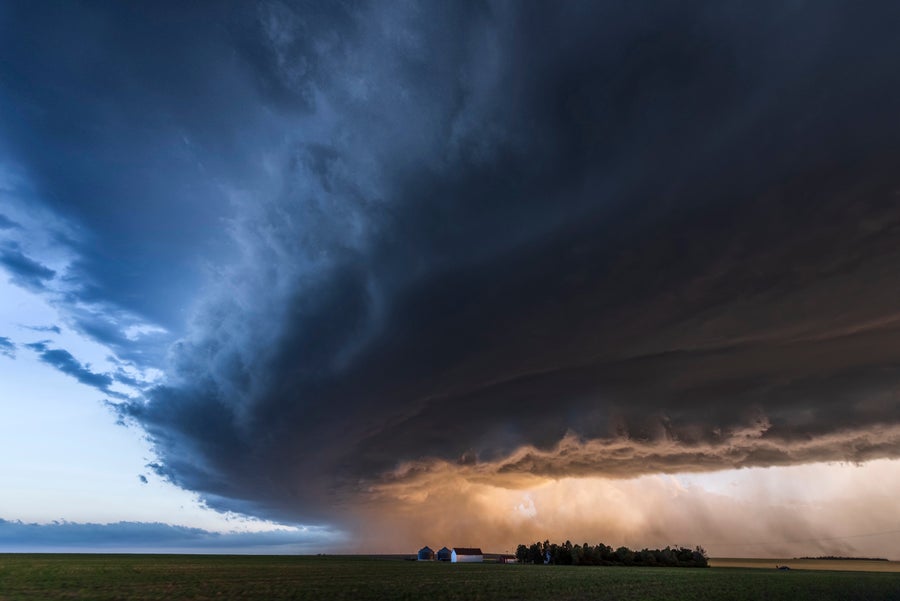
Severe mothership shaped thunderstorm races across Kansas, USA. john finney photography/Getty Images
.
.
Click the link below for the complete article:
.
__________________________________________
 James' World 2
Leave a comment