
Click the link below the picture
.
Today mathematician Alan Turing is world-famous because he helped the Allies achieve victory against the Axis powers by deciphering an encryption that was considered unbreakable. That story inspired the 2014 film The Imitation Game. Turing’s cryptographic work remained under wraps until the 1970s, however, so his incredible achievements only became known after his death.During his lifetime, Turing was known among certain experts. He developed the mathematical model of a computer and explained which mathematical
quantities it could calculate—and which tasks would exceed even the most sophisticated algorithms. He is also well known for a test that he developed, later named after him, that assesses how “human” artificial intelligence appears to be. For instance, if people cannot tell whether they are chatting to a real person or an AI, then the machine has passed the Turing test.
The list of Turing’s scientific contributions is long. But one area of his research is rarely mentioned: his work on mathematical biology that dealt with the formation of patterns. He was interested in the question of how animals develop their impressive stripes and spots, and he was convinced that there must be a mechanism by which pigments in skin cells arrange themselves into these patterns.
How Does the Tiger Get Its Stripes?
When I first heard about this, I was puzzled. One of my physics professors mentioned a link between abstract mathematical operators and a tiger’s stripes in a first-semester lecture, a connection that made me and my fellow students laugh rather than think. After all, what could the pattern of a tiger’s skin have to do with abstract mathematics? Until then, I had assumed that some complex biochemical processes led to the tiger’s impressive patterns of dots and stripes—not something that could be represented by a tensor (a kind of high-dimensional table).
I now realize that I lacked Turing’s imagination. According to his mother, even as a child, he was a dreamer who marveled at the natural world around him. He wanted to understand his surroundings. Mathematics lent itself as a language to reduce even the most complex relationships to the essentials. And so Turing found a very simple mechanism that could explain nature’s patterns.
To understand Turing’s ideas, you first need a little biological background. A tiger’s coat pattern is already determined before it is born. In the embryo, pigment-producing cells emerge at the point where the spinal column will later develop. From there, they migrate through the entire body. Although research into these cells was lacking in Turing’s time, he recognized that there was a developmental process that formed skin patterns, and he wanted to find out how this occurred.
It was impossible to model all the interacting molecules of an animal embryo. Moreover, Turing was not an expert in biochemistry. Therefore, as is usual for mathematicians, he started with a very simple model. He investigated how two different pigment-producing molecules, which he generally called morphogens, spread from cell to cell.
A Story of Two Morphogens
Let’s assume that one morphogen is responsible for the color black and another for orange. The more black or orange morphogens there are, the more of these molecules are generally produced. In addition, these two substances influence each other: the orange morphogens can inhibit the production of the black ones.
.
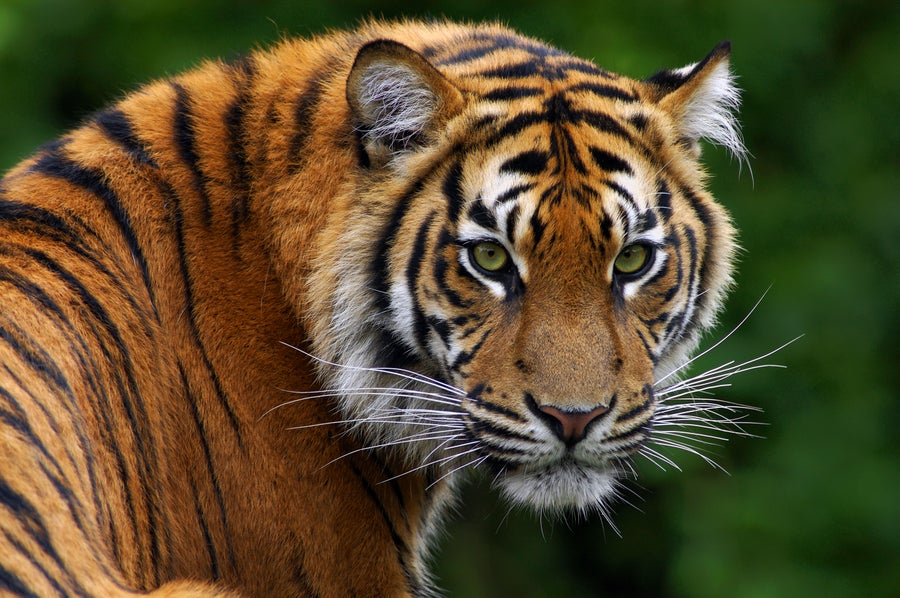
Sumatran tiger (Panthera tigris sumatrae). Juniors Bildarchiv GmbH/Alamy Stock Photo
.
.
Click the link below for the complete article:
.
__________________________________________
 James' World 2
Leave a comment