
Click the link below the picture
.
In hindsight, I am still not sure why the operators of the Danish-flagged MV Coco allowed me onboard. By the time I arrived last June, the vessel had been sailing for several weeks in the Bismarck Sea, a part of Papua New Guinea’s territorial waters, digging chunks of metal-rich deposits out of the ocean floor with a 12-ton hydraulic claw. The crew was testing the feasibility of mining seafloor deposits full of copper and some gold. It was probably the closest thing in the world to an operational deep-sea mining site. And the more I learned about the endeavor, the more surprised I became about the project’s very existence.
On that summer morning, I arrived on a red catamaran after rolling over six-foot swells in the South Pacific for two hours, and I clambered up a metal ladder hanging down on the Coco’s starboard side. The 270-foot, 4,000-ton vessel towers at its prow, its vast aft deck full of cranes, winches, and a remotely operated submersible. I was there at the invitation of Richard Parkinson, who founded Magellan, a company that specializes in deep-sea operations. At the top of the ladder, two crew members hauled me onboard the ship, which was roughly 20 miles from the closest shore, and a British manager for Magellan named James Holt greeted me, his smile sun-creased from more than two decades at sea. After a safety briefing, he ushered me through a heavy door into a dark, windowless shipping container on the rear deck that served as a control room.
Inside the hushed cabin was a young Brazilian named Afhonso Perseguin, his face lit by screens displaying digital readings and colorful topographic charts. Gripping a joystick with his right hand, he delicately maneuvered a big, boxy remotely operated vehicle, or ROV, over a patch of seafloor a mile below. I watched on monitors as a robotic arm protruded from the ROV toward a monstrous set of clamshell jaws suspended from a cable that rose all the way up to the ship. Perseguin used the ROV’s arm to steer the jaws as a colleague beside him radioed instructions to a winch operator on deck.
Hydraulics drove the open clamshell into a gray chunk of flat seafloor ringed by rocky mounds and jagged slopes. The opposing teeth dug in, throwing up clouds of silt that filled the video feeds from the ROV. The robotic arm released, and the winch started hauling the jaws, clamped shut around their rocky cargo, on an hour-long journey up to the ship.
Within minutes, Perseguin reversed the ROV to survey the wider scene, revealing chimneys of rock looming up from the seafloor, pale yellow and gray in the submersible’s powerful lights. Small mollusk shells dotted their surface; a crab scuttled out of frame. “Quite amazing, really, isn’t it?” murmured John Matheson, a shaven-headed Scot supervising the ROV team. As Perseguin steered the ROV slowly around a column, the cameras suddenly captured a glassy plume of unmistakably warmer water spewing up from a hidden crevice.
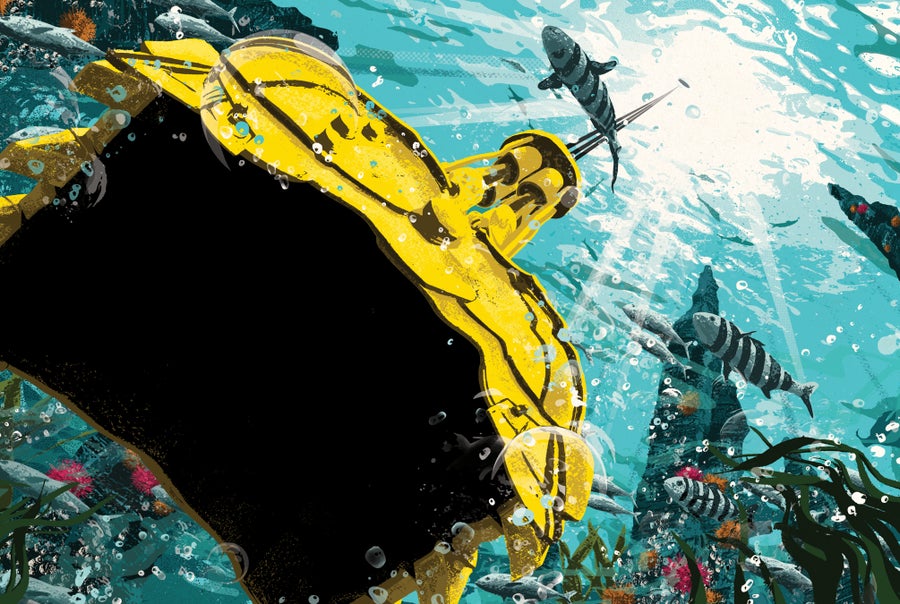
Hydraulics drove the monstrous clamshell jaws into a gray chunk of seafloor, throwing up clouds of silt that filled the video feeds from the remotely operated vehicle.
That hydrothermal vent marked the edge of a tectonic plate in the Bismarck Sea. The metal-rich magma ejected over millennia from several such vents—some dormant, some still active like this one—was Magellan’s prize. The teams on the ship, hired by a company called Deep Sea Mining Finance (DSMF), were conducting bulk seafloor mining tests under a 2011 mining license issued by the Papua New Guinea (PNG) mining regulator. I was the only reporter onboard to witness the operation.
Worldwide, oceanographers have found three distinct types of mineral deposits on the deep seafloor. Manganese crust is an inches-thick, metal-rich pavement that builds up over millions of years as dissolved metallic compounds in seawater gradually precipitate on certain seafloor regions. Polymetallic nodules are softball-size, metal-rich rocks strewn across enormous seafloor fields. And massive sulfide deposits, such as the ones being mined by the crew of the Coco, are big mounds and stacks of rock formed around hydrothermal vents. Over the past decade, several companies have developed detailed but still hypothetical plans to profit from these deposits, hoping to help meet the world’s surging demand for the valuable metals necessary for batteries, electric cars, electronics, and many other products. Scientists have warned that these efforts risk destroying unique deep-sea habitats that we do not yet fully understand, and governments have been reluctant to grant exploration licenses in their territorial waters. But from what I saw during my two days and one night onboard the Coco, DSMF was digging in, and a new era of deep-sea mining had all but begun.
Holt, one of Magellan’s offshore managers, said the aim was to test the physical requirements and environmental impacts of pulling up sulfide deposits. What would soon become unclear, however, was why the operators were stockpiling mounds of excavated rock on the seabed, and who in PNG knew the Coco was there.
.
 Mark Smith
.
.
Click the link below for the complete article:
.
__________________________________________
 James' World 2
Leave a comment