
Click the link below the picture
.
In 2013, Susan Klugman, an obstetrician and geneticist who is currently president of the American College of Medical Genetics and Genomics, got back test results that were “really weird.” Her patient was a pregnant woman who had opted for noninvasive prenatal testing, or NIPT, a screen for Down syndrome and a handful of other conditions that had been on the market for only two years. Now Klugman was looking at a lab report that suggested the 13-week-old fetus had a chromosomal condition that should have been lethal. And yet here it was on ultrasound, with a beating heart, developing organs and no sign of a problem. After several rounds of diagnostic testing, Klugman reassured the woman that her baby would most likely be fine. Nine months later, she read by chance in her local newspaper that the new mother had died of renal cancer. Mysterious test results and an unexpected cancer—surely, Klugman thought, there must be a connection.
For decades, prenatal testing for Down syndrome and other chromosomal conditions had fallen into two categories: invasive biopsies using a needle to collect fetal cells from the amniotic fluid or the placenta, or biomarker testing via a simple blood draw from the pregnant person. The invasive test carries a small but real chance of miscarriage. Biomarker testing is easier, cheaper, and safer, but because it looks at proxy measures and not the fetal DNA itself, it casts a wide and leaky net. Some people carrying a fetus with a chromosomal condition are missed, while the majority of those flagged as high risk turn out to be false positives.
Thus, the introduction of a more accurate and noninvasive blood test in 2011 was embraced enthusiastically by expectant parents. Today, NIPT is used in more than 60 countries, and sales of the test have attained a market value of more than $4.5 billion. In the U.S. alone, it is used in more than a million pregnancies a year. Multiple labs offer NIPT. And while they have their differences, they have this in common: all of them work by examining something called cell-free fetal DNA.
In living cells, DNA is contained in discrete structures known as chromosomes. As cells die and are replaced, chromosomes are deconstructed, and tiny snippets of DNA are released into the bloodstream. If sequenced, these blood-borne snippets can be traced back to their chromosome of origin like jigsaw puzzle pieces using our human genome map as if it were the picture on the box. A random sampling of cell-free DNA will consist of DNA from all chromosomes in proportion to their size—the largest chromosome being represented by the most segments, and so on—and therefore we can predict the number of segments we expect to see from each chromosome of origin.
In a pregnant person, some of this cell-free DNA is fetal DNA from the placenta. In the epiphany that spawned NIPT, Hong Kong–based researcher Dennis Lo realized that even though fetal DNA is only a small part of the whole, the fetal genome can be accurately assessed if the numbers are precise enough because any underrepresentation or overrepresentation of a given chromosome is clearly coming from the fetus. After all, the pregnant person’s chromosomal status is known, so their contribution to the cell-free DNA in the sample is entirely predictable.
That’s a safe assumption almost all the time. But from the earliest days of NIPT, there were rare instances of abnormal results that could not be explained by variations in fetal DNA. Sheetal Parmar, senior vice president of medical affairs for women’s health at Natera, who has been at the NIPT lab since it began testing in 2013, recalls that it was clinicians who first drew their attention to a possible link between certain oddball results and malignancies in pregnant people. “It started with people coming back to us and saying, ‘Hey, this particular patient had this finding and has been diagnosed with cancer,’” Parmar says.
But anecdotes aren’t evidence, and this left the labs in an awkward spot. Telling a person they have cancer—an unknown cancer of unknown origin, requiring unspecified follow-up, which insurance will be unlikely to cover —is not something to be done lightly, much less when the person involved is pregnant. NIPT tests showing multiple missing or added chromosomes, which labs had begun to suspect might be a potential indication of cancer, were officially labelled “nonreportable” results. Unofficially, genetic counselors and obstetricians have told stories of off-the-record phone calls from friends at labs whispering suggestions that a certain patient should “get checked out.”
In 2019, convinced that this cancer signal was real, Diana Bianchi, director of the Eunice Kennedy Shriver National Institute of Child Health and Human Development, began a study intended to provide clearer guidance to labs and clinicians about how and when to follow up on these atypical results. Called IDENTIFY (Incidental Detection of Maternal Neoplasia through Non-invasive Cell-Free DNA Analysis), the study offered a thorough evaluation to any patient who was currently pregnant or less than two years postpartum, who didn’t already have a cancer diagnosis and whose results were “discordant”—that is, cases in which the fetus seemed fine, yet the pregnant person’s NIPT results showed a pattern of extra and missing chromosomes that should have been impossible in a viable pregnancy.
.
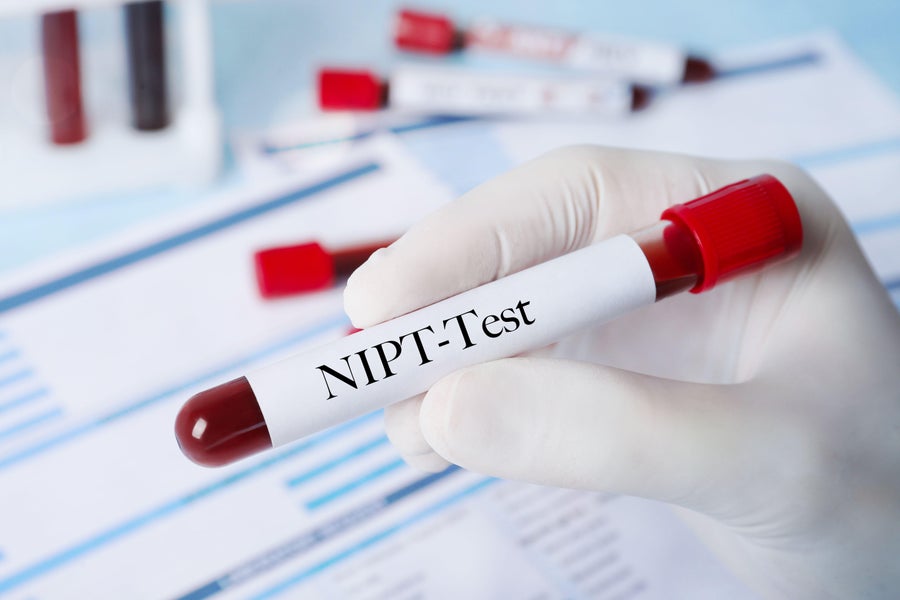
A noninvasive prenatal test. Olga Yastremska/Alamy Stock Photo
.
.
Click the link below for the complete article:
.
__________________________________________
 James' World 2
Leave a comment