
Click the link below the picture
.
Here’s a simple question: What’s a moon?
As with so many questions in science, it may seem straightforward but truly isn’t. “Why, a moon is a celestial body that orbits a planet,” you’re probably thinking. Well, sure—if you squint your eyes and don’t look too closely, that’s a pretty decent description.
But rigidly defining the term “moon” isn’t so easy.
The canonical example is of course our own moon, a decently big chunk of rock that orbits Earth. But centuries ago the first telescopic observations of other planets revealed that many have moons as well; Jupiter has four giant, easily seen satellites, and Saturn has several that are visible by modest means as well. So at that point in time, our definition of “moon” seemed safe enough.
Then, of course, things got complicated—because they always do. As telescopes got bigger and better, more moons were found. Mars has two, and poor Mercury and Venus have none, but in contrast, moons seemingly kept sprouting on Jupiter like mushrooms after a rainstorm. For the first half of the 20th century, Jupiter was known to have an even dozen. A handful more were found telescopically in the 1970s, and the numbers jumped a bit when we started sending spacecraft to the outer planets. Then, in the 2000s, the numbers leaped upward as more exacting techniques were used to scrutinize Jupiter’s environs.
As of this writing Jupiter has 95 confirmed moons. They range in size from mighty Ganymede, the largest in the solar system at more than 5,200 kilometers across—wider than the planet Mercury!—to the tiniest that we’re able to see from Earth, at roughly 1 km in diameter. Saturn is more distant from us than Jupiter, so its moons are harder to see, yet we now know it boasts at least 274 moons, a staggering number! Of these, 128 were just announced this month by scientists who had used an advanced searching technique that allows extremely faint satellites to be spotted in telescopic observations. Most of these new additions are only a few kilometers across.
It’s clear that with ever more powerful equipment, we’ll find that many planets have orbital companions of arbitrarily small dimensions. Is something the size of a football stadium a moon? Sure! But what about something the size of a car, a basketball or a grape? What about a grain of dust?
Saturn’s rings are composed of trillions of small icy particles. Is each of these a moon?
At some lower limit, that term just doesn’t seem to fit.
The problem is further complicated by the fact that many asteroids have moons. More than 430 asteroids are known or suspected to be orbited by smaller asteroids. It’s possible that those satellites were formed from low-speed collisions that either ejected material that subsequently coalesced as moons or slowed two asteroids enough to put them in orbit around each other. In some cases, an asteroid and its moons may have even formed together.
Out past Neptune are countless small icy and rocky bodies called Trans-Neptunian Objects (TNOs), and many of these have moons as well. While some TNOs could be called dwarf planets because of their size, many more are tiny and don’t even come close to falling into that category.
And, although I hate to complicate things even more, I should note that if we broaden our moon definition to “any object that orbits something bigger,” then planets are moons. Even small stars that orbit big stars would be moons!
.
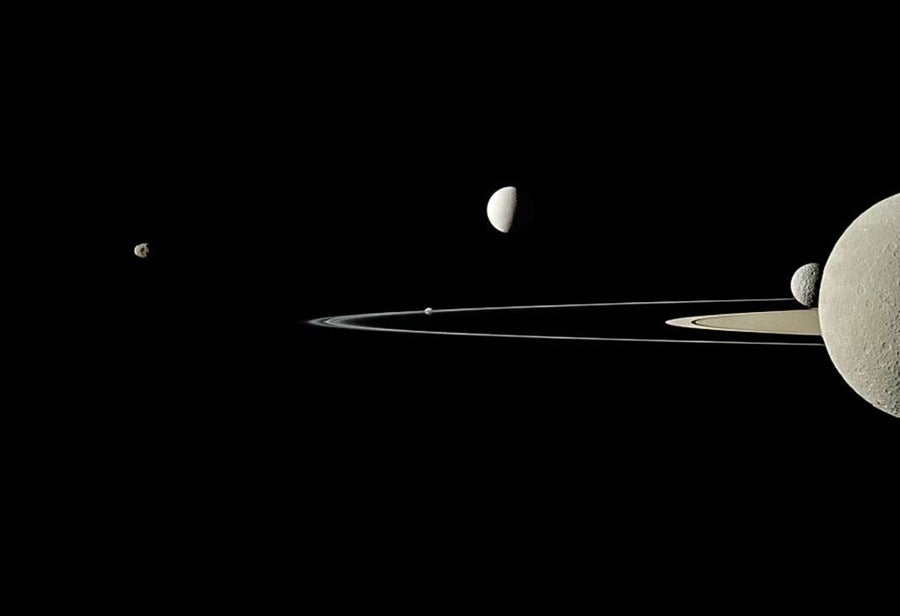
A quintet of Saturn’s moons come together in this image from NASA’s Cassini spacecraft. NASA/JPL-Caltech/Space Science Institute
.
.
Click the link below for the complete article:
.
__________________________________________
 James' World 2
Leave a comment