
Click the link below the picture
.
There’s a certain universal experience that transcends age, background, and even our best intentions. It’s the subtle (or not-so-subtle) cringe, the weary sigh, the fleeting moment of “Oh, hell no” when faced with the disruptive, disobedient or destructive behavior of someone else’s child.
Whether it’s the out-of-nowhere, ear-piercing shriek in the coffee shop, the relentless toy-banging in the doctor’s waiting room or the seemingly endless stream of “Why?” questions, the feeling that other people’s children are annoying is surprisingly common. And if you’ve ever felt that way, you’re definitely not alone.
It’s not that we’re heartless monsters. But there’s something about the unbridled enthusiasm, the unfiltered honesty, and the sheer volume of some little humans that can test the patience of even the most even-keeled among us.
We may find other people’s kids annoying for various reasons, often tied to behavior, expectations or environment. Dr. Matthew Morand, a licensed psychologist, told HuffPost this topic comes up more than people think. His advice? “Minimize the negative voices in your head.”
But how, when you’re at your wit’s end?
First, keep this basic principle in mind.
Morand’s strategy is simple: “Utilize ‘the other shoe’ mentality. If I were to count how many times a child has kicked the back of my head on an airplane, I could sue their parents for traumatic brain injury. Most people’s responses typically go right for the negative and pass judgment. I ask them, and ask myself, ‘Have my children not been the difficult ones?’ How can I get angry at that child when I have literally worn the other shoe?”
Dr. Kristen Piering, a licensed clinical psychologist, agrees. “If you’re annoyed by a kid out in public, keep in mind that we need kids to experience these places to learn how to engage appropriately in society.”
She added, “Kids are people, too, and can have bad days like anyone else. If they act in a way you find ‘annoying,’ they may have had a rough day at school or a fight with a friend.”
Consider whether the source of the problem is the kid or the parent.
Parents can relate, but what about those of us without kids? Morand says, “Focus on whether the parent is cognizant of their child’s behavior. We can give credit and find a sense of calmness in respecting that parenting is hard, and if that parent is trying to address the behavior, then that is all that really matters.”
And sometimes it’s not even the kids themselves. It’s the parents. The ones who seem blissfully unaware (or just don’t care) as their little ones dismantle the local bookstore or treat public spaces as their personal playgrounds (and garbage bins). It’s the “hands-off” approach taken to an extreme, leaving the rest of us to contend with the resulting bedlam.
That said, what you see isn’t always the whole story. Piering said, “Not everyone parents the same way, and that’s OK. You have no idea what goes on in their home, and something that might seem like an odd parenting choice to you may have come from years of knowing their child and what works best for their child and their family.”
Follow a 3-step rule to keep your frustration in check.
So, how do we navigate this minefield of mini-humans without losing our marbles? Perhaps some expert-advised strategies for keeping your sanity intact (even when surrounded by the most lively of children) can help before we pull our hair out.
Shira Schwartz, a school psychologist and district administrator, has a three-step rule: 1. Ignore; 2. Redirect; 3. Resist the urge to parent.
.
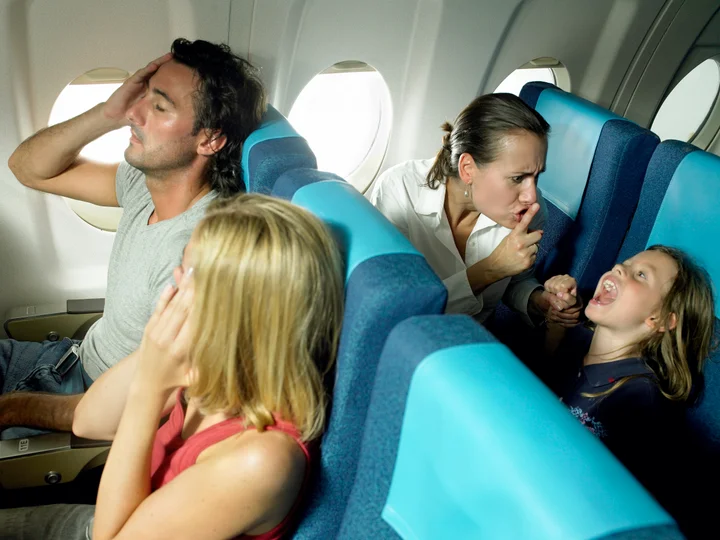 Hans Neleman via Getty Images We’ve all been here.
.
.
Click the link below for the complete article:
.
__________________________________________
 James' World 2
Leave a comment