
Click the link below the picture
.
CLIMATEWIRE | How can projects that scrub carbon dioxide from the atmosphere reduce their sky-high costs?
For a planned development in Texas, one answer is to draw power directly from a wind farm.
The innovative project, announced Monday by three European companies, could be the world’s first direct air capture development to rely primarily on so-called behind the meter electricity. That means the DAC facility would run mainly with low-cost clean power that’s generated on site, not metered out from the grid.
The facility is slated to come online in 2028 and is intended to eventually remove up to 500,000 metric tons of carbon from the atmosphere per year — more than the average annual emissions of a natural gas plant, according to EPA data. The planned facility is larger than any other direct air capture plant currently in operation, although several DAC projects under development are similarly sized.
The new Texas project is being led by Return Carbon, a Dutch project development and investment company, and Skytree, a direct air capture technology firm also based in the Netherlands, with wind power from the North American renewables subsidiary of EDF, the state-owned French utility. Carbon dioxide the facility pulls from the sky would be stored permanently underground by the Texas firm Verified Carbon.
“It is a new framework, which we have agreed with EDF,” said Martijn Verwoerd, the co-founder and managing director of Return Carbon, said in an interview before publicly revealing the deal. “That’s why we’re announcing it.”
The novel agreement would ensure that Return Carbon, which plans to own and operate the direct air capture facility, has access to consistent supply of low-cost clean energy from Texas’s windy gulf coast. Verwoerd declined to say the price per kilowatt-hour Return Carbon has locked in and said the consortium would decide on a precise location later this year.
For EDF, the deal would reduce the likelihood that it has to sell its electricity at a loss or even pay to add it to the grid, Verwoerd explained. Utilities can suffer so called negative power prices when electricity production exceeds the demand for power.
The agreement also allows EDF to redirect its electricity from Return Carbon onto the grid when there is “peak pricing in the market,” he said. In that scenario, the direct air capture facility could operate using renewable energy from a separate agreement Return Carbon has struck with other power providers or go offline until electricity prices fall to an acceptable level.
It’s a “win-win for all parties,” Verwoerd said.
To avoid the worst impacts of climate change, scientists say the world needs to immediately reduce its emissions of carbon dioxide, the main source of which is the burning of oil, gas and coal. At the same time, countries and companies need to begin deploying carbon dioxide removal technologies such as direct air capture to reduce the amount of carbon that’s already been spewed into the atmosphere.
Neither are happening quickly enough, with President Donald Trump promising to double down on oil drilling while slashing federal support for climate-related initiatives.
.
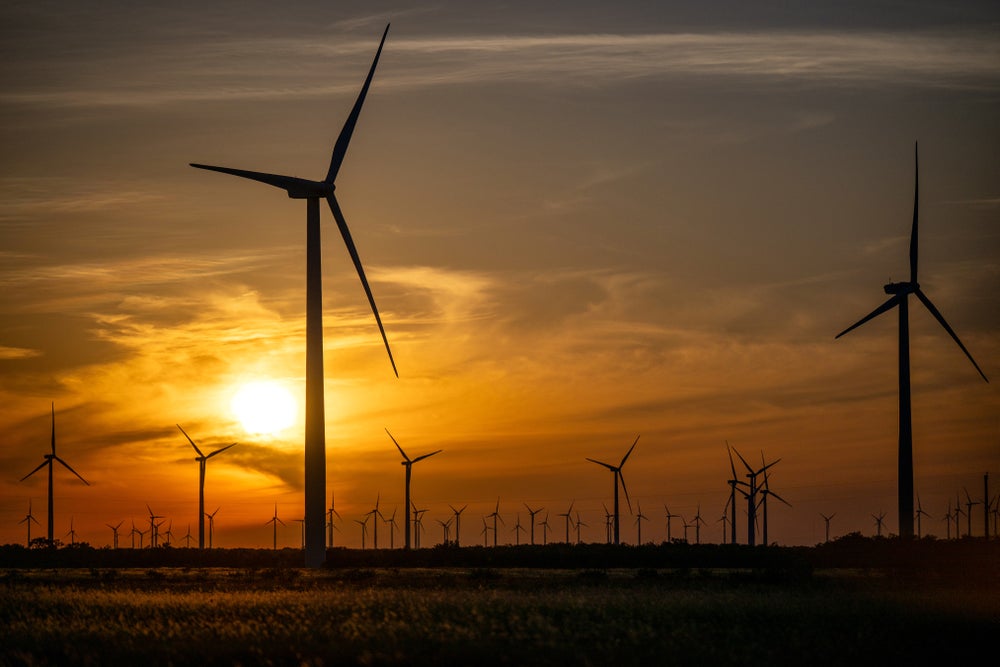
Wind turbines in a field at sunrise on June 28, 2024, in Nolan, Texas. Brandon Bell/Getty Images
.
.
Click the link below for the complete article:
.
__________________________________________
 James' World 2
Leave a comment