
Click the link below the picture
.
Forget the canary in a coal mine: today the danger zone is the entire U.S., and the sentinel species comprise a growing list that includes the Golden-cheeked Warbler, the Florida Scrub Jay and the Mottled Duck.
These are among 42 U.S. bird species that have been placed on “red alert” by the conservation initiative Road to Recovery—and included in State of the Birds 2025, a new report released by a separate group of governmental and nonprofit organizations called the North American Bird Conservation Initiative. The report analyzes population trends for more than 700 bird species across the U.S. and its key habitat types—and identifies a total of 229 species that experts deem to be of high or moderate conservation concern. “Bird populations are continuing to decline, and one third of species in the U.S. require urgent conservation attention,” says report co-author Amanda Rodewald, an ecologist at Cornell University.
This is bad news for humans, too, she emphasizes. The concerning declines in bird populations “indicate to us that environments are changing in ways that can have negative outcomes for people as well,” Rodewald says. “We live in the same habitats as birds, so if they’re not healthy for birds, they’re not healthy for us.” In addition, bird-related activities, such as purchasing bird seed for feeders or equipment for bird-watching and photography, contributed some $279 billion to the U.S. economy in 2022 alone.
Road to Recovery had looked at population trends for each species, identifying birds on the “tipping point” and grouping them into three color-coded categories based on total and recent trends. For example, the Greater Prairie Chicken, an eye-catching and iconic bird that has lost much of its habitat and splintered into small groups with little genetic diversity, is listed as a “red alert” tipping-point species. In contrast, a “yellow alert” tipping-point species called the Pinyon Jay has also lost its woodland habitat because of drought and insects, among other factors, but its populations are stabilizing.
The new report evaluates how birds that are reliant on particular ecosystems are faring. Those that are found only in grasslands or in arid landscapes, for example, are doing quite poorly, with populations decreasing by more than 40 percent since 1970. Among 31 species that rely on arid landscapes, none are showing population increases.
One new development raises particular concern: duck species overall have seen steep declines in the past few years, potentially because of drought, Rodewald says. “That is certainly sobering,” she says, noting that waterfowl and waterbirds overall had always been a “bright spot” in similar analyses.
Peter Marra, a conservation biologist at Georgetown University, who was not involved in the new report but conducted 2019 work showing that the U.S. had some three billion fewer birds than in 1970, says that the new findings offer a valuable look at which species need the most urgent response.
Both Rodewald and Marra highlight shorebirds as a group to be concerned about. Species in this group rely on the delicate regions where freshwater or saltwater meets land, Marra says. “We’re changing the natural landscape in multiple and complex ways, and to expect these species to persist is just crazy,” he says.
.
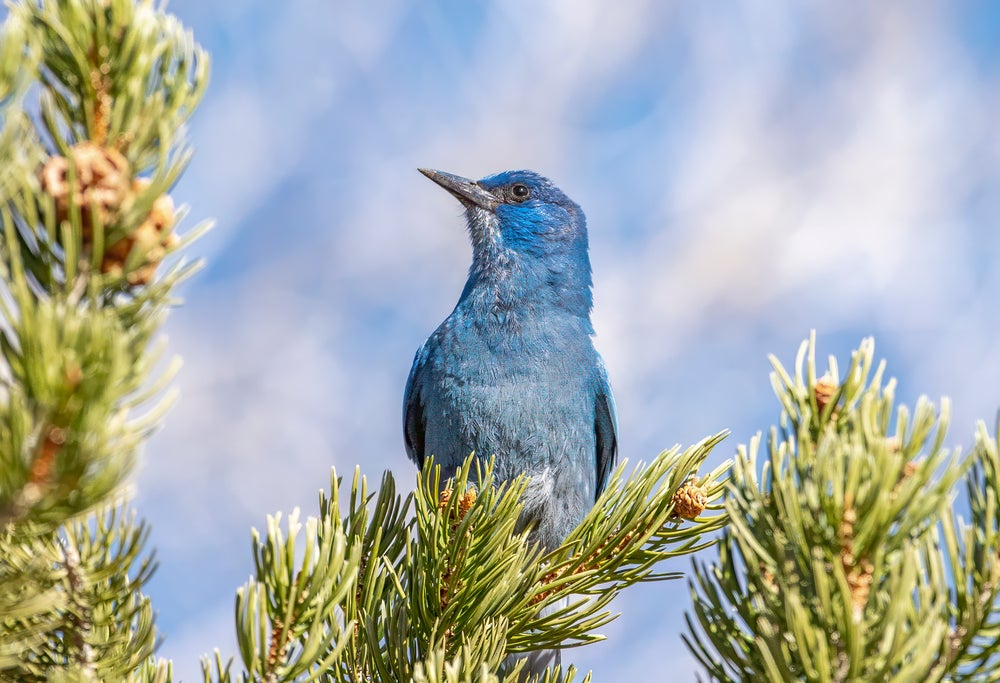
An increasingly uncommon Pinyon Jay perches on the top of a Pinyon Tree in a Colorado forest. Gerald DeBoer/Getty Images
.
.
Click the link below for the complete article:
.
__________________________________________
 James' World 2
Leave a comment