
Click the link below the picture
.
The world is divided by war. Influenza outbreaks smolder in livestock herds and bird flocks for years. The public is deeply skeptical of the value of medical interventions. Public health agencies offer misleading advice and are focused only on keeping the public calm. There is a shortage of qualified medical professionals, with no end in sight.
No, this isn’t 2025—it’s 1918. In the pivotal book The Great Influenza, historian John Barry lays out the conditions that primed the population of the U.S. that year for one of the worst plagues in history and acted like so much dry tinder just waiting for a spark. That spark exploded into the conflagration of the 1918 influenza pandemic, which killed an estimated 50 million people worldwide and left many others disabled.
A little more than a century later, now is perhaps as good a time as any to ask the question: How prepared are we for another influenza pandemic? On the surface, this is an easy question to answer. Modern medicine and public health have advanced far beyond 1918. Whereas the scientists of that era struggled to identify the germ that caused the pandemic, we live in a time of genomic sequencing and global infectious disease surveillance, of mRNA vaccine technology and antiviral medications. Our governments have pandemic preparedness plans, stockpiles of vaccines and drugs, and, having dealt with the COVID pandemic, experience with contact tracing and isolation.
Other conditions, however, are eerily similar to those of 1918. Geopolitical crises crowd public health concerns off the front page of newspapers. A dangerous influenza strain, in this case the H5N1 avian flu virus, has recently been circulating freely within poultry flocks, spreading widely in livestock herds in the U.S. and causing infections in farm workers. False lessons drawn from the COVID pandemic have driven public skepticism of medical information to all-time highs. Public health agencies sometimes offer contradictory and falsely soothing messages, further eroding their credibility. And after five years of COVID, hospital systems are stretched thin, and burnout and staffing shortages have thinned the ranks of the doctors and nurses who will be on the front line of the next pandemic. Making matters worse, the Trump administration’s interventions over the past two months have gravely weakened surveillance of and control over the virus’s spread.
The global response to the COVID pandemic offers little solace. In late 2019, as SARS-CoV-2, the virus that causes COVID, gripped China, infectious disease surveillance failed across much of the rest of the globe. Western governments faltered right out of the gate at limiting the spread of the virus—contact tracing detected fewer than 2 percent of all COVID cases in the U.S., for example. The pandemic response plan was ignored, and molecular tests were too few and too late. There were not enough high-quality masks, and antiviral drugs for COVID had not yet been developed. The plan was to “flatten the curve,” but in practice, hospitals ran out of beds, intensive care units ran out of oxygen and morgues ran out of space. While lives were saved by social distancing and eventually vaccines, millions also died needlessly across the globe. They were victims of poor pandemic policy and a sluggish public health response, as well as misinformation and disinformation about vaccines and other health measures.
But that was—and still is—a different pandemic, one caused by a coronavirus rather than influenza, with a far lower death rate for acute cases and a somewhat different set of challenges. In contrast, when pandemic influenza hit in 1918, it killed 3 to 5 percent of the world’s population, and around half of those deaths were in young and healthy people. A pandemic similar in scale today would leave 200 to 400 million dead.
Revisiting the Deadly 1918 Pandemic
It’s hard to imagine now, but the 1918 influenza was far worse than the flu we know. Although many affected people experienced a severe bout of seasonal flu—fever, chills, body aches and headaches, followed by recovery—some fared a lot worse. As Barry puts it, these people “came with an extraordinary array of symptoms, symptoms either previously unknown entirely in influenza or experienced with previously unknown intensity.” Those symptoms included agonizing joint pain, burning pain above the diaphragm, subcutaneous emphysema (which occurs when pockets of air accumulate just beneath the skin), ruptured eardrums, kidney failure and severe nosebleeds.
.
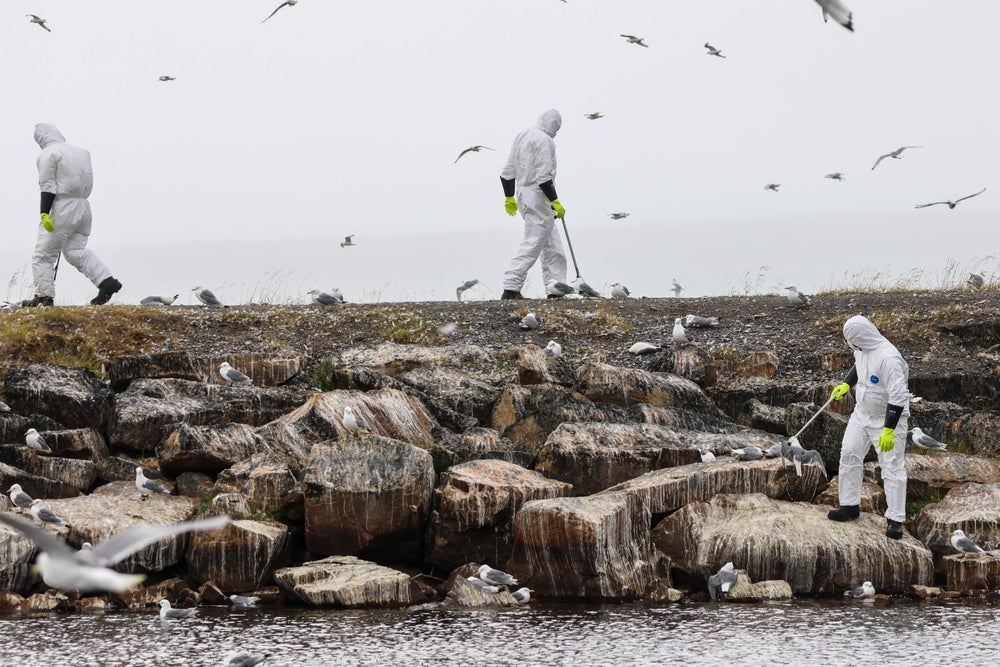
Dead birds are collected along the coast in the Vadso municipality of Finnmark in Norway following a major outbreak of bird flu on July 20, 2023. Oyvind Zahl Arntzen/NTB/AFP via Getty Images
.
.
Click the link below for the complete article:
.
__________________________________________
 James' World 2
Leave a comment