
Click the link below the picture
.
Behold! As the Ides of March approaches, witness as Earth’s shadow engulfs the moon!
Or, put another way, a total lunar eclipse is set to occur on the night of March 13 and into the early-morning hours of March 14. This is one of my favorite astronomical events; unlike its fast-paced and potentially hazardous solar counterpart, a lunar eclipse is slow and majestic, happens at night and doesn’t require any special equipment or optical aid to see. This makes it easy and fun to watch; you can pop outside every 15 minutes or so to check its progress, and you usually won’t miss anything.
The entire eclipse will be visible across essentially all of North America and most of South America.
The timings of the eclipse’s various stages are given below, but to understand those, you first need to understand how all this unfolds.
The moon orbits Earth once every 27 days or so. The phase we see it in (crescent, half full, and so on) depends on the angle between the sun, the moon and Earth. When the moon is new, between Earth and the sun, we are gazing at its unilluminated half, so it looks black. When it’s opposite the sun in the sky, we see its fully illuminated half, so it appears full. The other phases occur in between these two geometries, so we see various amounts of the moon’s surface lit. Despite a common misconception, Earth’s shadow has nothing to do with the phases.
But it’s why we have eclipses! Earth’s shadow falls in the direction away from the sun, so the moon has to be opposite the sun in our sky during an eclipse. This means a lunar eclipse can only happen at full moon. As the moon orbits Earth, it moves into Earth’s shadow, creating the stages of the eclipse.
The easiest way to understand how the eclipse works is to imagine it first as if you’re on the moon, looking up at Earth and the sun. From this viewpoint—which, incidentally, two lunar landers are set to see for this eclipse—it looks as if our planet is slowly moving in front of the sun. At first, you see Earth just barely blocking our star. The amount of light hitting you drops but not by much. Over time, Earth blocks more and more of the sun, and the illumination drops further. You’re in Earth’s shadow, yet because you can still see some of the sun, you’re not in full shadow. We call this part of the shadow the penumbra, which comes from the Latin for “near shadow.”
After about an hour, you see Earth completely block the sun. You’re in the deepest part of the shadow, called the umbra, and it is dark all around you. Eventually, Earth leaves the sun’s face—you leave the umbra and move back into the penumbra—and the ground around you is partially illuminated once again—until Earth moves completely off and the eclipse is over.
What does this look like from Earth? After all, I’d bet this is where you’ll be watching this event from! When there isn’t a lunar eclipse, if you look into the sky opposite the sun, you can’t see Earth’s shadow because it’s projected onto empty space. But if you could see the shadow, it would look like two concentric circles in the sky. The big one is the penumbra, and the smaller one inside it is the umbra. When the moon begins moving into the penumbra, it does technically get darker, but it’s hard to tell at first. Once the moon is much deeper in, its dimming becomes more obvious.
.
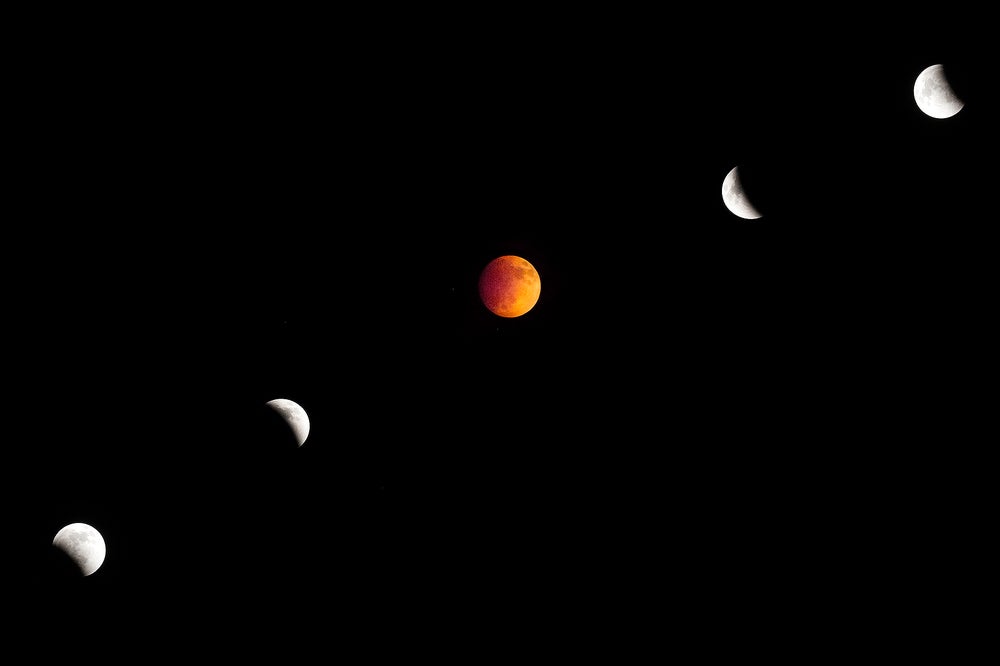
A time lapse image of a total lunar eclipse’s progression. John Coletti/Getty Images
.
.
Click the link below for the complete article:
.
__________________________________________
 James' World 2
Leave a comment