
Click the link below the picture
.
Microsoft has announced that it has created the first ‘topological qubits’ — a way of storing quantum information that the firm hopes will underpin a new generation of quantum computers. Machines based on topology are expected to be easier to build at scale than competing technologies, because they should better protect the information from noise. But some researchers are sceptical of the company’s claims.
The announcement came in a 19 February press release containing few technical details — but Microsoft says it has disclosed some of its data to selected specialists in a meeting at its research centre in Santa Barbara, California. “Would I bet my life that they’re seeing what they think they’re seeing? No, but it looks pretty good,” says Steven Simon, a theoretical physicist at the University of Oxford, UK, who was briefed on the results.
At the same time, the company published intermediate results — but not the proof of the existence of topological qubits — on 19 February in Nature.
Superconducting wire
Topological states are collective states of the electrons in a material that are resistant to noise, much like how two links in a chain can be shifted or rotated around each other while remaining connected.
The Nature paper describes experiments on a superconducting ‘nanowire’ device made of indium arsenide. The ultimate goal is to host two topological states called Majorana quasiparticles, one at each end of the device. Because electrons in a superconductor are paired, an extra, unpaired electron will be introduced, forming an excited state. This electron exists in a ‘delocalized’ state, which is shared between the two Majorana quasiparticles.
The paper reports measurements suggesting that the nanowire does indeed harbour an extra electron. These tests “do not, by themselves” guarantee that the nanowire hosts two Majorana quasiparticles, the authors warn.
According to the press release, the team has carried out follow-up experiments in which they paired two nanowires and put them in a superposition of two states — one with the extra electron in the first nanowire, and the other with the electron in the second nanowire. “We’ve built a qubit and shown that you can not only measure parity in two parallel wires, but a measurement that bridges the two wires,” says Microsoft researcher Chetan Nayak.
“There’s no slam dunk to know immediately from the experiment” that the qubits are made of topological states, says Simon. (A claim of having created Majorana states, made by a Microsoft-funded team based in Delft, the Netherlands, was retracted in 2021.) The ultimate proof will come if the devices perform as expected once they are scaled up, he adds.
Early announcement
Some researchers are critical of the company’s choice to publicly announce the creation of a qubit without releasing detailed evidence. “If you have some new results not connected to this paper, why don’t you wait until you have enough material for a separate publication?” says Daniel Loss, a physicist at the University of Basel, Switzerland. “Without seeing the extra data from the qubit operation, there is not much one can comment,” says Georgios Katsaros, a physicist at the Institute of Science and Technology Austria in Klosterneuburg.
.
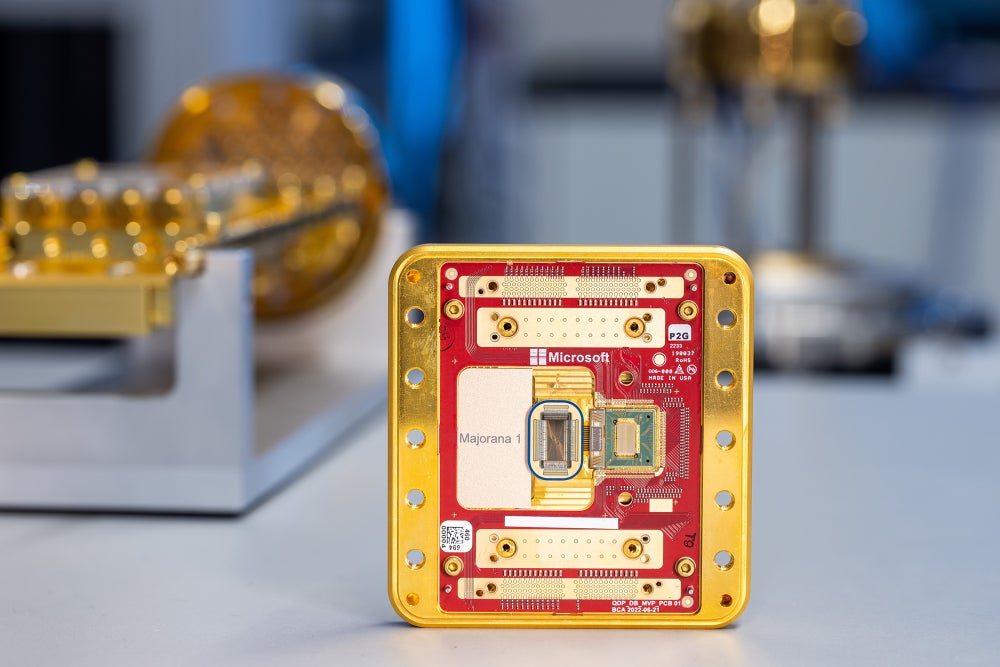
Microsoft has unveiled its Majorana 1 quantum chip. © John Brecher for Microsoft
.
.
Click the link below for the complete article:
.
__________________________________________
 James' World 2
Leave a comment