
Click the link below the picture
.
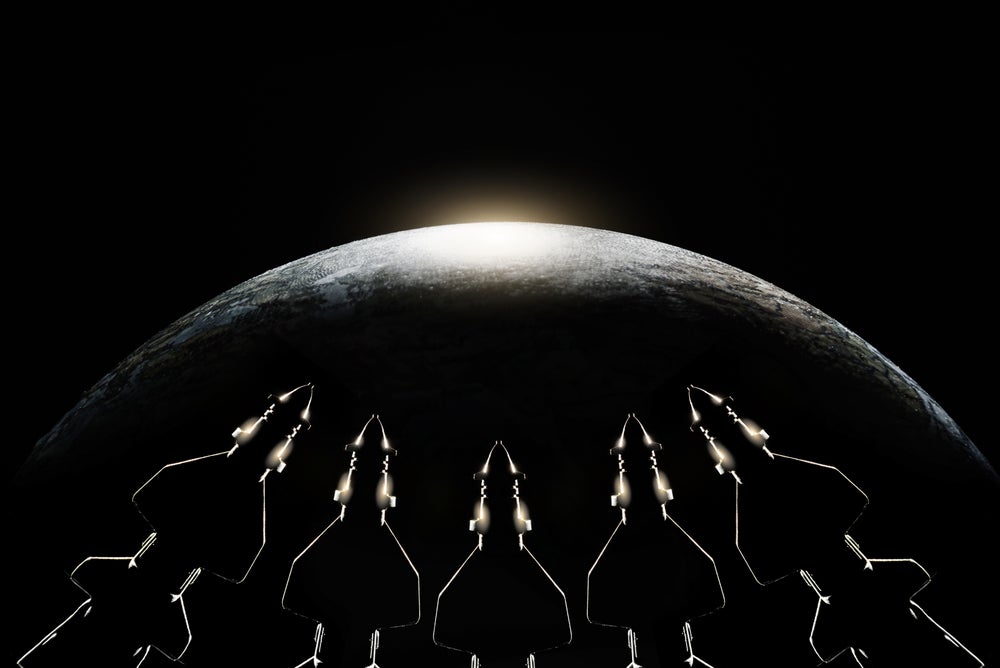
“There is always a well-known solution to every human problem—neat, plausible, and wrong,” according to H. L. Mencken. Today we might ponder his words to diagnose the revival of another neat, plausible and boneheaded idea: ringing the planet with orbiting missiles to somehow make the U.S. safer.
In January, President Donald Trump called for a “next-generation missile defense shield” for the U.S. in an executive order. Named an “Iron Dome for America” after Israel’s short-range missile defense system—which it has nothing to do with—the plan would pour hundreds of billions of additional dollars into the long-underperforming rathole of U.S. missile defense efforts while weaponizing space. In the order, Trump referenced then president Ronald Reagan’s 1983 initiative, known as “Star Wars,” to build a missile defense shield with ground- and space-based weapons, saying it was “canceled before its goal could be realized.”
A similar fate awaits Trump’s plan—for the same reasons that Reagan’s missile-defense fantasia, including a late-1980s orbital version known as “Brilliant Pebbles,” never panned out: it will cost too much, won’t work and will endanger us all.
Right now the U.S. has 44 ground-based interceptor missiles stationed on the U.S. West Coast and aimed against ballistic missile attacks from the unstable nation of North Korea. They have worked 12 times out of 21 tests, a paltry success rate achieved only after $250 billion spent since their 1985 beginning. This illustrates the intrinsic, expensive difficulty of intercepting even dummy intercontinental ballistic missiles (ICBMs). It’s just hard to hit them.
What’s driving Trump’s Iron Dome? Fear of nuclear-tipped hypersonic missiles developed by Russia and China, which reach speeds of Mach 5, about one mile per second. Unlike ballistic missiles, which arc into space before returning to Earth, hypersonic ones maneuver and fly on a flat trajectory, which would be challenging for U.S. ground interceptors. “Most terrestrial-based radars cannot detect hypersonic weapons until late in the weapon’s flight due to line-of-sight limitations of radar detection,” the Congressional Research Service noted in a recent report.
In pursuit of “peace through strength,” the executive order argued, “the United States will guarantee its secure second-strike capability.” That means the ability to launch nuclear missiles as payback after a hypersonic nuclear attack on the U.S.—one that would mean World War III had started—supposedly to be assured via hypersonic-missile-detecting satellites, plus satellites to link these sensors to interceptors and the “deployment of proliferated space-based interceptors.”The idea is that space-based interceptors would presumably get a jump on blocking missiles over the current ground-based ones. (Natch, there are also space lasers planned. Although, with apologies to Dr. Evil, we’ve yet to hear if equally impractical “sharks with frickin’ laser beams attached to their heads” will also make a debut.)
.
Alexey Koza/Getty Images
.
.
Click the link below for the complete article:
.
__________________________________________
 James' World 2
Leave a comment