
Click the link below the picture
.
CAPE CANAVERAL, Fla. — The private Athena lunar lander is on its way to the moon.
A SpaceX Falcon 9 rocket lifted off shortly after sunset this evening (Feb. 26), carrying Athena and NASA’s ride-along Lunar Trailblazer orbiter aloft against a darkening sky here at NASA’s Kennedy Space Center (KSC).
Athena — which was built by the Houston-based spaceflight company Intuitive Machines — carries 10 NASA science instruments, many of which are designed to hunt for signs of water ice. Lunar Trailblazer will do similar work from its higher perch. That’s a big priority for NASA, which aims to establish one or more human settlements on the moon via its Artemis program.
“I’m very excited to see the science that our tech demonstrations deliver as we prepare for humanity’s return to the moon and the journey to Mars,” Nicky Fox, associate administrator of NASA’s Science Mission Directorate, said during a prelaunch briefing today.
The Falcon 9 launched at 7:16 p.m. EST (0017 GMT on Feb. 27) this evening from KSC’s Launch Complex-39A. About 8.5 minutes later, the rocket’s first-stage booster came back to Earth for a landing on SpaceX’s A Shortfall of Gravitas droneship as planned. This was the ninth launch and landing of the Falcon 9 booster (B1083) supporting the IM-2 mission.
The Falcon 9’s upper stage rocketed onward. It deployed Athena into translunar injection orbit about 43.5 minutes after liftoff and Lunar Trailblazer four minutes later, as planned.
Athena’s mission is called IM-2, because it’s the second launch to the moon in as many years for Intuitive Machines. IM-2 is part of NASA’s Commercial Lunar Payload Services (CLPS) program, which seeks out commercial partnerships to deliver science and technology gear to the moon.
Athena’s ambitious mission focuses on the abundance of water ice and other resources near the moon’s south pole, and the prospect for future missions to utilize those resources for sustainable habitability in space — a process known as in-situ resource utilization (ISRU). To fulfil all IM-2’s objectives, the lander is carrying two secondary vehicles: a mini rover named MAPP (Mobile Autonomous Prospecting Platform) that was built by the Colorado company Lunar Outpost and Grace, an Intuitive Machines “hopper” robot that will explore the region around the landing site via a series of leaps.
IM-2 follows Intuitive Machines’ historic first mission, IM-1, by just over a year. The IM-1 lander, “Odysseus,” launched in February 2024, also on a CLPS flight. Odysseus managed to make it to the surface, pulling off the first-ever soft lunar landing by a private spacecraft. But the probe came in too fast and broke one of its landing legs, which caused it to tip over during the touchdown. As a result, the spacecraft’s high-gain antenna was blocked, preventing the transmission of some of the data that NASA had hoped to collect.
.
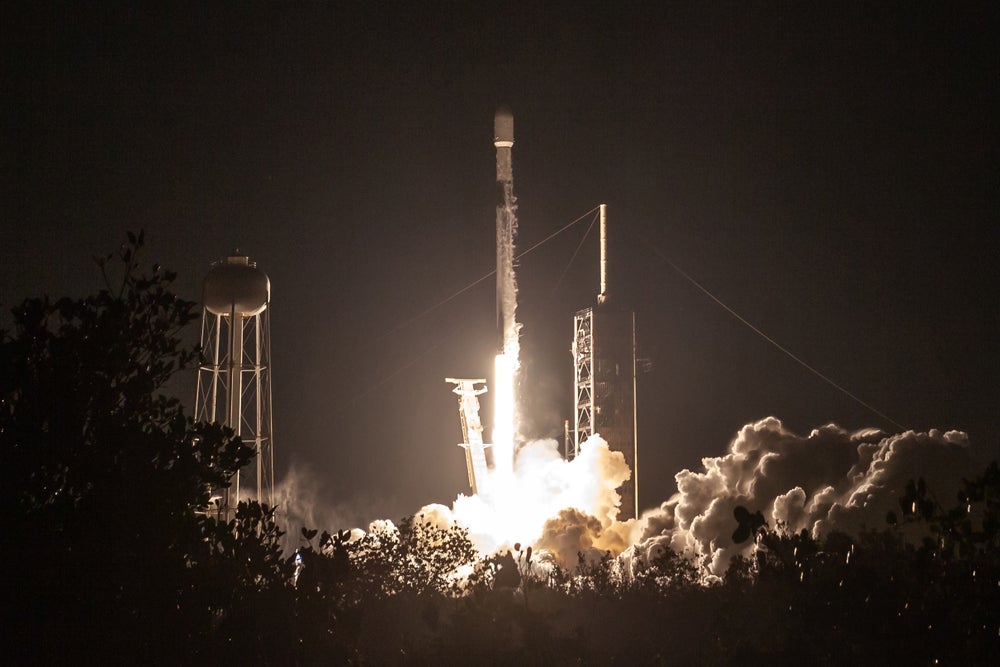
A SpaceX Falcon 9 rocket launches from NASA’s Kennedy Space Center, carrying the Intuitive Machines moon lander Athena. As part of NASA’s CLPS (Commercial Lunar Payload Services) program, Athena carries scientific experiments to search for water near the lunar south pole. Manuel Mazzanti/NurPhoto via Getty Images
.
.
Click the link below for the complete article:
.
__________________________________________
 James' World 2
Leave a comment