
Click the link below the picture
.
t’s February 2025. The world feels like complete chaos, and it’s hard to step away from the news. Maybe your body feels tight, and perhaps your mind is racing.
Take a deep breath, then keep reading.
It isn’t just you: lots of people have expressed that they have felt overwhelmed and burned out from the events of recent months. Disasters, including Hurricane Helene and the Los Angeles–area wildfires, served as the backdrop to a frighteningly tense presidential election. And the new administration has acted loud and fast, often in ways that judges are already declaring unconstitutional.
To a degree, the result feels familiar. News overload is nothing new; major crises such as September 11 and the early months of the COVID pandemic delivered a similar onslaught of rapid-fire headlines that were laden with fear and uncertainty. However, experts say the developments during these first weeks of President Donald Trump’s second administration are posing a very real mental health threat that people may need new skills to manage. Scientific American spoke with experts in psychology and beyond about what’s happening and how to stay calm and grounded through it.
What Is the ‘Flood the Zone’ Strategy?
Political strategist Steve Bannon, who advised Trump during his first term, has openly discussed overwhelming the media as a key priority to advance right-wing objectives. “All we have to do is flood the zone,” Bannon told Frontline in 2019. “Every day we hit them with three things. They’ll bite on one, and we’ll get all of our stuff done: bang, bang, bang.”
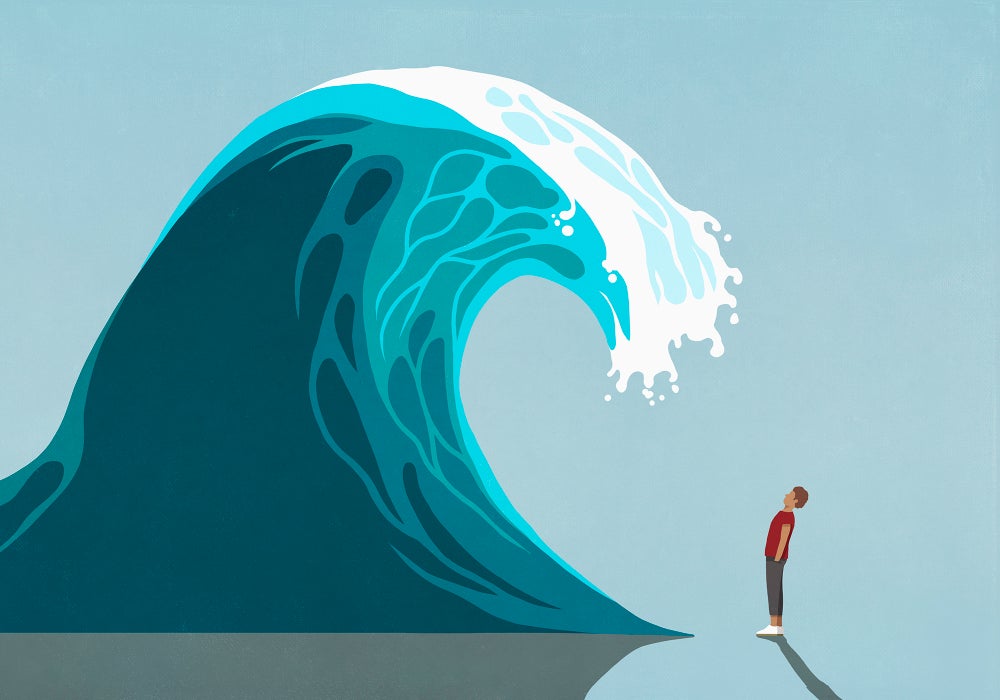
This approach is reminiscent of the “Gish gallop” tactic that Trump has used during debates to barrage opponents and fact-checkers with so many lies and half-truths that it becomes impossible to adequately address them all. Away from the podium and inside the Oval Office, it’s a strategy that harkens back to a predigital Soviet practice of producing huge amounts of disinformation meant to make people question reality, as many experts have noted. The Trump administration’s version of this tactic uses volume to create paralysis among the opposition, says Dannagal Young, a professor of communication at the University of Delaware. “It’s the sense that you are being overwhelmed by a tidal wave,” she says. “How do you push back against a tidal wave? You can’t.”
In addition to the sheer number of actions coming from the administration, many are also entirely unprecedented. Without historical U.S. parallels to work from, our brain is less able to calculate what these developments might lead to, and that can make processing the news even more difficult. “The chaos that ensues is really hard to make sense of because we don’t know the consequences,” says Kristen Lee, a psychotherapist and a teaching professor of behavioral science at Northeastern University.
But it’s not just the volume of headlines and the intellectual difficulty of understanding what’s happening that make current news overwhelming. The key, psychologists say, is the emotional weight of those headlines’ content—especially for people who find what’s happening in the U.S. today to be genuinely frightening.
Fear in the Brain, Fear in Societies
For someone worried about the administration’s policies creating tangible harm, each new headline can create a spark of fear—and fear is a remarkably powerful emotion. “Threat and fear take the priority in our brains,” says Arash Javanbakht, a psychiatrist and a neuroscientist at Wayne State University. “When you’re afraid, all you’re thinking about is what you’re afraid of.”
.
 Malte Mueller/Getty Images
.
.
Click the link below for the complete article:
.
__________________________________________
 James' World 2
Leave a comment