
Click the link below the picture
.
In the wake of the Second World War, US leaders adopted the view that scientific progress is an “essential key to our security as a nation, to our better health, to more jobs, to a higher standard of living, and to our cultural progress”. And for the next eight decades, government officials on both sides of the political aisle agreed to invest in US science. Just one month into the second administration of Republican President Donald Trump, scientists fear that that long-time consensus is disintegrating.
Acting with unprecedented speed, the administration has laid off thousands of employees at US science agencies and announced reforms to research-grant standards that could drastically reduce federal financial support for science. The cuts form part of a larger effort to radically reduce the government’s spending and downsize its workforce.
Although US courts have intervened in some cases, Republicans in both chambers of the US Congress — which largely blocked Trump’s efforts to cut science funding during his first term as president from 2017 to 2021 — have mostly fallen in line with the agenda for Trump 2.0. For many researchers, this first month signals a realignment of priorities that could affect science and society for decades to come.
These actions are all “unprecedented”, says Harold Varmus, a former director of the US National Institutes of Health (NIH) who is now a cancer researcher at Weill Cornell Medicine in New York City. “No one has ever seen a [presidential] transition in which one of the most valuable parts of our government enterprise is being taken apart.”
The Trump White House did not respond to Nature’s request for comment.
Here, Nature unpacks the Trump team’s blazing-fast actions on science so far (scroll to bottom to see timeline ‘Science impacts: one month of Trump 2.0’) and talks to policy watchers about what’s next.
Fast and furious
The overhaul of US science kicked off within hours of Trump’s inauguration on 20 January, when he signed dozens of executive orders, which are presidential directives on how the government should operate inside existing laws.
Some of those orders had been anticipated, including pulling the United States out of the 2015 Paris agreement to rein in global climate emissions and terminating the nation’s membership in the World Health Organization. Others had surprising and immediate ripple effects through the scientific community.
One order erroneously attempted to define only two biological sexes, male and female, and banned federal actions “that promote or otherwise inculcate gender ideology”. Biomedical-research agencies such as the US Centers for Disease Control and Prevention (CDC) scrambled to respond by, among other things, taking down data sets from their websites and pulling back manuscript submissions from scientific journals to purge terms including ‘gender’ and ‘transgender.’
Another executive order banned what Trump called “illegal and immoral discrimination programs, going by the name ‘diversity, equity, and inclusion’ (DEI)”. Any federal employee who did not report colleagues defying the DEI orders would face “adverse consequences”, according to an e-mail sent to government workers. To many scientists’ dismay, agencies began terminating DEI programs, including environmental-justice efforts, which are programs aimed at protecting low-income communities vulnerable to pollution and climate change. Even some scientific societies and private research organizations scrubbed DEI mentions from their websites. In one of Trump’s orders, he called for the investigation of foundations, non-profit organizations, and other private entities not in compliance.
On 27 January, just one week into the new administration, Trump’s budget office froze all federal grants and loans, saying that it needed to review government spending to ensure that it aligned with the executive orders. Chaos erupted as agencies, including the NIH and the US National Science Foundation (NSF) — both major funders of basic science — halted grant payments, canceled review panels for research-grant funding, and paused communications. A federal judge temporarily blocked the order, but disruptions and confusion continue.
Principal investigators who lead research teams are suffering in this environment, says a university scientist who requested anonymity because their research is funded by multiple US agencies. “Everything is on you to manage your grants and your team,” they say, adding that “there’s a lot of fear of people not wanting to say or do the wrong thing” and therefore lose financial support for their work. “It’s completely chaotic; I’m losing sleep.”
.
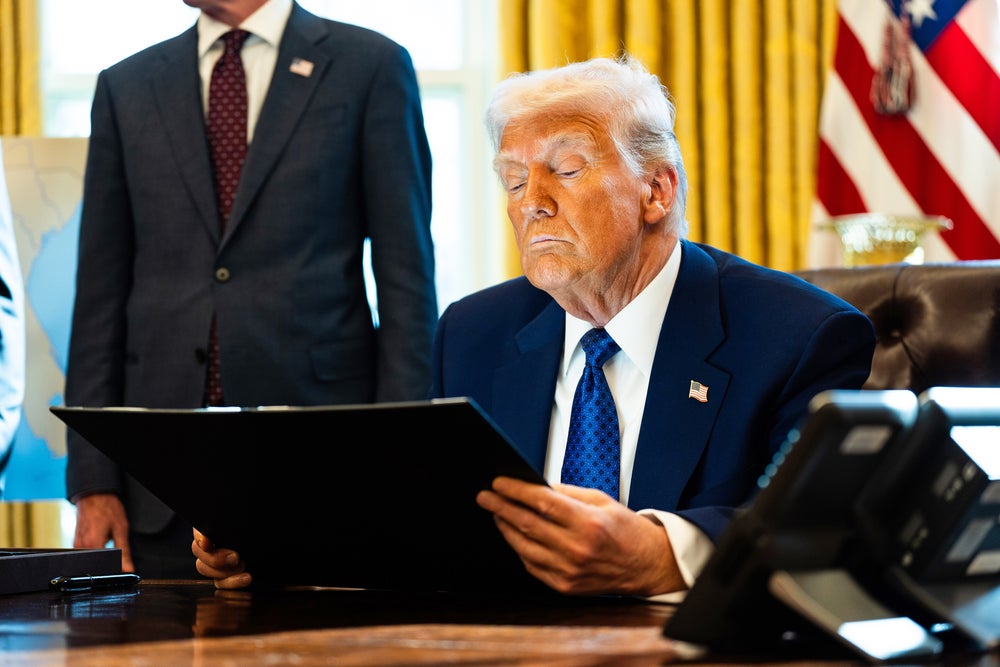
U.S. President Donald Trump looks at an executive order on halting federal funds for schools and universities that impose coronavirus vaccine mandates before signing in the Oval Office of the White House on February 14, 2025. Demetrius Freeman/The Washington Post via Getty Images
.
.
Click the link below for the complete article:
.
__________________________________________
 James' World 2
Leave a comment