
Click the link below the picture
.
Our brains are full of plastic.
This was the fun news I read earlier this week while picking up dinner take-out, packed in plastic containers, crammed in a plastic bag, and accompanied by Styrofoam cups. Great, I thought, convenience culture is killing us.
But is it? This is the problem with the slew of research finding microscopic shards of plastic in our arteries, kidneys, and livers, the findings that our oceans, food, soil, and air are teeming with tiny bits of Tupperware. Scientists still don’t know what this plastic is doing to us. And because research takes time, while scientists are trying to answer question, we just keep inhaling, eating, and drinking tiny pieces of plastic.
Why? Regulatory action has never really stopped the U.S. plastics industry from cranking out more plastic, even as clean air and water advocates try to fight the industry’s pollution problems in court and locals wage grassroots wars to slow the permitting of more plants that spew all those toxic chemicals. And now, back in office, is a president beholden to fossil fuel interests (where petroleum and natural gas are plastics precursors), a leader who uses his new powers to demand the use of plastic straws, and an administration that is hell-bent on crippling EPA’s mission to keep us safe rather than empowering it.
Meanwhile, we do not know what all this plastic is doing to us. And no one currently in charge seems to care.
Everything that goes into our bodies gets filtered through our livers and kidneys, so maybe it’s not a big surprise that bits of plastic find their way into those organs. Same with our hearts; microplastics end up in our blood and can get stuck in our clogged arteries. But our brains are designed to keep things out, through something called the blood-brain barrier. The researchers behind the brain plastics study think the tiny shards of plastic hitch a ride on fat molecules to get inside brain cells. And what’s worse is how much microplastics the researchers think might be in a whole human brain: 10 grams. Imagine 2.5 teaspoons of sugar. Now sub in plastic. Gross.
They looked at preserved brains from about a decade ago and compared them to brains from last year. The fresher brains had more plastic in them than the older brains. And yes, they accounted for all the plastic needed to hold and manipulate the brains in their study, just in case those tubes and such were leaching plastic. So, year after year, surrounded by more and more plastic, our bodies are at minimum, storage tanks, and at worst, under an unrelenting attack.
How is this even happening? Chemistry. Capitalism. Convenience culture. To make plastic, petroleum refineries isolate hydrocarbons and then crack those hydrocarbons into even smaller compounds like ethylene or propylene. They then do a little chemistry to stick those smaller compounds into repeating structures called polymers. These polymers then juiced with other chemicals that give them different properties, to mold them into plastics that are bendy, plastics that are hard, plastics that are resistant to heat and other things.
.
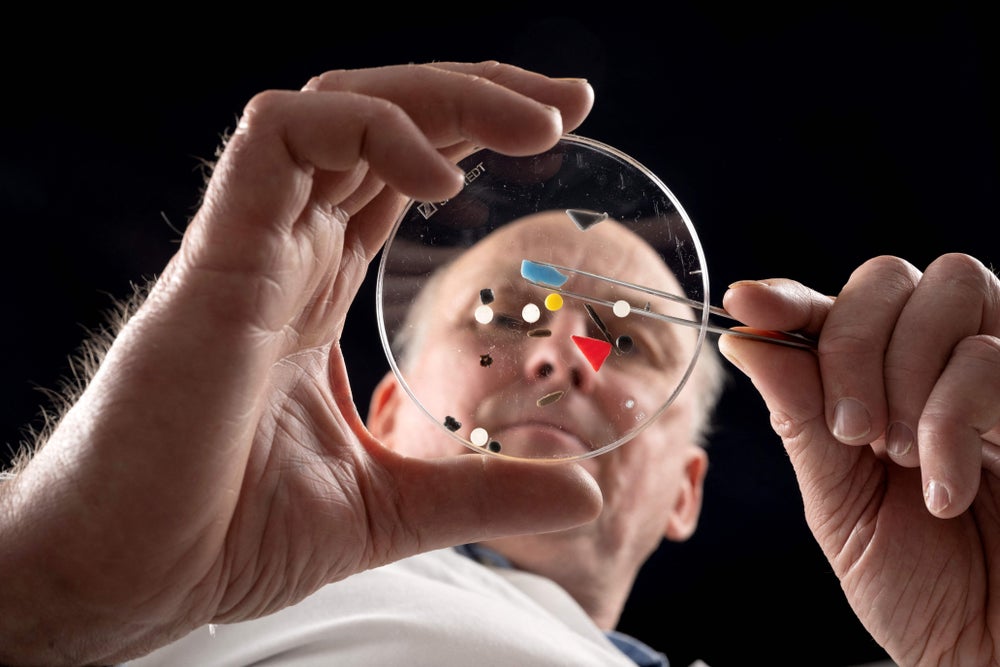
Richard Thompson, director of the Marine Institute of Plymouth analyzes nurdles and other micro-plastics in a laboratory on February 27, 2023. Ben Stansall/AFP via Getty Images
.
.
Click the link below for the complete article:
.
__________________________________________
 James' World 2
Leave a comment