
Click the link below the picture
.
CLIMATEWIRE | Clean energy has gotten steadily cheaper for years thanks to a global network of research facilities and factories.
That’s over now.
President Donald Trump’s decision on Saturday to slap steep tariffs on Canada, Mexico and China signals the birth of a new global trade regime: one focused on nationalist protections, with potentially expensive repercussions for Americans. And although clean energy is a bit player in the president’s trade war, the tariffs could hit the solar, battery, wind, and electric vehicle industries particularly hard.
“It probably slows down the energy transition because it drives up cost, especially the tariffs on China, and creates chaos” in supply chains, said David Victor, a professor of innovation and public policy at the University of California, San Diego. It “probably also introduces a large amount of uncertainty about the credibility of international rules on trade investment, insofar as those seem to matter at all anymore.”
Trump’s order — which is scheduled to go into effect Tuesday — places a 25 percent tariff on goods from Canada and Mexico and a 10 percent tariff on Chinese imports. It imposes a lower levy of 10 percent on Canadian oil imports.
A White House fact sheet posted Saturday night called tariffs “a powerful, proven source of leverage” for stemming the flow of immigration and drugs like fentanyl. The order could significantly increase prices for goods, with organizations like the U.S. Chamber of Commerce and American Petroleum Institute raising concerns over the impact on the U.S. economy.
“Energy markets are highly integrated, and free and fair trade across our borders is critical for delivering affordable, reliable energy to U.S. consumers,” API President and CEO Mike Sommers said in a statement.
The tariffs come as clean energy industries race to curb costs in a bid to displace fossil fuels, the main drivers of climate change.
Trade has been a key reason behind the global decline in clean energy costs in recent decades. The average lifetime cost of utility-scale storage fell 83 percent between 2009 and 2024, even after accounting for a post-Covid bump in solar costs, according to Lazard, an investment bank. Onshore wind costs were down 65 percent over that time.
Tariffs threaten those gains. The American Clean Power Association, a trade group, said it was “concerned that increasing the costs of energy production inputs will put upward pressure on consumer energy costs and diminish our capacity to unleash energy abundance.”
“While the fuel relied upon by wind and solar energy — complemented by battery storage — is free, some parts for these machines that harness these renewable resources are manufactured in Canada and Mexico,” the group added.
Roughly three-quarters of the world’s lithium-ion batteries are made in China, according to the International Energy Agency.
.
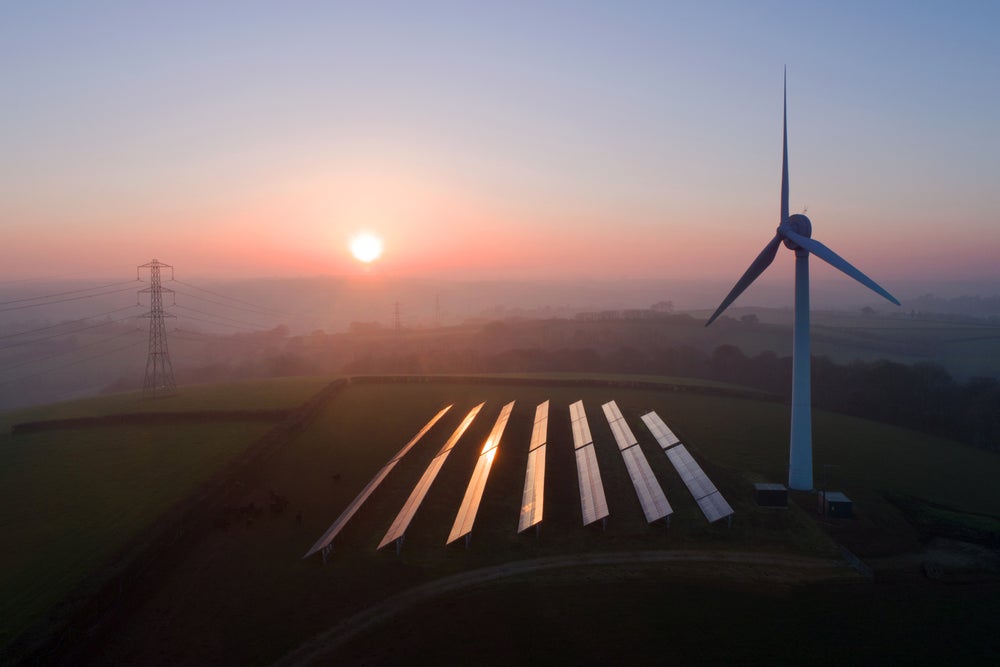
The president’s new tariffs on Canada, Mexico, and China could hit the solar, battery, wind, and electric vehicle industries particularly hard. Peter Cade/Getty Images
.
.
Click the link below for the complete article:
.
__________________________________________
 James' World 2
Leave a comment