
Click the link below the picture
.
A few captive bonobos recently faced a seemingly simple task: locate a tasty snack hidden under one of three cups. Because bonobos are brainiacs, pinpointing the cup with the treat should have been no sweat.
But there was a wrinkle: the apes were relying on a human, not another member of their own species, to flip over the correct cup. What’s worse, this person sometimes did not see where the food was placed. So the bonobos took it upon themselves to point out the correct cup to their human partner.
“The bonobos knew when their partner was ignorant, and they communicated proactively to make sure that their ignorant partner still made the correct choice,” says Christopher Krupenye, an evolutionary cognitive scientist at Johns Hopkins University, who helped run the experiment.
Krupenye and his graduate student Luke Townrow described the bonobos’ behavior in a paper published today in the journal Proceedings of the National Academy of Sciences USA. Their findings provide compelling evidence that the apes can infer someone’s ignorance and also act to help clear up the confusion.
The ability to infer the mental states of others is often referred to as theory of mind. Humans utilize theory of mind to successfully communicate and coordinate with one another. For example, intuiting when someone lacks certain information helps us determine when and how to share knowledge.
Researchers have proposed that humans’ closest evolutionary cousins, chimpanzees and bonobos, may also possess theory of mind. But few have examined this idea in controlled experimental environments, according to the authors.
Krupenye and Townrow worked with three male bonobos living at Ape Cognition and Conservation Initiative, a research center in Des Moines, Iowa. During the experiment, one of the male bonobos would sit across from Townrow as a treat, like a grape or a peanut, was placed under one of three cups on the table between them. If Townrow flipped over the correct cup, the bonobo would receive the reward.
In some trials, Townrow could see the treat being placed under the cup. In others, his view was blocked by cardboard. Once the treat was stashed, he would wait 10 seconds before flipping over a cup.
The bonobos appeared to know when Townrow had his eye on the treat. In the trials where he had observed the placement of the treat, the apes patiently waited for him to flip over the correct cup. In the trials where Townrow’s view was blocked, however, the bonobos pointed toward the correct cup in an effort to fill him in on what he had missed. “They got the task immediately and knew where to point,” Townrow says.
.
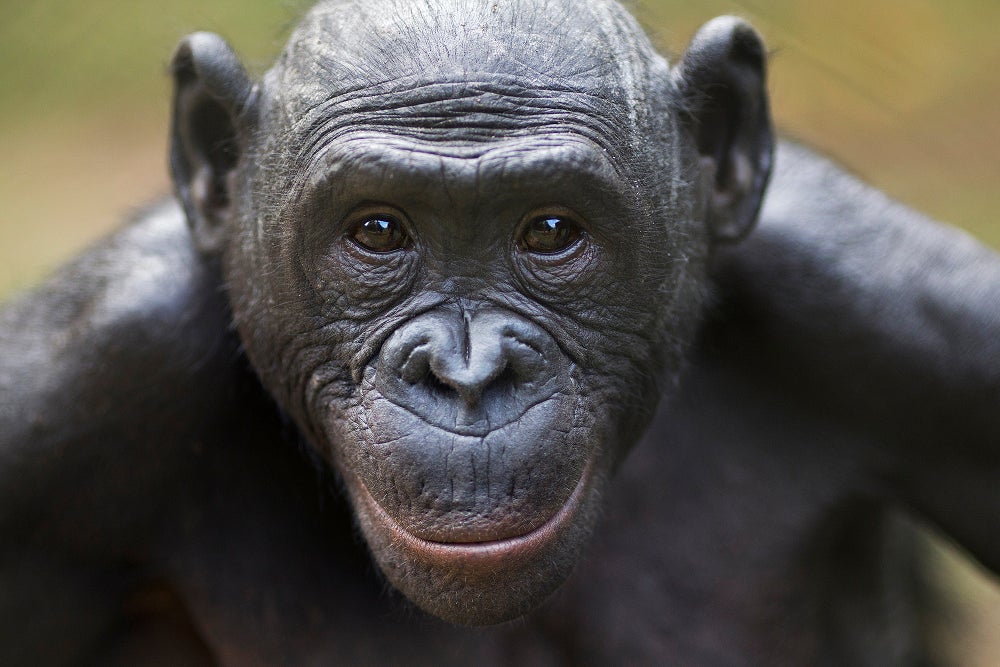
Female bonobo. Anup Shah/Getty Images
.
.
Click the link below for the complete article:
.
__________________________________________
 James' World 2
Feb 04, 2025 @ 20:17:11
🙌🙌🙌
LikeLike