
Click the link below the picture
.
As the new moon rises this week, it ushers in a new year on the lunar calendar used by many cultures across East and Southeast Asia. On the Chinese zodiac’s 12-year lunar cycle, 2025 is the Year of the Snake—an animal that symbolizes wisdom and change.
These limbless reptiles can be found on every populated continent, thanks to an evolutionary “big bang” some 125 million years ago. There are more than 3,000 snake species, with incredible variation among them. Some of the animals are smaller than an earthworm, while others are longer than a pickup truck. Some are harmless to humans, whereas others are venomous. And the ecological roles they play as critical pest controllers and nutrient cyclers are often underappreciated. So as we look to the year ahead, let’s give our odd, wriggly friends some appreciation.
Shimmying Serpents
Snakes’ signature move is the slither. But they can also scrunch forward like an inchworm or launch themselves from a coiled position to leap or strike. And a few years ago scientists discovered another, stranger method of snake movement: “lasso locomotion.” Researchers were testing ways to keep brown tree snakes away from birds’ nests in Guam. They put wide metal cylinders at the bottom of poles, expecting this to deter the snakes, which generally need to wrap themselves twice around a pole or tree trunk to climb it with their normal, accordionlike “concertina locomotion.”
Instead, the team found that snakes were literally tying themselves into knots to surpass the barriers. The reptiles would wrap their tail just once around the barrier and then hook the tip around their body. This created a sort of lasso shape that the snakes could use to shimmy up the pole—ever so slowly but effectively.
Thermal Vision
Pythons, boas, pit vipers, and more can hunt in total darkness. They sense prey animals not only by smell but also by the heat their quarry emanates. These snake’s so-called pit organs enable them to “see” this heat; the organs act like a thermal camera that allows the reptiles to home in on a target.
Pit organs are membrane-covered divots near a snake’s nostrils. Infrared radiation emanating from potential prey heats up the membrane, which causes it to thicken and changes the small electric charge that runs across the membrane’s outer surface. That voltage change gets passed to nerve cells, which send the information to the brain.
Open Wide
Snakes generally don’t chew their food. Instead, they swallow prey whole and slowly digest it over the course of days. Burmese pythons, for example, can spend an entire week digesting a single meal. While they normally eat smaller mammals like rodents, these pythons have also been spotted consuming comparatively enormous alligators and deer. They can open their mouth four times wider than their skull.
.
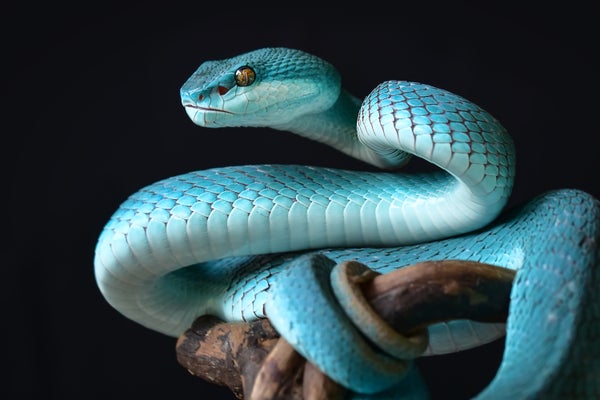
Blue Insularis snake. Ikhsan Yohanda/Getty Images
.
.
Click the link below for the complete article:
.
__________________________________________
 James' World 2
Leave a comment