
Click the link below the picture
.
Nicotine pouches—small, flavored packets placed between the gums and lips—have recently become an increasingly appealing option for people trying to avoid cigarettes and traditional “smokeless” oral tobacco products. Since the pouches were introduced to the U.S. market in 2014, they’ve found a steady following, particularly among people between the ages of 25 and 44. This month 20 products from the popular ZYN brand became the first such pouches to be “authorized” by the U.S. Food and Drug Administration. While this falls short of the FDA’s designation of being “approved” as generally safe, it allows ZYN to continue selling its three- and six-milligram nicotine pouches in 10 different flavors, including spearmint, citrus, coffee, cinnamon, and menthol.
The FDA’s decision on ZYN, whose manufacturer, Swedish Match, had applied for authorization in 2020, was “long overdue,” says Jasjit Singh Ahluwalia, a physician and public health scientist at Brown University, who
has studied nicotine addiction for more than 30 years. The agency’s ruling drew from a study facilitated by Swedish Match that suggests the pouches got people to switch from other tobacco products such as cigarettes—which can contain dozens of compounds linked to cancer or other diseases. Pouches such as ZYN contain substantially fewer harmful chemicals than cigarettes.
The FDA apparently “concluded that the public health benefits have outweighed the risks,” says Mary Hrywna, an associate professor at the Rutgers School of Public Health and a founding member of the university’s Institute for Nicotine and Tobacco Studies. “It doesn’t mean that the products are safe.”
ZYN pouches were the top-selling oral nicotine brand in the U.S. by the end of 2023; that same year Philip Morris International (PMI), the tobacco conglomerate that owns Swedish Match, reported shipping almost 385 million cans of the pouches to the U.S. More broadly, total U.S. nicotine pouch sales rose from 126 million units in the last five months of 2019 to 808 million in the first three months of 2022, according to a JAMA report. Hrywna says that the FDA’s authorization of ZYN is a good first step in cracking down on bad actors.
“The market has exploded, and some of those manufacturers are just opportunists exploiting the lack of enforcement,” Hrywna says. “Now there’s at least one authorized [pouch] product, and so at the very least, I would think that the FDA could now take more forcible action on products that have not submitted any type of application.”
Nicotine pouches’ rise in popularity—and their potentially enticing flavors and marketing—have driven up concern about underage use. In the U.S. people must be age 21 or older to legally purchase any nicotine product, but last April the FDA issued more than 100 warning letters to brick-and-mortar and online retailers that sold ZYN to people under age 21. The 2024 National Youth Tobacco Survey found that pouch use among middle and high school students was 1.8 percent, meaning approximately 480,000 students. The FDA notes this rate among youth to be relatively low—e-cigarette use was 5.9 percent (1.63 million students) in comparison—but groups are concerned about any level of use by kids. So-called ZYNfluencers on TikTok and other social media platforms have been criticized for promoting the pouches to young adults.
.
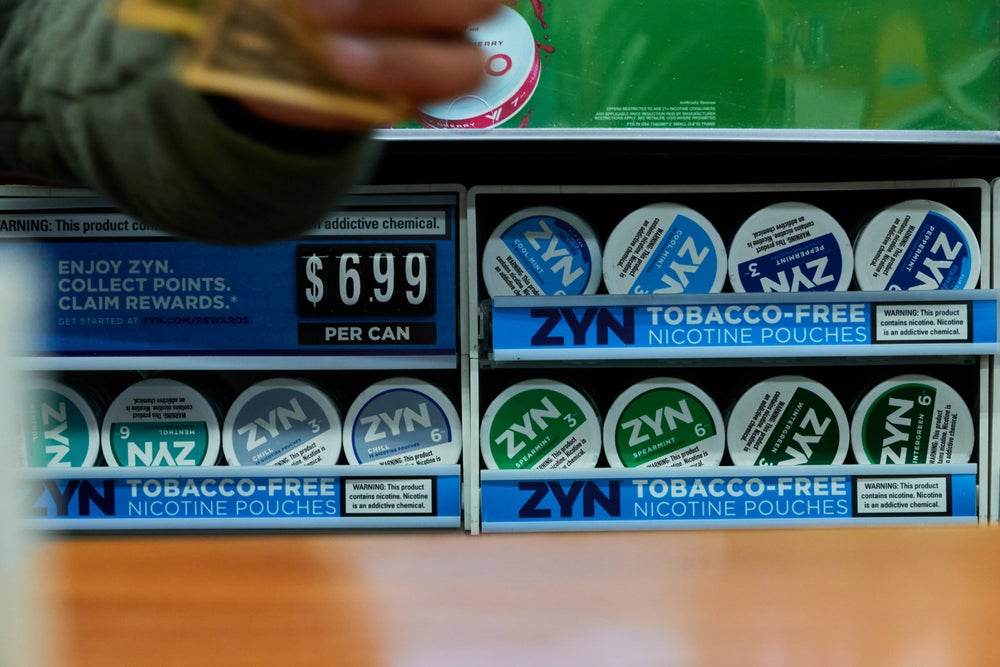
ZYN smokeless nicotine pouch containers for sale at a convenience store on January 27, 2024. Bing Guan/Bloomberg via Getty Images
.
.
Click the link below for the complete article:
.
__________________________________________
 James' World 2
Leave a comment