
Click the link below the picture
.
A thrilling crush, excruciating embarrassment or fervent dedication to a cause—adolescence can mean all of these things. For me, it involved a burning curiosity about the natural world, which led one time to my grandmother discovering a bag of cow eyeballs in the fridge. My dad had helped me collect them at a slaughterhouse for dissection.
I didn’t mean to upset anyone; I just wanted to figure out how sight works. Like others my age, I was also driven to understand why things are the way they are and how they could or should be different. A while after my eyeball phase, I declared myself a humanist and took to wearing a four-inch peace sign around my neck. My sister and I began writing and performing (admittedly somewhat histrionic) folk songs through which we attempted to express our discontent with various global, local, and historical injustices.
As a teen, I was swimming in big ocean waves, so to speak—watching, listening, questioning, and grappling to make sense of all the complex cultural and emotional information coming my way. Who are we humans, anyway, and who am I? Now, 35 years later, I am still fascinated by these questions and by the ways in which adolescents struggle to make sense of what they witness and experience.
Take these responses from teens in urban Los Angeles to my asking them why they think some people in their neighborhood commit violent crimes:
“They have, like, a lot of emotions. They’re really mad, so they just kill somebody. Like, overly aggressive.”
“Everyone has a history. Like, everybody has an action or choice or some sort of history—some sort of thing happened to them that affects how they act in the future.”
The difference between the quotes is subtle but critical in its implications for brain development. The first one describes the proximal reason for a crime and represents the kind of focused thinking people need to keep themselves safe and to respond appropriately to shifting circumstances. But the second reveals awareness of the broader historical, cultural or social context in which individuals do the things they do.
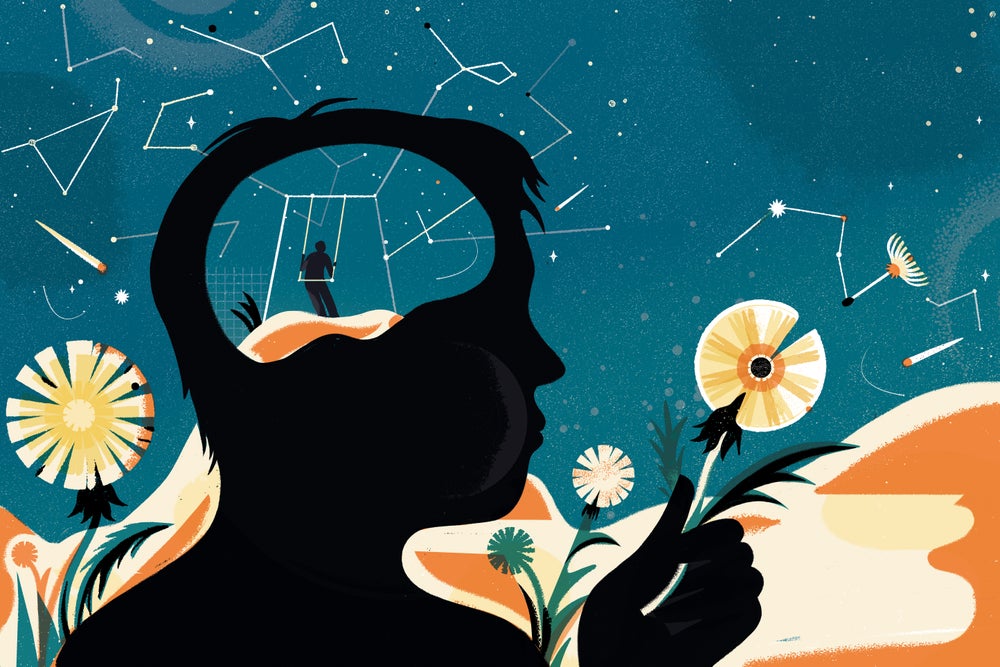
Every adolescent I have worked with, irrespective of IQ score or social or economic background, has the capacity for such mental time travel. By listening closely to teenagers’ reflections and observing their brain activations as they lay in a neuroimaging scanner, my colleagues and I discovered that thinking that ranges flexibly from the here and now, as in the first quote, to the past, the future, and everywhere else, as in the second, seems to literally build their brains. During such wide-ranging, emotionally powerful, reflective thinking—which we call transcendent because it soars beyond the moment—key brain networks activated and deactivated in complex, dynamic patterns, which, our data indicated, grew and strengthened their connections.
This emerging capacity to muse in abstract ways enables teenagers to understand themselves, their family, friends, and society at large and to imagine what their own place in the world might be. Over time such transcendent thinking constructs resilience to adversity and places young people on a path to future satisfaction with life, work, and relationships. Our research helps to explain why adolescents can be among society’s most visionary and idealistic citizens (and, alternatively, some of its most self-absorbed) and shows that to truly empower their growth, parents, schools, and communities need to focus less on what kids know and more on how they think.
.
 Cinta Fosch
.
.
Click the link below for the complete article:
.
__________________________________________
 James' World 2
Leave a comment