
Click the link below the picture
.
With Donald Trump back in office, much of the world is still struggling to make sense of his appeal to so many Americans. This is especially the case now, after he became a felon, incited an insurrection, and promised to govern as a dictator. How does someone so unfiltered, unrefined, and dismissive of moral codes and norms end up getting elected?
It may be those very things that are core to his appeal—Trump is not the first head of state who has capitalized on brash behavior to gain that position. He may appeal to the average voter for the very same reasons you keep watching that reality television show you love to hate: these shows delight people by giving them a look at something that feels both “real” and “taboo.” Trump is among many successful politicians who have succeeded by appearing more relatable, such as George W. Bush, who famously scored as the more appealing candidate “to have a beer with” in the 2000 and 2004 presidential elections, the authentic emotional appeal of Barack Obama or the “bumbling clown” image of Boris Johnson. But Trump’s appeal seems different.
In our experience as business professors, we’ve seen how business models that include seemingly repellent behavior can captivate audiences—and as a television personality, Trump has been no exception. Trump the politician has pulled from that same playbook. We have spent years studying how transgression (an act that goes against law, norms or standards), stigma and emotions affect businesses, stakeholders, and even society. Trump’s election had striking similarities to what we have observed in businesses based on voyeurism. That is, the anchor of his appeal is tied to how the perception of his authenticity and his transgressions fuel human emotion.
Think about reality shows such as Big Brother, social media influencers, erotic webcam and OnlyFans models and “slum tourism.” These are businesses that let audiences “peek” into things that are typically kept private. These are businesses based on voyeurism—they turn people’s curiosity about private and forbidden aspects of others’ lives into a product or service that generates money. Experiencing something forbidden creates a unique mix of emotions—thrill, curiosity and even discomfort—that people are willing to pay for. To succeed, such businesses balance showing enough “realness” to feel authentic and forbidden with avoiding crossing lines that might alienate their audience.
Of course, Trump is a reality television show character turned president, and part of the success of his shows was brashness—berating hapless contestants or yelling “you’re fired” over and over. Just as voyeuristic businesses do, Trump has positioned himself as both authentic (he “tells it like it is,” people say) and transgressive (he does and says things as a political leader that people in his position normally do not). In this way, Trump has cultivated a distinct persona that resonates with certain audiences and keeps them engaged amid—and often because of—controversies. Here’s how this works.
Authenticity is about delivering experiences that feel real, connecting audiences with the unfiltered “truth” of a subject. Trump’s followers often say they like it when he resists traditional political correctness and “elite” social norms, such as the carefully calibrated communication that is often associated with people in positions of power. Despite his wealth and high status, people see him as an “authentic” figure. Trump’s blunt manner, frequent social media outbursts and disregard for polished speeches all reinforce this perception. That makes him seem more honest to his followers, regardless of whether or not he is telling the truth. They believe that he’s acting without artifice, bringing an undiluted version of himself directly to the public, which is one half of the voyeurism puzzle. In voyeuristic businesses, the same is expected. Webcam models, for example, are perceived to bring their full personality to their performances, casting aside the tropes seen in classic pornography. Reality star actors are seen as being unfiltered and unrefined—they are more “real,” even if it’s staged.
.
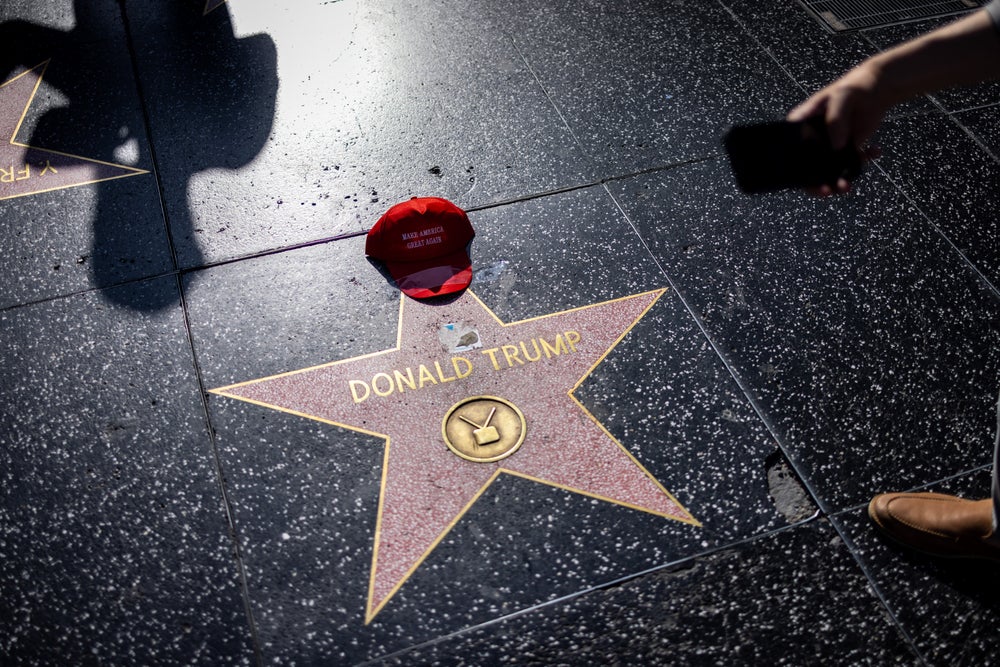
In May 2024 a red hat with the saying “Make America Great Again” was placed on the Hollywood Walk of Fame star of now president Donald Trump hours after he was found guilty of 34 felony charges of falsifying business records in an effort to influence the 2016 election. Jay L. Clendenin/Getty Images
.
.
Click the link below for the complete article:
.
__________________________________________
 James' World 2
Leave a comment