
Click the link below the picture
.
The Los Angeles area has been at the mercy of fire and wind this month, and this weekend a third element will join the mix: water.
Rain is forecast to begin as soon as Saturday afternoon and to continue as late as Monday evening, says meteorologist Kristan Lund of the National Weather Service’s Los Angeles office. The area desperately needs the precipitation, but experts are warily monitoring the situation because rain poses its own risks in recently burned areas—most notably the potential occurrence of mudslides and similar hazards.
“Rain is good because we’ve been so dry,” Lund says. “However, if we get heavier rain rates or we get the thunderstorms, it’s actually a lot more dangerous because you can get debris flows.”
Fires do a couple of different things to the landscape that can increase the risk of burned material, soil, and detritus hurtling out of control.
When fires burn hot or long enough, they leave an invisible layer of waxy material just under the surface of the ground. This develops from decomposing leaves and other organic material, which contain naturally hydrophobic or water-repellent compounds. Fire can vaporize this litter, and the resulting gas seeps into the upper soil—where it quickly cools and condenses, forming the slippery layer.
When rain falls on ground that has been affected by this phenomenon, it can’t sink beyond the hydrophobic layer—so the water flows away, often hauling debris with it. “All of the trees, branches, everything that’s been burned—unfortunately, if it rains, that stuff just floats,” Lund says. “It’s really concerning.”
Even a fire that isn’t severe enough to create a hydrophobic layer can still cause to debris flows, says Danielle Touma, a climate scientist at the University of Texas at Austin. Under normal conditions, trees and other plants usually trap some rain above the surface, slowing the water’s downward journey. But on freshly burned land there’s much less greenery to interfere; all the rain immediately hits the ground.
And whereas healthy vegetation holds soil together with its roots, fires can easily burn off the fine roots that do most of that work. “So then you have all this loose soil that can be transported by water as well,” Touma says.
This month the three largest Los Angeles–area fires have created nearly 50,000 acres of fresh burn scar, Lund notes, and some of that scar is in mountainous terrain that facilitates mudslides. Current forecasts suggest the rain will mostly fall below the rate of a quarter-inch per hour—below the intensity that tends to increase the risk of debris flows, Lund says. But this weekend the region does face a 10 to 20 percent chance of thunderstorms, which can cause short bursts of rain that may be heavy enough to trigger flows.
.
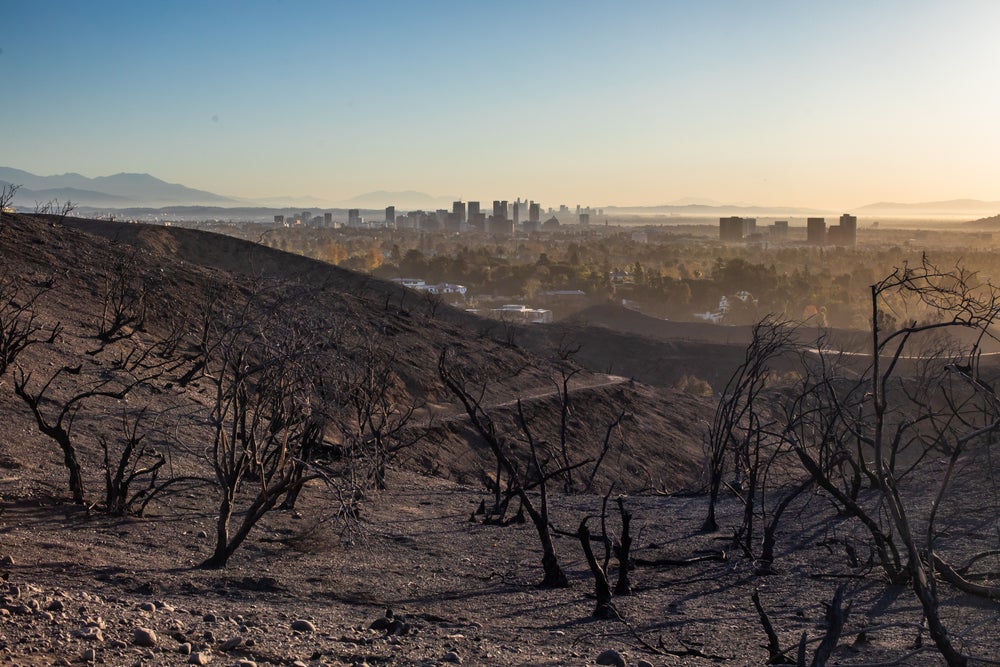
Trees burned by the Palisades Fire are seen from Will Rogers State Park, with the City of Los Angeles in the background on January 15, 2025. Apu Gomes/Getty Images
.
.
Click the link below for the complete article:
.
__________________________________________
 James' World 2
Leave a comment