
Click the link below the picture
.
Astronomers are grappling with a complex cosmic mystery lurking at the dark heart of a distant galaxy some 270 million light-years from Earth. And its resolution could revolutionize our understanding of how black holes feast on matter throughout the universe.
Known as 1ES 1927+654 and located in the constellation Draco, this far-off island of stars harbors at its core a supermassive black hole weighing more than a million suns—which, surprisingly, isn’t very remarkable. Most large galaxies, including our own, host such hefty monstrosities at their center. But this black hole has proved extraordinarily strange: the object shocked observers with an abrupt outburst of radiation so intense that it apparently obliterated the black hole’s corona, an enveloping cloud of whirling, billion-degree plasma, for three months in 2018. The outburst, it was thought, could’ve come from a tidal disruption event, which occurs when an unlucky star is torn apart and devoured after drifting too close to a black hole. Many research groups began closely monitoring the system, watching across the next few years as the corona reassembled itself and quiescent conditions returned, until the black hole unleashed more surprises—dramatically flaring in radio waves and flickering with rapid pulses of x-rays.
Such a dizzying assortment of dynamic activity is unprecedented around a supermassive black hole and can’t be readily explained by any typical tidal disruption event. Eileen Meyer, an astronomer at the University of Maryland, Baltimore County, who led an international team in the investigation of the system’s radio emissions with the use of multiple telescopes on the ground and in space, recalls her initial impression of 1ES 1927+654 as that of a very “boring, faint radio blob.” But as she and her colleagues saw more and more strange activity unfold, she realized “this [black hole] was weird, very weird.” In particular, her team’s observations revealed that shortly after its radio wave flare-up, the black hole had belched out a pair of giant, oppositely directed plasma jets traveling at one-third the speed of light. This was the first time the creation of such jets had been witnessed in real-time, and it was a clear indicator of extreme activity closer in to the black hole. Meyer presented her team’s findings last week at the 245th meeting of the American Astronomical Society in National Harbor, Md., and was lead author on an accompanying paper published January 13 in the Astrophysical Journal Letters.If a run-of-the-mill act of stellar destruction wasn’t behind the black hole’s bizarre behavior, what was? A crucial clue could lie in the timing of the black hole’s flickering x-ray pulses, which were unveiled via work led by Megan Masterson, a doctoral candidate at the Massachusetts Institute of Technology. Using data from the European Space Agency’s XMM-Newton x-ray space telescope, Masterson and her colleagues found a telltale pattern in the pulses: an oscillation in their flickering that became faster and faster over two years. “The period of this oscillation changed dramatically from 2022 to 2024,” Masterson says. “We started out in 2022 at an 18-minute period, and by 2024, we were at a seven-minute period—so the period has basically been cut in half. That has never been observed around a supermassive black hole before.” A paper reporting the results, co-authored by Masterson, Meyer, and others, was posted to the preprint server arXiv.org in January and has been accepted for publication in the February 13 edition of Nature.
The most obvious explanation for these x-ray oscillations, the researchers say, is that they’re a clear but indirect signal of a substantial something orbiting very close to the black hole. It’s so close, in fact, that it must be plowing through the black hole’s accretion disk—a maelstrom of infalling matter made incandescent from frictional heating as it piles up around the gravitational monster’s maw. If that were the case, the researchers realized, each flickering eruption would correspond to the object completing one orbital cycle, upon which it would swoop through and agitate the accretion disk to kick out a burst of x-rays. And the curious quickening of the oscillations appeared to be a sign that this object’s orbit was decaying, bleeding off energy and spiraling ever closer and faster toward a point of no return—the black hole’s event horizon—via the emission of ripples in spacetime called gravitational waves.
For Masterson, the next step was simple: “I calculated how long it’s going to take that body to inspiral and be eaten,” she says. The math told Masterson that the hypothetical object’s final plunge would occur in January 2024. Then, at last, the mysterious x-ray oscillations would stop.
.
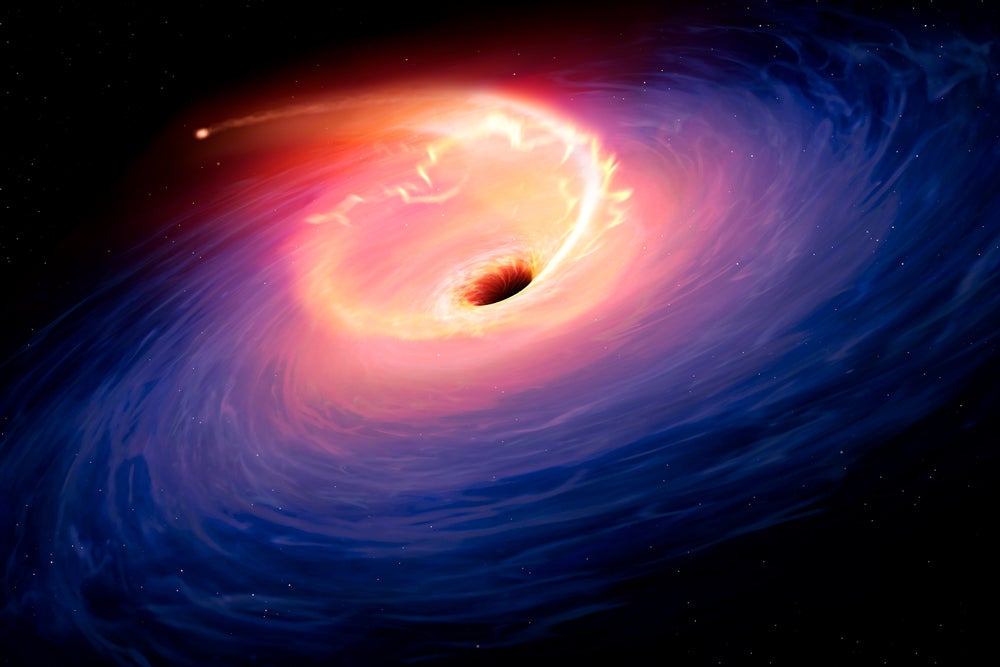
An artist’s impression of a tidal disruption event, in which a star passes too close to a supermassive black hole and is ripped apart. Astronomers studying a mysterious system some 270 million light-years from Earth may have found a black hole-circling star that somehow escaped this fate. Mark Garlick/Science Photo Library/Getty Images
.
.
Click the link below for the complete article:
.
__________________________________________
 James' World 2
Leave a comment