
Click the link below the picture
.
Firefighters in southern California are battling the Palisades and Eaton Fires, which have killed at least 25 people, burning a cumulative 37,700 acres and at least 12,000 structures. The plumes of smoke are even visible from space.
Residents of many fire-prone areas—as well as those far downwind—have grown familiar with the orange, apocalyptic haze of wildfire smoke as these blazes have become more common because of climate change. Such smoke can contain an unpredictable cocktail of chemicals associated with heart and lung diseases and even cancer, which is the leading cause of death among firefighters. Here’s what makes wildfire smoke so dangerous.
No Ordinary Pollutant
When trees, shrubbery, and other organic matter burn, they release carbon dioxide, water, heat—and, depending on the available fuel, various volatile compounds, gaseous pollutants, and particulate matter. Those tiny particles, which become suspended in the air, can include soot (black carbon), metals, dust, and more. If they’re smaller than 2.5 microns in diameter, they can evade our body’s natural defenses when inhaled, penetrating deep into the lungs and triggering a wide variety of health problems.
Such fine particulate matter is a common pollutant; it’s also created by motor vehicles and industrial plants, for example. But the kind present in wildfire smoke might be even more dangerous. Researchers studying health outcomes in southern California concluded that exposure to particular matter smaller than 2.5 microns, called PM2.5, from wildfires was up to 10 times more harmful to human health compared with exposure to PM2.5 from other sources. The researchers estimated that wildfire-generated particulate matter was three to four times more toxic—but they don’t yet know why.
More Dangerous Fuel
As humans develop ever more land, we grow the number of points of contact between human settlements and increasingly flammable forests. This makes it more likely that an errant, human-caused spark will ignite a blaze—and that the resulting wildfire will consume homes, offices, cars, and other human-made infrastructure, expanding the types and amounts of toxic compounds going up in the smoke. Paints, sealants, insulations, metals, and more can release many kinds of volatile organic compounds, gaseous pollutants and particulate matter.
A 2023 study by researchers at the Environmental Protection Agency found that emission factors for some toxic compounds were more than 1,000 times higher in urban wildfires than in fires that burned in woodland areas.
Unpredictable Chemistry
It’s surprisingly hard to predict what compounds someone is exposed to when they inhale wildfire smoke. What’s in the smoke depends on a few factors: what was burned (a ponderosa pine, for example, or a car), the temperature at which it burned (was it flaming or smoldering?), and how far and for how long the smoke has traveled. As the smoke ages, it is exposed to sunlight. This radiation can hit nitrogen oxides (NOx) and volatile organic compounds (VOCs), setting off a complex set of reactions that usually results in another secondary pollutant: ozone, the main component of smog, which can damage the lungs.
And as smoke containing VOCs travels and settles over other cities, it can mix with even more local pollution in the form of NOx—giving it the opportunity to form a larger amount of ozone. Research also suggests that VOCs and particulate matter—each of which can be toxic—can combine to make their respective health risks even worse.
.
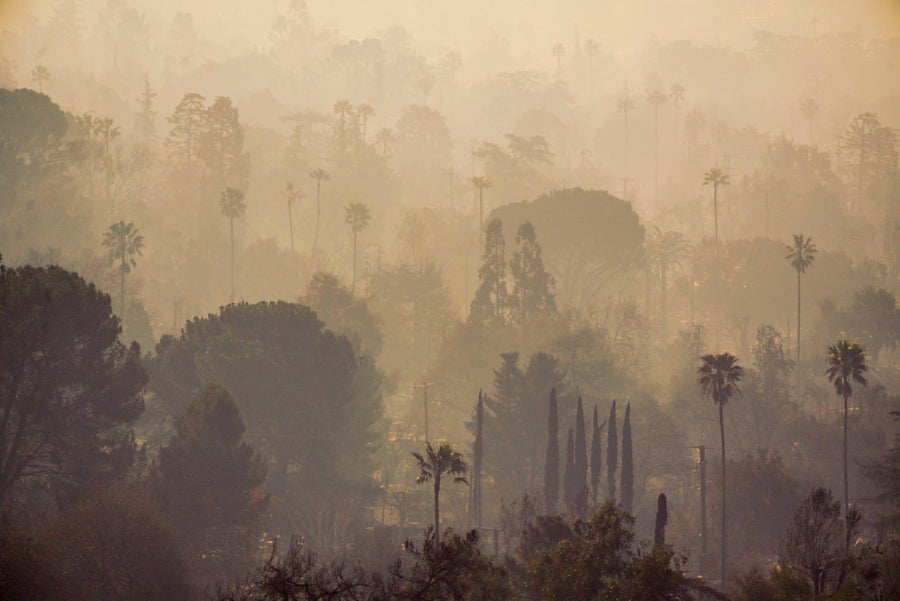
Smoke over destroyed homes in the aftermath of the Eaton Fire in Altadena, California, US, on Saturday, Jan. 11, 2025. Firefighters are making some progress on controlling the deadly blazes that have scorched Los Angeles, as the toll of destruction rises with entire neighborhoods reduced to ash. Kyle Grillot/Bloomberg via Getty Images
.
.
Click the link below for the complete article:
.
__________________________________________
 James' World 2
Leave a comment